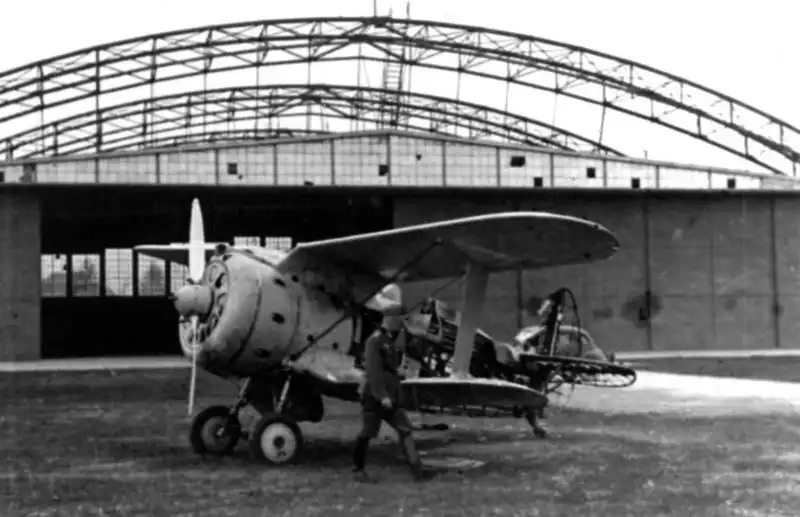
A damaged Soviet I-153 “Chaika” biplane fighter sits on a captured airfield during Operation Barbarossa. The image reflects the rapid destruction of Soviet aviation in summer 1941.
A Fighter Left Behind
This photograph shows a damaged Soviet I-153 “Chaika” fighter aircraft abandoned on an airfield captured by German forces during the summer of 1941.
The scene is typical of the opening weeks of Operation Barbarossa, when the Soviet Air Force suffered catastrophic losses on the ground, with hundreds of aircraft destroyed before they could even take off.
The I-153 "Chaika"
The Polikarpov I-153, nicknamed "Chaika" ("Seagull"), was one of the last operational biplane fighters to see widespread military service.
Its principal characteristics included:
- Biplane configuration with a distinctive gull-shaped upper wing
- Excellent maneuverability at low altitudes
- Armament consisting of machine guns and, on some variants, unguided rockets
- Maximum speed of approximately 425 km/h
Although agile and reliable, the aircraft had become technologically obsolete by 1941, particularly when compared with modern German monoplane fighters.
Biplane Versus Modern Air Combat
By the beginning of the Second World War, fighter aviation had largely transitioned to fast monoplane aircraft with retractable landing gear, enclosed cockpits, and more powerful engines.
Against aircraft such as the Messerschmitt Bf 109, the I-153 suffered from several major disadvantages:
- Lower maximum speed
- Poorer climb performance
- Limited survivability in modern aerial combat
While the aircraft remained effective in certain low-altitude missions and against less capable opponents, its combat value declined rapidly as aerial warfare evolved.
The Destruction of Soviet Airfields
During the opening phase of Operation Barbarossa, the Luftwaffe achieved air superiority within only a few days.
This success resulted from several factors:
- Surprise attacks against Soviet airfields
- Highly concentrated Luftwaffe strike operations
- Poor dispersal of Soviet aircraft on the ground
- Limited combat readiness in many frontline aviation units
As a consequence, hundreds of Soviet aircraft, including numerous I-153 fighters, were destroyed or captured before they could be employed in combat.
A Symbol of the Early War Losses
This damaged fighter represents far more than the loss of a single aircraft.
It illustrates the devastating setbacks suffered by Soviet military aviation during the summer of 1941, when outdated equipment, strategic surprise, and highly coordinated German operations combined to inflict enormous losses.
Nevertheless, surviving Soviet pilots and ground crews continued to resist throughout the campaign, helping delay the German advance while the Red Army rebuilt its air forces with newer aircraft and improved organization.
Historical Photograph Information
Location: USSR
Date: Summer 1941
Photographer: Unknown
Recommended Books
Stalin's Falcons — E.R. Hooton. A detailed study of Soviet Air Force operations during the opening years of World War II.
Soviet Air Force Fighter Colours 1941–1945 — Erik Pilawskii. Covers camouflage, markings, and numerous Soviet fighter types, including the I-153.
Barbarossa: Hitler's Invasion of Russia 1941 — David Stahel. An authoritative account of the opening campaign and the collapse of Soviet frontier defenses.
Red Stars: Soviet Air Force in World War II — Carl-Fredrik Geust & Sergey Petrov. A comprehensive overview of Soviet combat aviation, aircraft development, and wartime operations.