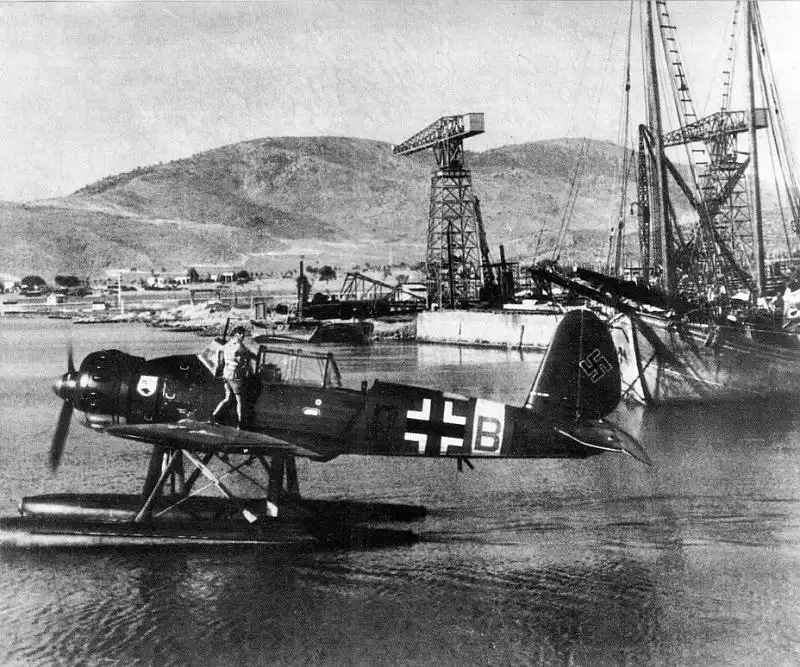
A German Arado Ar 196A-2 floatplane stands inside a port facility on Crete in 1943. The aircraft belonged to a Luftwaffe maritime reconnaissance squadron operating over the Mediterranean.
The Eyes of the Kriegsmarine:
This photograph shows a floatplane stationed within a port facility on the island of Crete in 1943.
The aircraft carries the code 7R+BK, identifying it as a machine of the 2nd Squadron of Maritime Reconnaissance Group 125 (Seeaufklärungsgruppe 125, or SAGr.125). Operating over the Mediterranean Sea, units such as SAGr.125 performed vital reconnaissance, patrol, anti-submarine, and coastal defense missions for both the Luftwaffe and the Kriegsmarine.
At first glance, the Arado 196 appears to be a modest seaplane. In reality, it became one of the most successful and versatile naval aircraft fielded by Germany during the Second World War.
Germany's Standard Naval Floatplane:
The Arado Ar 196 was developed during the late 1930s as a replacement for older German reconnaissance seaplanes.
The aircraft featured:
- A single engine.
- Two large floats.
- Folding wings on some variants.
- Excellent visibility from the cockpit.
- Strong defensive and offensive armament.
Unlike many reconnaissance aircraft of the period, the Arado was capable of fighting as well as observing.
Its robust construction and reliable handling made it popular among crews operating from both coastal bases and warships.
The Ar 196A-2 Variant:
The aircraft shown in this photograph is an Ar 196A-2, one of the early combat variants.
Designed primarily for coastal patrol and maritime strike missions, it was armed with:
- Two 20 mm MG FF cannons mounted in the wings.
- One forward-firing 7.92 mm MG 17 machine gun.
- Flexible rear defensive machine guns for the observer.
- Light bombs or depth charges for attacking surface vessels and submarines.
For a floatplane, this was impressive firepower.
The Arado could not compete with modern fighters, but it was more than capable of defending itself against patrol aircraft and attacking lightly protected targets at sea.
Service in the Mediterranean:
By 1943, Crete had become one of Germany's most important military bases in the eastern Mediterranean.
Aircraft operating from the island monitored Allied naval activity between:
- Egypt.
- Cyprus.
- Greece.
- The Aegean Sea.
- The Eastern Mediterranean shipping routes.
Maritime reconnaissance groups spent countless hours searching for enemy convoys, submarines, and warships.
The information they gathered was critical for directing German air and naval operations throughout the region.
The Floatplane That Captured a Submarine:
One of the most remarkable episodes involving the Arado 196 occurred in May 1940.
The British submarine HMS Seal had been damaged after striking a mine and subsequently came under attack by German anti-submarine forces.
Attempting to escape toward neutral Swedish waters, the submarine was discovered by an Arado 196 piloted by Oberleutnant Mehrens. The aircraft attacked with bombs and machine-gun fire. Soon a second Arado, flown by Oberleutnant Schmidt, joined the assault.
Already damaged and unable to continue resistance, the British submarine eventually surrendered.
The arrival of German naval forces later secured the prize.
This unusual incident remains one of the very few cases in military history where aircraft effectively compelled a submarine to surrender.
A Workhorse of Naval Aviation:
The Arado 196 served throughout the war in a variety of roles.
Its missions included:
- Coastal reconnaissance.
- Anti-submarine patrols.
- Convoy escort.
- Artillery spotting.
- Search and rescue operations.
- Maritime strike missions.
The aircraft was also widely deployed aboard German capital ships, including battleships and heavy cruisers.
Catapult-launched Arados extended the reconnaissance range of surface warships far beyond the horizon, providing commanders with valuable intelligence.
An Aircraft Built for the Sea:
Unlike many wartime aircraft that achieved fame through spectacular victories, the Arado 196 earned its reputation through reliability and versatility.
It operated in harsh maritime environments, often flying long patrols over open water where mechanical failure frequently meant death for the crew.
Yet despite these challenges, the aircraft remained in frontline service throughout the war and was widely regarded as one of the best floatplanes of its era.
The photograph from Crete captures one of these hardworking machines during the height of German operations in the Mediterranean—a reminder that naval aviation depended not only upon famous fighters and bombers but also upon the patient reconnaissance crews who searched the sea day after day.
Recommended Reading:
- Arado Ar 196 Units in Combat
- German Seaplanes of World War II
- Warships and Reconnaissance Aircraft of the Kriegsmarine
- Luftwaffe Maritime Operations
- German Naval Air Service
- The Mediterranean Air War
Photo details:
📍 Location: Crete, Greece
📅 Date: 1943
📷 Photographer: Unknown