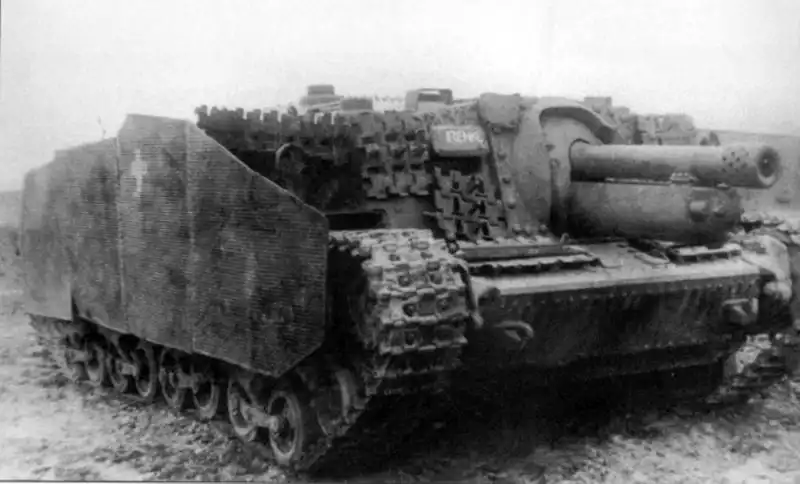
A captured Hungarian 43M Zrínyi assault gun stands abandoned after fighting on the Eastern Front. The vehicle was later sent to Kubinka for examination by Soviet specialists.
Hungary's Most Successful Armored Fighting Vehicle:
This photograph shows a captured Hungarian 43M Zrínyi self-propelled gun during the final stages of the fighting on the Eastern Front in 1944.
After its capture by Soviet forces, the vehicle was transported together with other Hungarian armored vehicles to the famous proving grounds at Kubinka, where specialists examined enemy equipment recovered from the battlefield.
Although far less famous than German tanks such as the Panther or Tiger, the Zrínyi was arguably the most successful armored vehicle produced by wartime Hungary.
The Search for an Effective Assault Gun:
By 1942, Hungarian military planners recognized the growing importance of self-propelled artillery.
German experience on the Eastern Front had demonstrated the effectiveness of assault guns in supporting infantry attacks and destroying fortified positions. Hungary sought to develop a similar vehicle using components already available to its domestic industry.
The result was the 43M Zrínyi, named after the Hungarian national hero Miklós Zrínyi, a celebrated military commander of the sixteenth century.
Rather than designing an entirely new vehicle, engineers adapted the chassis of the Hungarian Turán medium tank.
This approach reduced development time and simplified production.
Inspired by the German StuG III:
The Zrínyi followed the same basic concept as the highly successful German StuG III.
Instead of mounting its main weapon in a rotating turret, the gun was installed within a fixed armored superstructure.
This arrangement offered several advantages:
- Lower silhouette.
- Simpler production.
- Stronger frontal armor.
- Reduced weight.
- Better protection for the crew.
The design sacrificed flexibility in exchange for improved battlefield survivability and manufacturing efficiency.
For a country with limited industrial resources, this was a practical solution.
The 43M Zrínyi II:
The vehicle shown in the photograph is the better-known 43M Zrínyi II.
It was armed with a 105 mm howitzer intended primarily for infantry support.
Its main tasks included:
- Destroying field fortifications.
- Supporting infantry assaults.
- Engaging machine-gun positions.
- Providing close artillery support.
Although not specifically designed as a tank destroyer, the large-caliber gun could still pose a threat to enemy armored vehicles under favorable conditions.
An earlier version, known as the Zrínyi I, carried a long-barreled 75 mm gun intended for anti-tank combat. However, only a small number were completed.
Production and Combat Service:
Hungarian industry produced approximately sixty-six Zrínyi II assault guns between 1943 and 1944.
The vehicles served primarily on the Eastern Front, where Hungarian forces fought alongside Germany against the advancing Red Army.
Despite their relatively small numbers, the Zrínyi crews generally reported favorable experiences with the vehicle.
Compared to many Hungarian armored fighting vehicles, the Zrínyi possessed:
- Reliable mechanical performance.
- Effective fire support capability.
- Reasonable armor protection.
- Good mobility for its size.
Military historians often regard it as Hungary's finest indigenous armored vehicle of the war.
The Battle for Hungary:
By late 1944, the Red Army had crossed into Hungary and was advancing toward Budapest.
The remaining Zrínyi assault guns participated in increasingly desperate defensive battles as Hungarian and German forces attempted to slow the Soviet advance.
The fighting became particularly intense during the siege of Budapest and subsequent operations throughout western Hungary.
Most surviving vehicles were eventually destroyed, abandoned, or captured during these battles.
Only a handful survived the war.
Soviet Evaluation at Kubinka:
The Soviet Union maintained a systematic program for examining captured enemy equipment.
Vehicles recovered from the battlefield were often sent to Kubinka, where engineers and military specialists analyzed their design, armor protection, armament, and mechanical reliability.
The captured Zrínyi shown in this photograph became part of that process.
Such examinations provided valuable intelligence regarding the industrial capabilities and military technology of Germany and its allies.
For Soviet engineers, even relatively rare vehicles like the Zrínyi offered useful insights into enemy armored warfare doctrine.
A Forgotten Fighting Vehicle:
Today, the Zrínyi remains largely unknown outside Hungary and military history circles.
Overshadowed by the more famous German tanks with which it fought, the vehicle nevertheless demonstrated that Hungary possessed a capable armored industry despite limited resources and wartime constraints.
The photograph captures one of the last surviving examples of this uncommon assault gun shortly before it entered Soviet hands. As a battlefield trophy and engineering curiosity, it represents both the ambitions and limitations of Hungary's wartime military industry.
Recommended Reading:
- Hungarian Armored Fighting Vehicles in World War II
- The Royal Hungarian Army in World War II
- Tanks of Hungary
- Axis Armored Fighting Vehicles
- Armored Units of the Hungarian Army
- Budapest 1944–1945
Photo details:
📍 Location: Hungary
📅 Date: 1944
📷 Photographer: Unknown