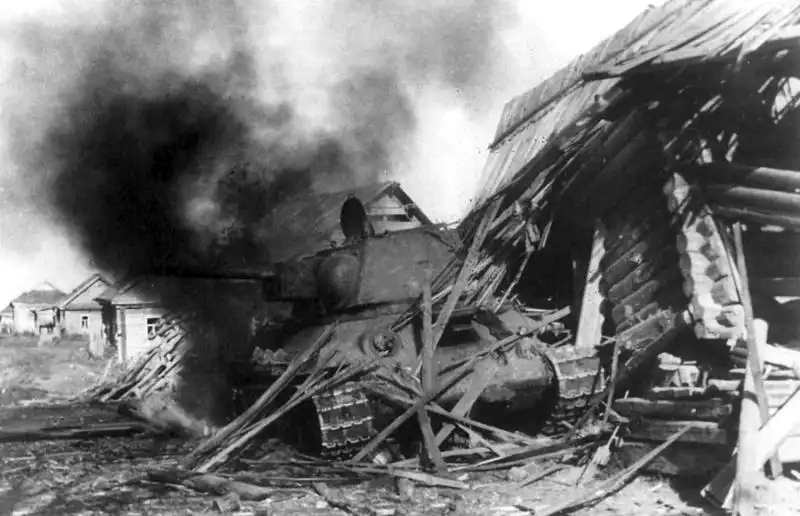
A damaged Soviet T-34/76 crashes through a wooden village house after being hit by enemy artillery during fighting on the Eastern Front in 1943.
A Battle Frozen in Time:
This remarkable wartime photograph captures a Soviet T-34/76 tank that smashed into a wooden village house after being damaged by enemy artillery fire during combat on the Eastern Front in 1943.
According to available information, the tank lost control after being hit while fighting in a rural settlement. Unable to maneuver, the vehicle plowed through the wall of a log house, partially destroying the structure before coming to a halt. Fortunately, the crew managed to escape their crippled tank.
The image preserves a dramatic moment that illustrates both the power and vulnerability of armored vehicles during the Second World War.
Fighting in Villages on the Eastern Front:
Although massive tank battles often dominate popular histories of the war, a significant amount of combat took place in villages, towns, and farming settlements.
Such locations created unique challenges for tank crews:
- Narrow roads restricted maneuverability.
- Wooden buildings concealed anti-tank guns.
- Rubble blocked movement.
- Infantry could approach from multiple directions.
- Visibility was often limited.
A tank operating in a village frequently became vulnerable to close-range artillery and anti-tank ambushes.
As a result, armored units depended heavily on infantry support to identify threats hidden among houses, barns, and tree lines.
The T-34: Backbone of the Red Army:
The vehicle shown in the photograph is a T-34/76, one of the most influential tanks of the Second World War.
Introduced shortly before the German invasion of the Soviet Union, the T-34 combined several advanced features:
- Sloped armor protection.
- Wide tracks for difficult terrain.
- Good mobility.
- A powerful 76.2 mm main gun.
- Relatively simple mass production.
These characteristics helped the Soviet Union build and field enormous numbers of tanks despite the disruption caused by the German invasion.
By 1943, the T-34 had become the backbone of Soviet armored forces.
What Happened to the Tank?
The exact circumstances behind this incident remain unknown, but the visible damage suggests a scenario frequently encountered on the Eastern Front.
After receiving an artillery or anti-tank gun hit, several outcomes were possible:
- Damage to steering controls.
- Loss of braking capability.
- Injury or death of the driver.
- Engine malfunction.
- Fire inside the fighting compartment.
Any of these problems could cause a moving tank to veer off course uncontrollably.
Given the considerable weight of a T-34—more than 26 tons—even a damaged vehicle possessed enough momentum to demolish a wooden structure.
The shattered wall seen in the photograph demonstrates the tremendous force involved.
Wooden Villages and Armored Warfare:
Across much of the Soviet Union, rural houses were traditionally built from logs.
These structures were surprisingly durable under normal conditions but offered little resistance to armored vehicles.
During the war, thousands of villages became battlefields as advancing and retreating armies fought over roads, bridges, and river crossings.
As a result, civilian buildings frequently suffered destruction from:
- Artillery fire.
- Air attacks.
- Fires.
- Demolitions.
- Tank collisions.
The house in this photograph became an unintended casualty of the battle unfolding around it.
Survival of the Crew:
One particularly important detail in the description is that the crew survived.
The survival of a tank crew after their vehicle had been disabled was never guaranteed.
Penetrating hits could ignite fuel, detonate ammunition, or fill the interior with deadly fragments of armor. Many crews had only seconds to abandon a damaged vehicle.
The fact that the crew escaped suggests that the damage, while serious enough to disable the tank, did not immediately destroy the fighting compartment.
For Soviet tankers in 1943, that alone would have been considered fortunate.
The Human Side of Mechanized War:
Photographs of tanks often focus on machines, armor, and weapons.
This image tells a slightly different story.
The wrecked T-34, the shattered home, and the absent crew all hint at the human experiences behind the battle. Somewhere nearby were tankers who had narrowly escaped death, civilians whose house had been destroyed, and soldiers continuing a fight that stretched across thousands of miles of the Eastern Front.
The photograph captures a brief moment after violence struck but before history moved on.
A Symbol of the Eastern Front:
The image of a T-34 embedded in a village house perfectly reflects the nature of warfare in Eastern Europe during the Second World War.
Battles did not occur only on open fields or famous battlefields. They unfolded in ordinary villages, along dirt roads, beside farms, and among civilian homes.
For millions of people, the war arrived literally at their doorstep.
This damaged T-34, frozen in place against a shattered wooden wall, remains a powerful reminder of that reality.
Recommended Reading:
- T-34 Mythical Weapon
- T-34 in Action
- Red Army Tank Commander
- Ivan's War
- Barbarossa to Berlin
- When Titans Clashed
Photo details:
📍 Location: USSR
📅 Date: 1943
📷 Photographer: Unknown