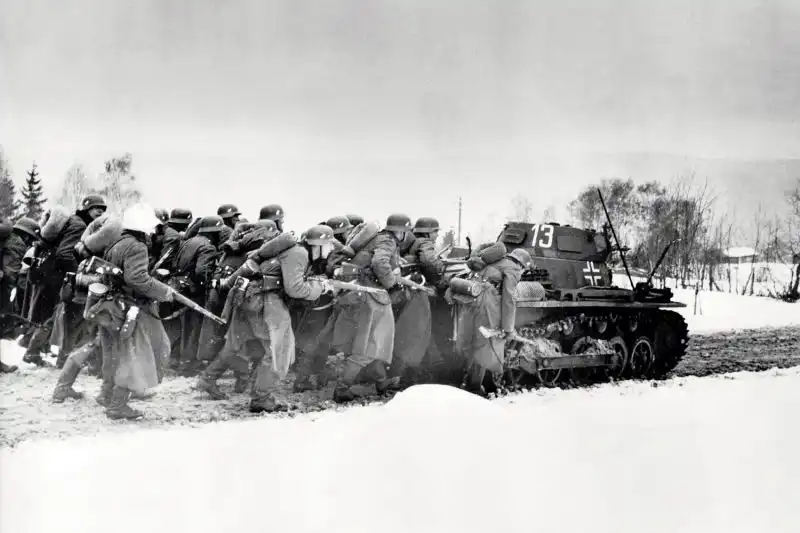
German infantrymen use a Panzer I tank as mobile cover while advancing along a mountain road during the invasion of Norway in 1940.
Using Armor as a Moving Shield:
This fascinating wartime photograph captures a moment of combat during the German invasion of Norway in the spring of 1940.
German infantrymen armed with Karabiner 98k rifles crouch behind a Panzerkampfwagen I light tank, using its armor as protection from enemy small-arms fire while advancing along a mountain road. The image demonstrates one of the most basic principles of modern warfare: cooperation between infantry and armored vehicles.
Although the Panzer I was already considered obsolete by the standards of 1940, its armor still provided valuable protection against rifle bullets and shrapnel.
Source of photograph: nationaalarchief.nl
Operation Weserübung:
The photograph was taken during Operation Weserübung, Germany's invasion of Norway and Denmark in April 1940.
The campaign represented one of the most ambitious military operations of the early war period. German forces simultaneously launched attacks against multiple Norwegian ports and strategic locations, seeking to secure:
- Control of the Norwegian coastline.
- Access to North Atlantic sea routes.
- Protection of Swedish iron ore shipments.
- Naval and air bases closer to Britain.
The rugged terrain of Norway created challenges very different from those encountered during campaigns in Poland or later in France.
Mountains, fjords, narrow roads, and harsh weather often restricted movement and complicated military operations.
The Tiny Tank That Started the Blitzkrieg:
The vehicle in the photograph is a Panzer I, Germany's first mass-produced tank.
Originally designed as a training vehicle, it entered service because Germany needed armored vehicles quickly during its military expansion of the 1930s.
The Panzer I was armed with:
- Two 7.92 mm machine guns.
- Light armor protection.
- A crew of two men.
By 1940 it was already underpowered and lightly armed compared to many contemporary tanks.
Nevertheless, it continued to serve because Germany lacked sufficient numbers of more advanced vehicles.
Why Infantry Stayed Close to Tanks:
The photograph provides an excellent example of combined-arms tactics.
Tanks rarely operated effectively without infantry support, while infantry often benefited from the protection and firepower tanks provided.
During advances, soldiers frequently moved behind armored vehicles because tanks offered protection against:
- Rifle fire.
- Machine-gun fire.
- Shell fragments.
- Sniper attacks.
The tactic was particularly useful on roads where natural cover was limited.
However, staying too close to a tank could also be dangerous. Enemy artillery, anti-tank guns, mines, or Molotov cocktails could quickly turn an armored vehicle into a deadly trap for nearby soldiers.
Fighting in Norway:
Combat conditions in Norway differed significantly from those on the continent.
German troops faced:
- Steep mountain terrain.
- Snow-covered roads.
- Limited transportation networks.
- Difficult supply routes.
- Determined Norwegian resistance.
In many sectors, tanks could only move along narrow roads and valleys, making them vulnerable to ambushes.
This environment often reduced armored warfare to a series of localized engagements rather than large-scale tank battles.
The mountain road visible in the photograph illustrates these limitations perfectly.
The Panzer I in Combat:
Despite its shortcomings, the Panzer I participated in nearly every major German campaign during the early years of the war.
It fought in:
- Spain during the Civil War.
- Poland in 1939.
- Norway in 1940.
- France in 1940.
- The Balkans.
- The opening stages of Operation Barbarossa.
Crews appreciated its reliability and mobility, but experience repeatedly demonstrated that the tank's armor and armament were insufficient against modern battlefield threats.
By the middle years of the war, surviving Panzer I vehicles were increasingly relegated to secondary duties.
A Snapshot of Early-War Warfare:
One reason this photograph is so valuable is that it captures the reality of combat rather than a staged propaganda scene.
The infantrymen are not charging heroically across open ground. Instead, they are doing what soldiers throughout history have always done under fire—seeking protection while continuing their mission.
The image also highlights how modest many early-war armored vehicles actually were. The Panzer I, often overshadowed by later German tanks such as the Panther and Tiger, played an important role during Germany's early victories despite its limitations.
A Road Through the Mountains:
This photograph freezes a brief moment during one of the less remembered campaigns of the Second World War.
German infantry and a small light tank move cautiously along a Norwegian mountain road, advancing under enemy fire in a landscape far removed from the vast battlefields that would later dominate the war.
The scene serves as a reminder that victory often depended not only on powerful weapons but also on cooperation, adaptability, and the ability of ordinary soldiers to survive under fire.
Recommended Reading:
- The German Invasion of Norway
- Germany's Northern Front
- Panzer I and II
- Blitzkrieg in the West
- The Norwegian Campaign 1940
- Panzer Operations
Photo details:
📍 Location: Norway
📅 Date: April–May 1940
📷 Photographer: Unknown