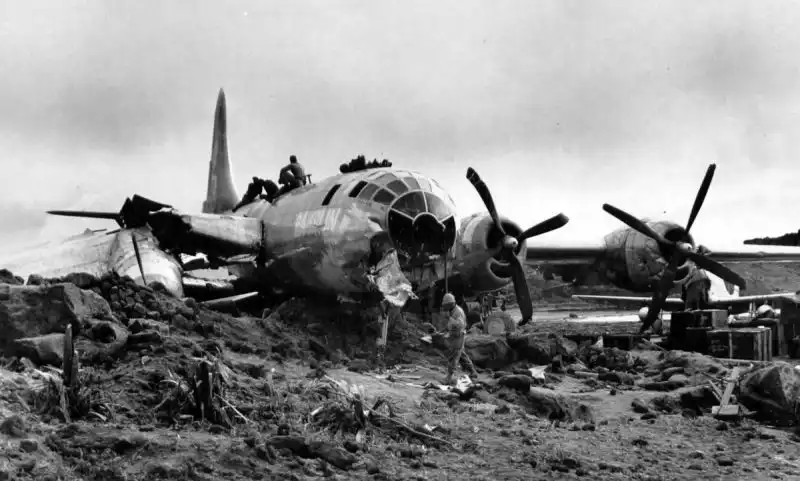
The damaged B-29 Ramblin Roscoe crashes during an emergency landing on Iwo Jima after returning from a bombing mission against Tokyo in April 1945.
A Bomber That Barely Made It Home:
This dramatic photograph shows the American Boeing B-29 Superfortress Ramblin Roscoe (serial number 42-24664) after a crash landing on the island of Iwo Jima on 14 April 1945.
The aircraft belonged to the 500th Bombardment Group of the United States Army Air Forces and had just returned from a night bombing mission against Tokyo. During the operation, Japanese fighters severely damaged the bomber, knocking out two engines and damaging part of its landing gear.
Despite these critical failures, the crew managed to keep the aircraft in the air long enough to reach the emergency airfields recently captured on Iwo Jima.
Mission No. 42:
The aircraft was returning from Mission No. 42, a large-scale night raid against the Japanese capital conducted on 13 April 1945.
By the spring of 1945, B-29 bombers operating from the Mariana Islands were carrying out relentless attacks against Japanese cities, industrial centers, transportation networks, and military facilities.
These missions often required crews to fly:
- More than 3,000 miles round trip.
- Through unpredictable weather.
- Under the threat of anti-aircraft fire.
- Against Japanese fighter interception.
Although American air superiority had grown significantly by 1945, Japanese pilots continued to inflict losses on attacking bomber formations.
The Road to Iwo Jima:
The capture of Iwo Jima in early 1945 was one of the most costly battles of the Pacific War.
For American planners, however, the island offered a crucial strategic advantage. Located roughly halfway between the Mariana Islands and Japan, it provided a valuable emergency landing site for damaged B-29s.
Before the island's capture, crews whose aircraft suffered serious damage often had little chance of survival. Many bombers were forced to ditch in the Pacific Ocean, where rescue was uncertain.
After American forces secured the island and repaired its airfields, thousands of B-29 crews owed their lives to Iwo Jima's runways.
Disaster on the Airfield:
Although Ramblin Roscoe successfully reached the island, the danger was not over.
The damaged landing gear failed during the landing attempt, causing the aircraft to lose control. During the crash, the bomber collided with a truck and continued across part of the airfield area.
The accident killed one member of the Naval Construction Battalions, better known as the "Seabees," and injured two others who were sleeping in a nearby tent.
Such incidents were not uncommon on wartime airfields, where hundreds of aircraft operated under difficult conditions and emergency landings occurred almost daily.
The Boeing B-29 Superfortress:
The B-29 was one of the most advanced aircraft of the Second World War.
Compared with earlier heavy bombers, it featured:
- Pressurized crew compartments.
- Remote-controlled defensive gun turrets.
- Powerful Wright R-3350 engines.
- Long-range capability.
- A large bomb load.
The aircraft represented a major technological leap forward and became the primary weapon of the American strategic bombing campaign against Japan.
However, the B-29 also suffered from numerous technical problems, particularly engine overheating and maintenance difficulties.
Even without enemy action, many aircraft were lost in accidents.
Why Iwo Jima Mattered:
The story of Ramblin Roscoe illustrates exactly why American commanders considered Iwo Jima worth its enormous cost.
During the final months of the war, the island served as an emergency haven for thousands of damaged bombers.
Historians estimate that more than 2,000 B-29s made emergency landings on Iwo Jima before the end of the war, saving many thousands of aircrew members who otherwise might have been lost at sea.
Every damaged bomber that reached the island represented trained specialists, experienced crews, and valuable aircraft preserved for future operations.
A Snapshot of the Pacific Air War:
Unlike photographs showing bombers in perfect formation or dramatic combat scenes, this image captures the harsh reality of strategic air warfare.
The twisted aircraft on the ground demonstrates that survival did not end when a bomber escaped enemy fighters. Mechanical failures, battle damage, exhausted crews, and difficult landings continued to threaten lives until the aircraft came to a complete stop.
For the crew of Ramblin Roscoe, reaching Iwo Jima meant survival. For one Seabee working on the island, however, the war proved fatal despite being far from the target city itself.
Legacy of Ramblin Roscoe:
The photograph remains a powerful reminder of the immense scale of the Pacific air campaign in 1945.
By April of that year, American bombers were striking Japan almost continuously, while emergency fields on Iwo Jima became lifelines for damaged aircraft returning from battle.
The wreck of Ramblin Roscoe represents both the vulnerability and resilience of the B-29 force—an air arm that played a decisive role in the final defeat of Imperial Japan.
Recommended Reading:
- Blankets of Fire
- Iwo Jima
- Target Tokyo
- B-29 Superfortress Units of World War 2
- Hell from the Heavens
- Pacific Crucible
Photo details:
📍 Location: Iwo Jima, Japan
📅 Date: 14 April 1945
📷 Photographer: Unknown