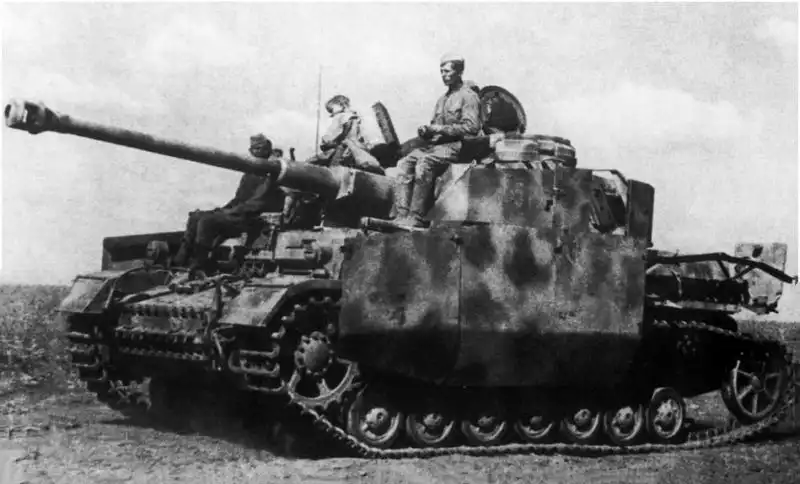
Red Army soldiers inspect a captured German Panzer IV Ausf. G during the fighting on the Eastern Front in 1943.
A Valuable Battlefield Prize:
This fascinating photograph shows Red Army infantrymen examining a captured German Panzerkampfwagen IV Ausf. G during fighting on the Eastern Front in 1943.
The soldiers appear to be studying the vehicle with genuine curiosity. Such scenes were common during the war, as enemy equipment offered valuable intelligence regarding armor protection, weapons, communications equipment, and manufacturing techniques.
Unlike destroyed tanks abandoned on the battlefield, an intact captured vehicle could provide military specialists with a wealth of information.
Identifying the Tank:
The vehicle shown in the photograph can be identified as a Panzer IV Ausf. G produced during April–May 1943.
Several distinctive features support this identification:
- Three-barreled smoke grenade launchers mounted on the turret.
- Early style side-skirt mounting brackets visible along the upper hull.
- Two front headlights, one on each fender.
- A drive sprocket featuring six solid spokes.
These details distinguish the vehicle from the later Panzer IV Ausf. H, which incorporated several modifications, including a different drive sprocket design and simplified external fittings.
Such production details are often invaluable to historians and military vehicle enthusiasts attempting to identify vehicles from wartime photographs.
Germany's Most Important Tank:
Although the Panther and Tiger tanks often receive more public attention, the Panzer IV was arguably Germany's most important armored fighting vehicle of the Second World War.
Originally designed before the war as a support tank, the Panzer IV evolved continuously to meet the growing threat posed by Allied armor.
By 1943, the Ausf. G variant featured:
- Improved armor protection.
- The powerful long-barreled 75 mm KwK 40 gun.
- Enhanced anti-tank capability.
- Better survivability against Soviet tanks.
These upgrades transformed the Panzer IV from an infantry-support vehicle into one of the Wehrmacht's primary tank killers.
The Eastern Front in 1943:
The year 1943 marked a turning point in the war between Germany and the Soviet Union.
Following the German defeat at Stalingrad, the Wehrmacht attempted to regain the initiative through a series of operations that culminated in the Battle of Kursk.
During this period, Panzer IV Ausf. G tanks formed a significant portion of German armored strength.
Unlike the newer Panther, which suffered serious mechanical problems during its early combat deployment, the Panzer IV was considered reliable, familiar to crews, and easier to maintain in field conditions.
As a result, it remained one of the backbone vehicles of German armored formations throughout the war.
Captured Equipment in Soviet Service:
The Red Army paid close attention to captured German equipment.
Specialized technical teams inspected enemy vehicles whenever possible. Captured tanks were often transported to proving grounds where engineers analyzed armor layouts, weapons systems, engines, and manufacturing methods.
Some captured German vehicles were even repaired and returned to service under Soviet control.
Panzer IV tanks were among the most frequently reused German armored vehicles because spare parts and ammunition could occasionally be obtained from battlefield stocks.
Soviet reports generally regarded the Panzer IV as a dangerous and well-designed opponent, particularly after the introduction of the long-barreled 75 mm gun.
Why the Soldiers Are Looking So Closely:
Photographs like this reveal an often-overlooked aspect of warfare: curiosity.
Frontline soldiers constantly encountered unfamiliar enemy weapons and equipment. A captured tank offered an opportunity to examine the machine that had previously been seen only through gunsights or from a distance under combat conditions.
The men in the photograph may be inspecting:
- Armor thickness.
- Damage sustained before capture.
- Internal equipment.
- Weapons and ammunition storage.
- Mechanical features unfamiliar to Soviet crews.
For soldiers who fought against German armor daily, seeing an intact Panzer IV up close was a rare opportunity.
The Panzer IV's Lasting Legacy:
The Panzer IV served on every major front of the European war and remained in production from 1937 until 1945.
More than 8,500 examples were built, making it Germany's most-produced medium tank.
Its adaptability allowed the design to remain effective far longer than many contemporary armored vehicles. Through constant modernization, it evolved from a pre-war support tank into one of the Wehrmacht's principal combat vehicles.
By 1943, vehicles like the Ausf. G represented the mature form of the Panzer IV and played a central role in Germany's armored operations across Europe.
A Moment Frozen in Time:
This photograph captures more than a captured tank. It records a brief moment when the machinery of war became an object of study rather than destruction.
The Red Army soldiers gathered around the Panzer IV are looking at one of the most recognizable German tanks of the Second World War—a machine that only hours or days earlier may have been fighting against them.
Today, the image provides historians with valuable evidence of both the technical evolution of German armored vehicles and the everyday experiences of soldiers on the Eastern Front.
Recommended Reading:
- Panzer IV and Its Variants
- Panzerkampfwagen IV Medium Tank 1936–45
- The Battle of Kursk
- Armored Champion
- Panzer Tracts No. 4
- When Titans Clashed
Photo details:
📍 Location: USSR
📅 Date: 1943
📷 Photographer: Unknown