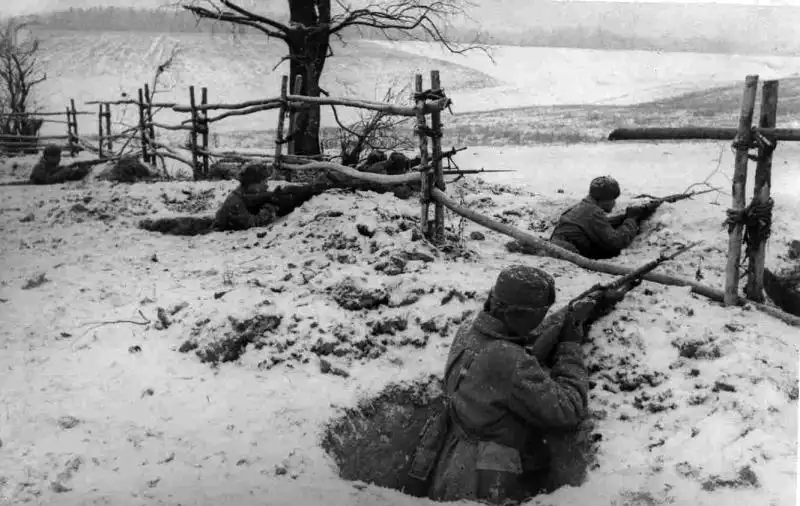
Soviet infantrymen occupy freshly dug snow-covered fighting positions during the Red Army counteroffensive in the Battle of Moscow, December 1941.
The Winter That Changed the War
This remarkable photograph captures Soviet infantrymen armed with Mosin–Nagant rifles and fixed bayonets occupying snow-covered defensive positions during the Red Army's counteroffensive in the Battle of Moscow in December 1941.
The image was taken at a crucial moment of the Second World War. Only weeks earlier, German forces had advanced to the very outskirts of the Soviet capital. Many foreign observers believed that Moscow would soon fall, delivering a potentially decisive blow to the Soviet Union.
Instead, the Red Army launched a powerful winter counteroffensive that shocked the Wehrmacht and marked Germany's first major strategic defeat of the war.
Source of photo information: photo.rgakfd.ru
A Position Still Under Construction:
One of the most interesting details visible in the photograph is the nature of the defensive works themselves.
The soldiers occupy individual foxholes dug into the frozen ground and covered with snow. These fighting positions appear relatively shallow and, importantly, are not yet connected by a continuous trench system.
This may indicate that the position was only recently occupied.
A likely explanation is that these troops had just advanced onto a newly captured ridge, hill, or defensive line during the Soviet counteroffensive. Rather than constructing a permanent fortified position, the soldiers may have been creating temporary cover while preparing for further advances.
Such situations were common during winter operations, when rapidly changing front lines often left little time for extensive engineering work.
The Battle of Moscow:
The Battle of Moscow was one of the largest military operations in history.
In the autumn of 1941, Germany launched Operation Typhoon, the massive offensive intended to capture the Soviet capital. German commanders expected the campaign to end before winter, believing that Soviet resistance was close to collapse.
The reality proved very different.
Despite enormous losses, the Red Army continued to mobilize new formations, while civilians and soldiers worked tirelessly to build defensive belts around Moscow.
By late November and early December, exhausted German forces found themselves fighting in severe winter conditions for which they were poorly prepared.
On 5 December 1941, Soviet forces launched a major counteroffensive along a broad front, forcing the Wehrmacht to retreat from many of its forward positions.
The Soviet Infantryman in Winter:
The men in this photograph represent the ordinary Soviet infantryman who bore the burden of the fighting.
Their primary weapon is the Mosin–Nagant rifle, one of the most widely used military rifles of the twentieth century. The fixed bayonets attached to many rifles reflect Red Army doctrine at the time, which emphasized keeping bayonets mounted whenever possible.
Winter combat imposed enormous hardships on soldiers:
- Deep snow restricted movement.
- Extreme cold affected weapons and equipment.
- Digging positions into frozen ground required tremendous effort.
- Supply lines were often unreliable.
- Frostbite became a constant danger.
Despite these difficulties, Soviet troops managed to maintain offensive pressure throughout much of the winter campaign.
Fighting for Every Hill and Village:
The photograph illustrates an important reality of the Battle of Moscow.
The campaign was not fought solely through dramatic tank battles or large-scale maneuvers. Much of the fighting involved infantry units advancing through forests, fields, villages, and frozen countryside, capturing one position after another.
Every ridge, road junction, and settlement could become the focus of intense combat.
Temporary defensive positions such as those shown here often served as staging areas before another advance or as emergency protection against German counterattacks.
The battlefield was constantly changing, and soldiers frequently had to adapt to new conditions with limited resources.
The Significance of the Soviet Counteroffensive:
The Soviet victory outside Moscow had consequences far beyond the immediate battlefield.
For the first time since the beginning of the war, German armies were forced into a large-scale retreat. The myth of Wehrmacht invincibility suffered a severe blow.
The counteroffensive demonstrated that:
- The Soviet Union remained capable of mounting major operations.
- German forces had reached the limits of their advance.
- The war in the East would not be won quickly.
- A long war of attrition now lay ahead.
Many historians regard the Battle of Moscow as one of the most important turning points of the entire Second World War.
A Photograph of Determination:
At first glance, the image appears simple: a group of soldiers crouching in shallow snow-covered positions.
Yet it captures a decisive moment in history.
These infantrymen stood on a front line where the future of the Soviet capital—and perhaps the entire Eastern Front—was being decided. Their positions may have been temporary, their trenches incomplete, and their conditions harsh, but they were part of the force that halted and then pushed back the German advance on Moscow.
The photograph serves as a powerful reminder that major historical victories are often built upon the endurance, labor, and sacrifice of ordinary soldiers facing extraordinary circumstances.
Recommended Reading:
- Moscow 1941
- The Battle of Moscow 1941
- When Titans Clashed
- Barbarossa
- Russia's War
- Ivan's War
Photo details:
📍 Location: Moscow Region, USSR
📅 Date: December 1941
📷 Photographer: Arkady Shaikhet