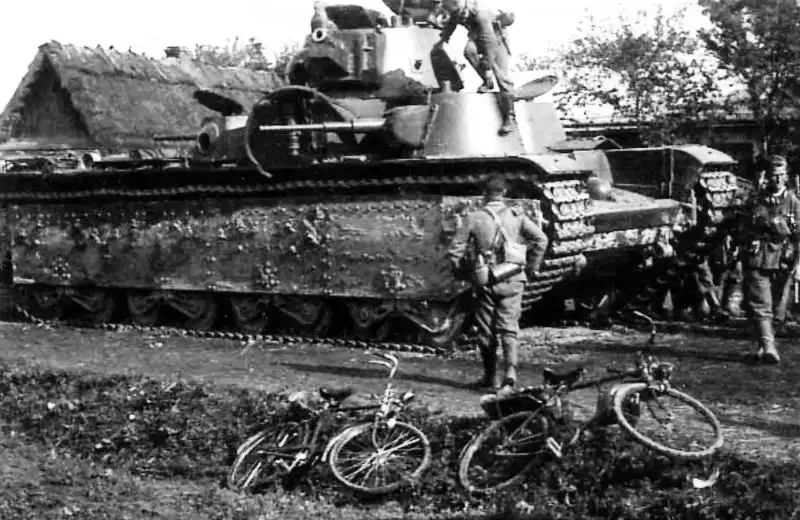
German soldiers examine an abandoned Soviet T-35 heavy tank in the village of Zapytiiv during the opening weeks of Operation Barbarossa, July 1941.
A Giant of the Red Army Left Behind:
This striking photograph shows German soldiers examining and posing beside a Soviet T-35 heavy tank abandoned on the main street of the village of Zapytiiv in the Lviv region during the summer of 1941.
The vehicle belonged to the 67th Tank Regiment of the 34th Tank Division, part of the 8th Mechanized Corps of the Soviet Southwestern Front. According to Soviet records, the tank suffered a serious mechanical breakdown on 3 July 1941. Its engine cylinder failed, the main clutch burned out, and the vehicle became inoperable. Before abandoning it, the crew removed its weapons and rendered it useless to the enemy.
The commander of the tank was listed as Yakovlev.
The Legendary T-35:
Few tanks of the Second World War were as visually impressive as the Soviet T-35.
Designed during the early 1930s, the T-35 embodied the interwar belief that heavily armed "land battleships" would dominate future battlefields. Instead of a single turret, it carried five turrets mounted on a massive hull.
Its standard armament included:
- One 76.2 mm main gun
- Two 45 mm cannons
- Multiple machine guns
- A crew of up to eleven men
At nearly 50 tons, the T-35 was among the largest operational tanks in the world when introduced.
To military parades in Moscow, it looked unstoppable.
On real battlefields, however, reality proved far less impressive.
A Victim of Mechanics Rather Than Enemy Fire:
One of the most important aspects of this photograph is what it does not show.
The tank was not destroyed by German anti-tank guns, air attacks, or other armored vehicles.
Instead, it became another victim of the mechanical problems that plagued many early-war Soviet armored formations.
The rapid German advance during Operation Barbarossa forced Soviet mechanized units into exhausting marches over long distances. Vehicles frequently broke down due to worn engines, damaged transmissions, lack of spare parts, or insufficient maintenance facilities.
Many Soviet tanks lost during the summer of 1941 were abandoned for mechanical reasons rather than combat damage.
The T-35 suffered particularly from this problem. Its enormous size, complex transmission, and heavy weight placed tremendous strain on its mechanical components.
Identifying an Early Production T-35:
The vehicle in the photograph can be identified as an early production example of the T-35 with conical turrets.
Several visible features support this identification:
- Conical secondary turrets
- Vertical-sided turret platform structure
- Folding driver's hatch
- Early-style access hatches in the side skirts
- Handrail radio antenna
- Rear machine-gun mount in the main turret bustle
- Rectangular side hatch on the main turret
These characteristics indicate that the tank was produced in late 1938.
Its factory serial number was 234-42.
Such details are extremely valuable for historians because relatively few T-35 tanks survived long enough to be photographed in detail.
The 8th Mechanized Corps in 1941:
The tank belonged to one of the Soviet Union's strongest mechanized formations on paper.
The 8th Mechanized Corps possessed hundreds of tanks and included some of the Red Army's most modern armored vehicles. Yet like many Soviet formations during the opening weeks of the German invasion, it faced enormous challenges:
- Constant air attacks
- Fuel shortages
- Poor communications
- Inadequate logistical support
- Mechanical failures
- Rapidly changing front lines
The corps participated in the massive tank battles fought in western Ukraine during June and July 1941, including the fighting around Brody, Dubno, and Lutsk.
Although Soviet forces often fought with determination, losses were catastrophic.
Why the Germans Loved Photographing T-35s:
German soldiers frequently photographed captured or abandoned T-35 tanks.
For many Wehrmacht troops, the vehicle appeared almost unbelievable. Its sheer size and unusual multi-turret arrangement made it one of the most exotic tanks encountered during the campaign.
Photographs of abandoned T-35s became popular propaganda material because they symbolized what German commanders claimed was the destruction of Soviet military power.
Ironically, many of these giant tanks had not been knocked out in battle at all. They had simply broken down and could no longer continue the retreat.
The End of the Multi-Turret Era:
The T-35 represented the final stage of a concept that was already becoming obsolete.
Military planners in several countries experimented with multi-turret tanks during the 1920s and 1930s. Combat experience eventually demonstrated that such vehicles were too large, too expensive, too mechanically complicated, and too difficult to command effectively.
By the outbreak of the Second World War, the future belonged to tanks with a single powerful turret and better armor protection.
The Soviet Union itself had already begun moving in that direction with vehicles such as the legendary T-34 and KV-1.
A Symbol of the Summer of 1941:
This photograph captures more than a disabled tank.
It reflects the chaos of the first weeks of the German invasion, when Soviet armored units struggled against both the enemy and their own equipment. The abandoned T-35 standing in the street of a Ukrainian village became a silent monument to a military doctrine that had already passed into history.
For the German soldiers posing beside it, the tank was a curiosity and a trophy.
For historians today, it is a reminder that in 1941 many Soviet losses resulted not only from combat but also from the enormous logistical and mechanical challenges faced by the Red Army during one of the most difficult periods of the war.
Recommended Reading:
- The T-35 Heavy Tank and Combat History
- Stumbling Colossus
- Barbarossa 1941
- The Red Army and the Second World War
- Russia's War
- Armageddon in Stalingrad
Photo details:
📍 Location: Zapytiiv, Lviv Region, Ukrainian SSR, USSR
📅 Date: July 1941
📷 Photographer: Unknown