A rare wartime photograph showing a Soviet T-28 medium tank with additional armor abandoned during the chaotic battles of July 1941 as German forces advanced deep into Soviet territory.
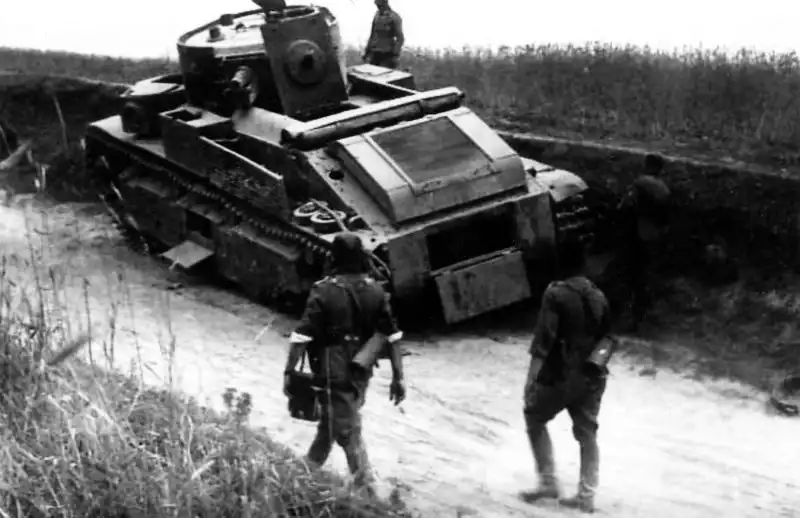
Abandoned Soviet T-28 Tank with Additional Armor Captured by the Wehrmacht:
The summer of 1941 was one of the most catastrophic periods in Soviet military history. As German armored spearheads advanced rapidly across the western regions of the Soviet Union during Operation Barbarossa, thousands of Soviet vehicles were destroyed, abandoned, or captured. This photograph shows one such casualty of those desperate weeks — a Soviet T-28 medium tank fitted with additional armor plates and left behind during the retreat.
The T-28: A Giant from Another Era:
When the T-28 entered service in the early 1930s, it was considered one of the most advanced medium tanks in the world. Designed as a breakthrough tank, it featured an unusual multi-turret arrangement consisting of a large central turret armed with a 76.2 mm gun and two smaller machine-gun turrets positioned forward.
At the time of its introduction, the T-28 was heavily armed and reasonably well protected. However, by 1941 its design was already becoming obsolete. The rapid development of anti-tank weapons during the late 1930s had significantly reduced its battlefield survivability.
Despite these shortcomings, the T-28 remained in service with the Red Army when Germany launched Operation Barbarossa in June 1941.
Additional Armor: An Attempt to Improve Survival:
The tank in this photograph is particularly interesting because it appears to be fitted with additional armor plates, commonly referred to as "appliqué armor" or "screen armor."
Following combat experience gained during the Winter War, Soviet engineers discovered that standard T-28 armor was vulnerable to modern anti-tank guns. As a result, some vehicles received supplementary armor plates welded onto the hull and turret.
These modifications increased protection against small-caliber anti-tank weapons and machine-gun fire. However, the extra weight also placed additional strain on an already aging chassis and engine.
Many of these upgraded vehicles fought during the first months of the German invasion.
Why Were So Many Soviet Tanks Abandoned?
One of the most striking aspects of the summer campaign of 1941 is the enormous number of Soviet tanks captured intact or nearly intact by German forces.
Contrary to popular belief, many were not destroyed in combat. Mechanical failures, fuel shortages, lack of spare parts, and disrupted supply lines often forced Soviet crews to abandon otherwise repairable vehicles.
The T-28 was especially vulnerable to such problems. Its complicated transmission and aging mechanical systems required constant maintenance. During the chaotic retreats of June and July 1941, crews frequently had no opportunity to recover disabled tanks.
As a result, German soldiers often encountered abandoned Soviet armor scattered along roads, in villages, and near former defensive positions.
The Collapse of the Frontier Battles:
The photograph reflects the dramatic events of the opening phase of Operation Barbarossa. Soviet mechanized corps possessed thousands of tanks on paper, but poor communications, insufficient training, logistical difficulties, and the speed of the German advance severely limited their effectiveness.
Many armored units fought courageously and inflicted significant losses on German forces. Nevertheless, the Red Army suffered catastrophic setbacks during the frontier battles of 1941.
Images like this abandoned T-28 became common across Ukraine, Belarus, and the Baltic region during the first months of the war.
A Rare Survivor of Soviet Multi-Turret Tank Design:
Today the T-28 remains one of the most recognizable Soviet tanks of the interwar period. Its distinctive multi-turret layout symbolizes a transitional stage in armored warfare before the emergence of more effective designs such as the T-34 and KV-1.
While ultimately overshadowed by these later vehicles, the T-28 played an important role in Soviet armored development and remains a fascinating subject for military historians and enthusiasts alike.
The abandoned machine shown in this photograph serves as a reminder of the chaos, destruction, and enormous material losses suffered during the opening months of the German-Soviet war.
Photo details:
📝 Source: Private wartime photograph
📍 Location: Ukraine, USSR
📅 Date: July 1941
📷 Photographer: Unknown
Recommended Reading:
- Barbarossa: The Russian-German Conflict 1941–1945
- When Titans Clashed
- Colossus Reborn
- The Soviet Tanks and Combat Vehicles of World War Two
- T-28 Medium Tank
- Operation Barbarossa and Germany's Defeat in the East