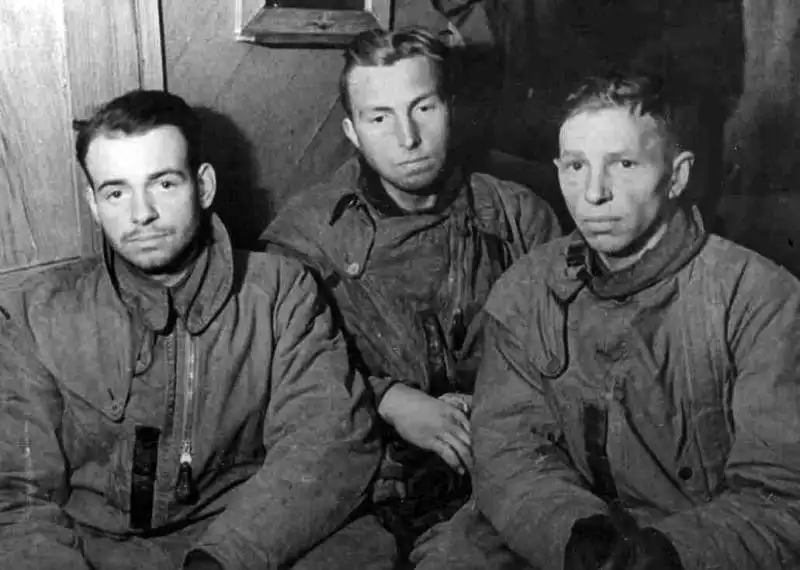
Crew members of a German Ju 88 bomber captured by Soviet forces in the Murmansk region after an emergency landing during the brutal Arctic campaign of 1941.
One of the lesser-known fronts of the Second World War stretched across the Arctic wilderness of northern Europe. While enormous battles raged around Moscow, Kiev, and Leningrad, German and Soviet forces fought another harsh campaign among mountains, tundra, and frozen rivers near Murmansk.
This rare wartime photograph shows three Luftwaffe airmen captured by Soviet naval infantry after their bomber was forced down in the Murmansk region during the autumn of 1941.
The image was taken by renowned Soviet war photographer Yevgeny Khaldei.
The Men in the Photograph:
The prisoners shown are crew members of a German Junkers Ju 88 bomber:
- Corporal Jakob Merzenik, radio operator
- Heinz Hartmann, air gunner
- Corporal Josef Marquardt, navigator
Only days earlier they had been flying combat missions over the Arctic front as part of the Luftwaffe's campaign against Soviet military targets in northern Russia.
Now they sat before a Soviet camera as prisoners of war.
The contrast between the confidence of an aircrew departing for a mission and the uncertainty visible in many photographs of captured servicemen is one of the most striking aspects of wartime photography.
The Fate of Ju 88 4D+RN:
The aircraft belonged to the famous Kampfgeschwader 30, one of Germany's principal bomber formations.
Their aircraft was a Junkers Ju 88A-5 carrying the tactical code 4D+RN and factory number J88.005039.
On 29 September 1941 the bomber failed to return from its mission. Instead, it made an emergency landing in the valley of the Klimkovka River in the Lovozero district of Murmansk Oblast.
The exact circumstances remain unclear, but aircraft operating over the Arctic faced numerous dangers:
- Soviet fighter interception
- Anti-aircraft fire
- Mechanical failures
- Navigation difficulties
- Severe weather conditions
Any one of these factors could turn a routine mission into a struggle for survival.
The Battle for Murmansk:
The fighting around Murmansk occupied a unique place in the war.
Unlike many Soviet cities overrun during 1941, Murmansk never fell to German forces. The city was of immense strategic importance because it remained one of the Soviet Union's most important Arctic ports.
Later in the war, vast quantities of Allied Lend-Lease supplies arrived through Murmansk and nearby ports, making the region a priority target for German air attacks.
German forces, supported by Finnish units, attempted to cut Soviet communications and capture key positions throughout the Arctic campaign. Despite repeated attacks, Soviet defenders managed to hold the line.
The Ju 88: One of Germany's Best Aircraft:
The aircraft flown by the captured crew was a Junkers Ju 88.
The Ju 88 proved to be one of the most versatile aircraft of the Second World War. Originally designed as a fast bomber, it later served as:
- Medium bomber
- Night fighter
- Reconnaissance aircraft
- Torpedo bomber
- Heavy fighter
Its adaptability made it one of the Luftwaffe's most valuable aircraft throughout the war.
Thousands were built, and they operated on virtually every front where German forces fought.
Prisoners of War on the Eastern Front:
Photographs of captured German servicemen from 1941 are relatively uncommon compared with later years of the war.
During the first months of Operation Barbarossa, German forces generally advanced rapidly and captured vast numbers of Soviet prisoners. Images showing the reverse situation were therefore less frequent and often attracted considerable attention in Soviet newspapers.
This photograph was later published in the newspaper Buryat-Mongolskaya Pravda on 1 January 1942, demonstrating its propaganda value. The image showed Soviet readers that German soldiers could also be defeated and captured.
A Human Moment in a Global War:
Although military history often focuses on armies, aircraft, and weapons, this photograph ultimately tells a human story.
Three young airmen who had left their base expecting another combat mission instead found themselves stranded in the Arctic wilderness and then taken prisoner by the enemy.
For them, the war changed completely in a matter of hours.
The image freezes that moment forever: not as victorious aviators, but as exhausted survivors whose future had suddenly become uncertain.
Recommended Reading:
- Murmansk 1941
- Arctic War
- The Luftwaffe War Diaries
- Barbarossa Derailed
- The Road to Stalingrad
- Witness to History
Source of information: Newspaper Buryat-Mongolskaya Pravda, No. 01 (7563), 1 January 1942.
Photo details:
📍 Location: Murmansk Region, USSR
📅 Date: 1941
📷 Photographer: Yevgeny Khaldei