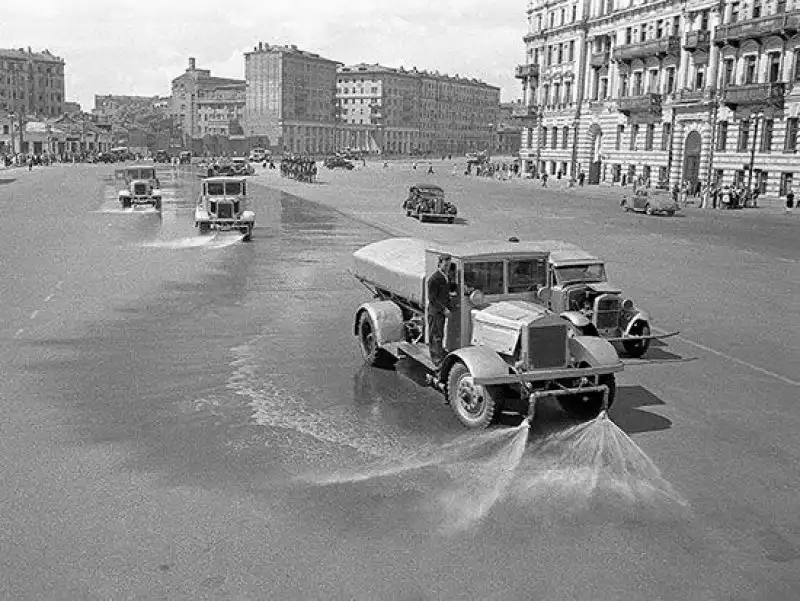
Soviet street-washing trucks follow the route of 57,000 German prisoners of war through Moscow on July 17, 1944, after the famous "Parade of the Vanquished" following Operation Bagration.
The Parade of the Vanquished
This remarkable photograph captures Soviet street-washing trucks moving along Moscow's Zubovsky Boulevard on July 17, 1944, immediately after one of the most extraordinary public events of the Second World War—the march of approximately 57,000 German prisoners of war through the Soviet capital. The view looks toward Smolensky Boulevard, with Prechistenka Street branching off to the right.
The prisoners had been captured during Operation Bagration, the massive Soviet summer offensive launched in June 1944. The operation destroyed much of Germany's Army Group Centre, liberated most of Belarus, and is widely regarded by military historians as one of the Wehrmacht's most devastating defeats of the entire war. Among the prisoners marched through Moscow were roughly 57,000 German soldiers and officers, including 19 generals, making it one of the largest public displays of captured enemy troops ever organized during World War II.
Why Were the Streets Washed?
Immediately after the columns of prisoners had passed, municipal street-cleaning trucks followed the same route, spraying the pavement with water. Officially, this was presented as routine cleaning. However, both contemporaries and later historians have often interpreted the act as a powerful symbolic gesture—washing away the invaders from the streets of the Soviet capital after three years of brutal war. Whether practical, symbolic, or both, the image quickly became one of the most memorable visual episodes associated with the parade.
A Symbol of Soviet Victory
The march itself served several purposes. It demonstrated to Soviet citizens that the Red Army had decisively seized the strategic initiative, reassured the Allied nations of Germany's mounting losses, and dealt a psychological blow to the Nazi regime. For many Muscovites, watching thousands of exhausted German prisoners pass through the city represented tangible proof that the tide of war had turned irreversibly in the Soviet Union's favor.
Today, photographs of the "Parade of the Vanquished" and the street-washing trucks that followed remain among the most recognizable images of the Soviet home front. Whether viewed as wartime propaganda, psychological warfare, or a genuine expression of public sentiment after years of immense suffering, they continue to symbolize one of the defining moments of the Red Army's victories in 1944.
Technical photo data:
📝 Source of information: Yandex Maps (location identification), archival photographs
📍 Location: Zubovsky Boulevard, Moscow, USSR
📅 Date of photo: July 17, 1944
📷 Photographer: Unknown
Recommended literature:
- David M. Glantz & Jonathan House — When Titans Clashed: How the Red Army Stopped Hitler
- David Stahel — Operation Bagration 1944
- Antony Beevor — The Second World War
- Richard Overy — Russia's War
- Parade of the Vanquished
- 57,000 German POWs Moscow
- German POWs
- Operation Bagration
- Operation Bagration victory
- German prisoners in Moscow 1944
- Street washing Moscow 1944
- Moscow July 17 1944
- Red Army Belarusian Offensive
- Moscow street cleaning WWII