Soviet troops in white winter camouflage march through liberated Klin as the Red Army begins driving German forces away from Moscow.
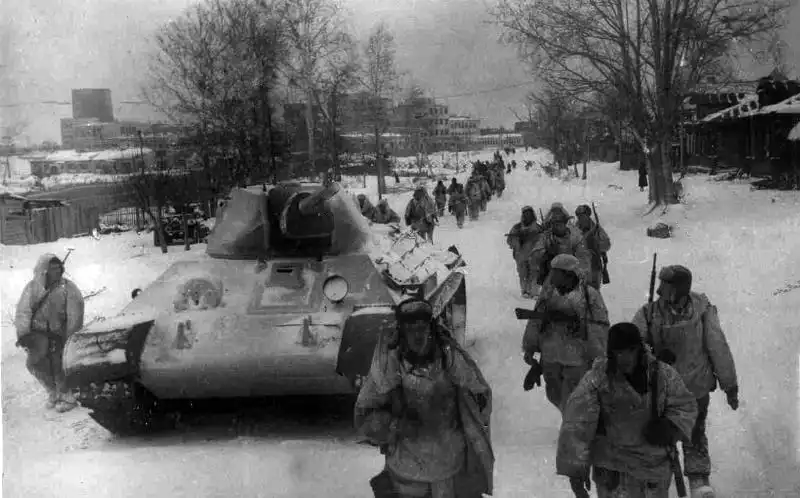
This remarkable wartime photograph captures Soviet troops advancing through the recently liberated city of Klin during the Red Army's counteroffensive near Moscow in December 1941.
The image shows soldiers dressed in white winter camouflage moving through snow-covered streets alongside a T-34 tank painted in winter camouflage. Only weeks earlier, German forces had occupied the city as part of their drive toward the Soviet capital.
Now the situation had dramatically changed.
For the first time since the beginning of Operation Barbarossa, the Wehrmacht was being forced into a large-scale retreat.
Source of photo information: Newspaper Izvestia, Issue No. 298, 18 December 1941.
The Battle for Moscow Reaches a Turning Point:
By late autumn 1941, German forces appeared dangerously close to achieving one of their main strategic objectives — the capture of Moscow.
The offensive known as Operation Typhoon had pushed deep into Soviet territory. Several Soviet armies had been encircled and destroyed, while German reconnaissance units reportedly observed the distant skyline of Moscow from advanced positions.
However, the German advance gradually lost momentum.
Exhausted troops, severe weather, overstretched supply lines, and increasingly determined Soviet resistance combined to halt the offensive before the city could be captured.
On 5 December 1941, the Red Army launched a major counteroffensive along the Moscow front.
The Liberation of Klin:
Klin occupied an important position northwest of Moscow along major transportation routes used by German forces.
The city was captured by the Wehrmacht in late November 1941 during the final phase of the German offensive toward Moscow. For a brief period, it served as an important German stronghold threatening the Soviet capital.
The Soviet counteroffensive quickly changed the situation.
Units of the Red Army attacked the German positions around Klin and forced the defenders to withdraw. The city was liberated on 15 December 1941 after intense fighting.
The photograph was taken only days after this victory, preserving a moment when Soviet forces were pushing westward through territory recently recovered from occupation.
Winter Camouflage on Men and Machines:
One of the most striking details in the image is the extensive use of winter camouflage.
The soldiers wear white camouflage suits designed to blend into the snowy landscape. Such clothing significantly reduced visibility to enemy observers and snipers during winter operations.
The T-34 tank visible in the photograph has also received a winter camouflage coating. Soviet tank crews frequently applied temporary white paint or lime-based mixtures over the standard green finish to improve concealment in snow-covered terrain.
Winter camouflage became an important tactical advantage during the fighting around Moscow.
The T-34 and the Soviet Counteroffensive:
The tank visible in the photograph represents one of the most iconic weapons of the Second World War.
The T-34 combined effective armor protection, excellent mobility in difficult terrain, and a powerful 76.2 mm gun. During the winter battles around Moscow, these characteristics allowed Soviet armored units to operate under conditions that often proved difficult for German vehicles.
Although the T-34 alone did not determine the outcome of the campaign, it became a symbol of Soviet resistance and recovery during the critical months of 1941.
A Symbol of Hope:
The significance of this photograph extends beyond its military content.
For millions of Soviet citizens, the liberation of cities such as Klin represented the first tangible evidence that the seemingly unstoppable German advance could be reversed.
The men marching through the city streets are not retreating. They are advancing.
That distinction made all the difference in the winter of 1941.
The liberation of Klin became one of the early successes of the Soviet winter counteroffensive and helped demonstrate that the Red Army remained capable of defeating the Wehrmacht in open battle.
The Beginning of the Long Road West:
At the moment this photograph was taken, nobody could know how long the war would continue.
More than three years of brutal fighting still lay ahead before Soviet troops would reach Berlin.
Yet the soldiers marching through Klin were participating in a turning point. The Battle of Moscow marked the first major strategic defeat suffered by Nazi Germany during the Second World War.
This image captures that historic transition — from desperate defense to determined advance.
Photo Details:
📍 Location: Klin, Moscow Region, USSR
📅 Date: December 1941
📷 Photographer: Leonid Velikzhanin
Recommended Reading:
- David M. Glantz — When Titans Clashed: How the Red Army Stopped Hitler
- Rodric Braithwaite — Moscow 1941: A City and Its People at War
- David Stahel — Operation Typhoon: Hitler's March on Moscow
- John Erickson — The Road to Stalingrad
- Steven J. Zaloga — Moscow 1941: Hitler's First Defeat
- Aleksei Isaev — The Battle for Moscow