A damaged B-29 Superfortress undergoes engine repairs in the Pacific, demonstrating the remarkable field maintenance capabilities of American wartime aviation.
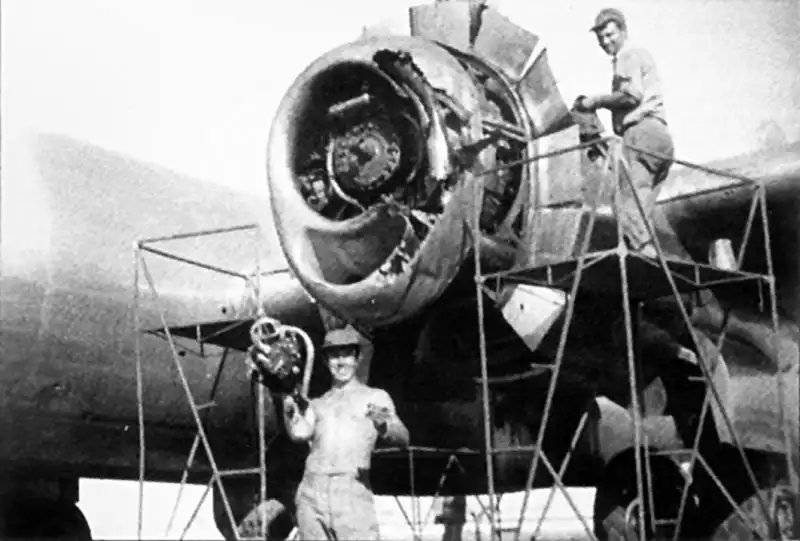
This fascinating wartime photograph shows American engineers and mechanics repairing a damaged Boeing B-29 Superfortress on a remote Pacific island during 1944.
The aircraft had suffered an unusual but dangerous mechanical failure. During a combat mission, one of its propellers reportedly broke free from the engine shaft. Such incidents were rare but not unheard of among high-performance wartime aircraft operating under extreme conditions.
The photograph captures the effort required to return a valuable bomber to service far from major industrial facilities and repair depots.
The B-29: America's Most Advanced Bomber:
The Boeing B-29 Superfortress was among the most sophisticated aircraft of the Second World War.
Featuring pressurized crew compartments, advanced fire-control systems, remote-controlled defensive turrets, and exceptional long-range capability, the B-29 represented a major technological leap forward in military aviation.
However, this sophistication came at a price.
The aircraft was mechanically complex, demanding extensive maintenance and highly trained ground crews. Keeping hundreds of B-29s operational across isolated Pacific islands became one of the greatest logistical achievements of the United States Army Air Forces.
When a Propeller Becomes a Projectile:
The failure described in connection with this aircraft illustrates the tremendous mechanical stresses experienced by large wartime bombers.
A fully loaded B-29 operated four powerful radial engines driving large metal propellers at high rotational speeds. If a propeller assembly failed, the consequences could be catastrophic.
Detached propellers sometimes struck the aircraft itself, damaging the fuselage, wings, or control surfaces. In extreme cases, flying debris could injure or kill crew members.
Even when the aircraft remained controllable, extensive repairs were often required before it could safely return to combat operations.
Field Repairs in the Pacific:
One of the most remarkable aspects of this photograph is the simplicity of the repair environment.
The work is being carried out outdoors using portable equipment and ladders rather than inside a large maintenance hangar.
Pacific island airfields frequently lacked the infrastructure available at major bases in the United States. Mechanics often worked in tropical heat, heavy rain, dust, and mud while servicing some of the most advanced aircraft of the war.
Despite these limitations, American maintenance personnel achieved exceptionally high operational readiness rates.
The Unsung Heroes of Air Warfare:
Strategic bombing campaigns depended on far more than pilots and aircrews.
Every combat sortie required the efforts of armorers, mechanics, electricians, engine specialists, sheet-metal workers, fuel crews, and countless other technicians.
A single B-29 could require hundreds of man-hours of maintenance between missions. Ground personnel often worked around the clock to ensure aircraft were ready for the next operation.
Photographs such as this one reveal a side of aerial warfare that is often overlooked but was absolutely essential to victory.
Keeping the Bombers Flying:
By 1944 and 1945, B-29 operations stretched across enormous distances in the Pacific Theater.
Aircraft regularly flew long missions over Japanese-held territory and later over the Japanese Home Islands themselves. Every bomber represented a major investment in resources, manpower, and industrial production.
Repairing damaged aircraft whenever possible was therefore a strategic necessity.
The ability to perform major maintenance work under field conditions allowed American air forces to maintain pressure on Japan despite the immense challenges posed by distance and environment.
More Than a Machine:
At first glance, this photograph appears to show a routine maintenance task.
In reality, it captures an essential component of modern warfare. The bomber will eventually return to the sky only because skilled technicians possess the knowledge and determination to repair it under difficult conditions.
The image serves as a tribute not only to the aircraft itself but also to the thousands of mechanics whose work rarely appeared in wartime headlines yet played a crucial role in the Allied victory.
Photo Details:
📍 Location: Pacific Ocean Theater
📅 Date: 1944
📷 Photographer: Unknown
Recommended Reading:
- Barrett Tillman — Whirlwind: The Air War Against Japan 1942–1945
- Richard B. Frank — Downfall: The End of the Imperial Japanese Empire
- Thomas M. Coffey — Iron Eagle: The Turbulent Life of General Curtis LeMay
- Edward Jablonski — The History of the United States Air Force
- Steven Birdsall — Superfortress: The Boeing B-29 and American Air Power
- Kenneth P. Werrell — Blankets of Fire: U.S. Bombers over Japan During World War II