German troops struggle with a disrupted ferry crossing near the Eastern Front after a dead horse blocks movement and chaos spreads across the river transport point.
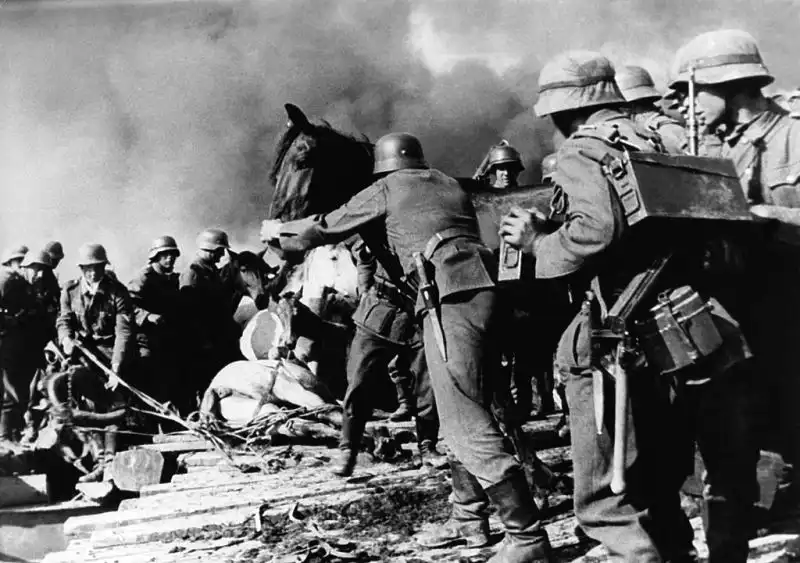
This wartime photograph captures a rare moment of operational disorder behind the German front line in the Soviet Union during the summer of 1942.
A ferry crossing used by German forces to move troops and equipment across a river has become congested after an incident involving a horse killed during what appears to have been an artillery or air strike. The resulting blockage disrupts movement at a critical logistics point located close to active combat zones.
In the background, heavy black smoke rises into the sky, indicating that the area is under direct or nearby threat from ongoing fighting.
The Fragility of Frontline Logistics:
River crossings were essential for maintaining the mobility of German armored and infantry formations on the Eastern Front. Bridges were often destroyed by Soviet forces or became unusable due to constant bombardment, forcing the Wehrmacht to rely on improvised ferry systems.
These ferry points became vital choke points where supplies, reinforcements, and evacuation traffic all converged. Any disruption could quickly lead to operational delays.
The scene shown in this photograph illustrates how even a single incident could destabilize the entire system.
Breakdown Under Pressure:
The immediate cause of the disruption appears trivial at first glance — a dead horse blocking movement. However, in a tightly packed military crossing point, even small obstacles could cause serious delays.
Vehicles and troops were forced to halt, creating congestion that spread rapidly along the queue. With limited space and constant pressure from the front line, there was little room for error or recovery.
The presence of a machine gun crew equipped with an MG 34 suggests that combat readiness was maintained even at the rear of the crossing site.
The MG 34 Crew and Combat Readiness:
In the foreground, a German machine gun crew equipped with the MG 34 is visible carrying a heavy load of ammunition. The MG 34 was one of the most advanced general-purpose machine guns of its time, capable of both sustained fire and high mobility depending on configuration.
Even during logistical operations such as river crossings, German units often remained fully armed due to the proximity of Soviet artillery strikes, partisan activity, and air attacks.
The overloaded ammunition carriage highlights the expectation that any location near the front could quickly become a combat zone.
Smoke on the Horizon:
The large plumes of black smoke in the background suggest that fighting or destruction was occurring nearby.
Such smoke was a constant feature of the Eastern Front, where artillery barrages, burning supply depots, destroyed vehicles, and village fires often marked the shifting line of battle.
For soldiers at crossing points, visibility of such smoke served as a constant reminder that the front line was never far away.
The Eastern Front as a System Under Strain:
By 1942, the war in the Soviet Union had become a massive logistical struggle. The German army, initially built for rapid mobile warfare, increasingly faced the challenge of maintaining long supply lines across vast territory.
River crossings like the one shown in this image became pressure points where speed, vulnerability, and chaos intersected.
This photograph captures not a major battle, but the slow friction of war — where delays, accidents, and small disruptions could influence larger operations.
A Moment of Controlled Disorder:
Despite the apparent chaos, order has not completely collapsed. Soldiers continue to operate, weapons are carried, and movement is being restored.
This balance between breakdown and control was a defining characteristic of the Eastern Front, where both sides constantly struggled to maintain operational momentum under extreme conditions.
The image stands as a reminder that war is not only decided in large battles, but also in the accumulation of countless logistical struggles like this one.
Photo Details:
📍 Location: USSR
📅 Date: Summer 1942
📷 Photographer: Unknown
Recommended Reading:
- David Stahel — Kiev 1941: Hitler's Battle for Supremacy in the East
- Robert Citino — The German Way of War
- David Glantz — Armageddon in Stalingrad
- Niklas Zetterling — The Eastern Front 1941–1945
- Earl F. Ziemke — Stalingrad to Berlin
- Antony Beevor — The Second World War