Iconic photograph by Emmanuil Evzerikhin capturing Soviet Red Army scout Nikolai Romanov armed with a PPSh-41 submachine gun and four RGD-33 hand grenades during the Battle of Stalingrad, August 1942.
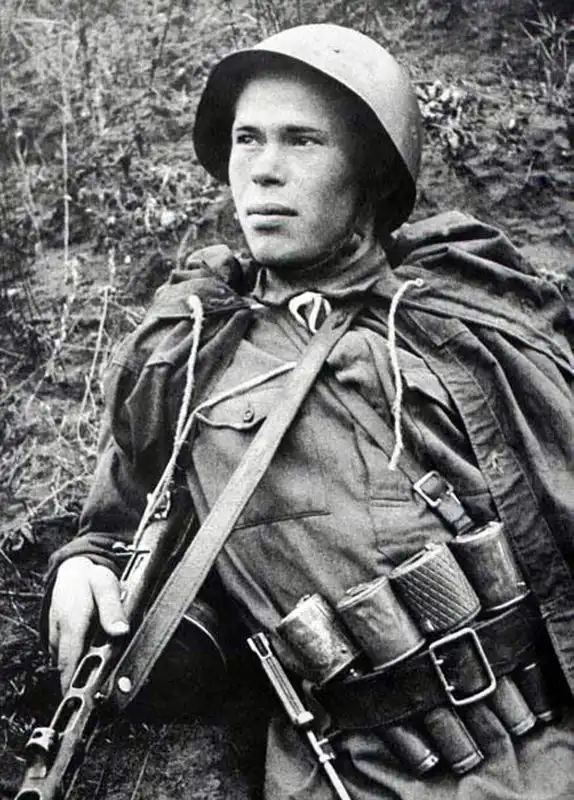
Soviet Reconnaissance Scout Nikolai Romanov at Stalingrad (August 1942)
This iconic World War II photograph taken by famed Soviet war correspondent Emmanuil Evzerikhin captures Red Army scout Nikolai Alekseevich Romanov (born 1921) during the defensive phase of the Battle of Stalingrad in August 1942. Believed to be a scout in the foot reconnaissance platoon of the 412th Rifle Regiment (1st Rifle Division), Romanov is depicted resting on an earth embankment laden with frontline combat gear.
Documented in official military records preserved in the Pamyat Naroda state archive, the photograph provides exceptional detail regarding tactical equipment issued to Soviet assault and recon units.
Tactical Breakdown: PPSh-41 and RGD-33 Hand Grenades
The scout's combat loadout highlights standard-issue Soviet weaponry optimized for close-quarters infantry fighting and covert raids:
- PPSh-41 Submachine Gun: Romanov holds the 7.62mm PPSh-41 (designed by Georgi Shpagin), featuring its perforated heat shroud and high rate of fire (900 RPM), making it the premier submachine gun for close-range urban warfare in Stalingrad.
- RGD-33 Stick Grenades: Tucked into his chest rig are four RGD-33 dual-purpose hand grenades (designed by Mikhail Dyakonov), revealing a specific tactical configuration.
Offensive vs. Defensive Grenade Mechanics Explained
A key visual detail in the photograph is the variation among the four RGD-33 grenades carried on Romanov's belt, illustrating the unique convertible design of Soviet stick grenades:
- Offensive Mode (Without Sleeve): Three of the grenades on his belt are fitted only with their thin sheet-metal explosive canisters. In this offensive configuration, the grenade produces lightweight blast fragments with a lethal radius of approximately 5–10 meters. This allowed an advancing soldier to throw the grenade while charging on open ground without risking self-injury from long-range shrapnel.
- Defensive Mode (With Fragmentation Sleeve): One grenade is fitted with a cross-hatched metal fragmentation jacket or "sleeve" (oboronitelnaya rubashka). This heavy scored metal sleeve converted the weapon into a defensive grenade. Upon detonation, the sleeve produced heavy high-velocity shrapnel effective up to 25–30 meters, requiring the throwing soldier to be safely behind cover or inside a trench line.
📍 Location: Stalingrad, Russian SFSR, Soviet Union
📅 Date: August 1942
📷 Photographer: Emmanuil Evzerikhin (TASS Photochronika)
📰 Primary Source: Pamyat-Naroda.ru Archives / Central Archives of the Russian Ministry of Defence
Recommended reading:
- Combat tactics of Soviet Red Army Reconnaissance Units (Razvedchiki) in WWII
- Technical engineering of the convertible RGD-33 stick grenade system
- Operational deployment of the PPSh-41 submachine gun in urban warfare
- The war photography of Emmanuil Evzerikhin during the Battle of Stalingrad