Historical photograph documenting mass executions of civilians in Kaunas by Nazi Einsatzgruppe A personnel, later submitted as key evidence at the Nuremberg Trials.
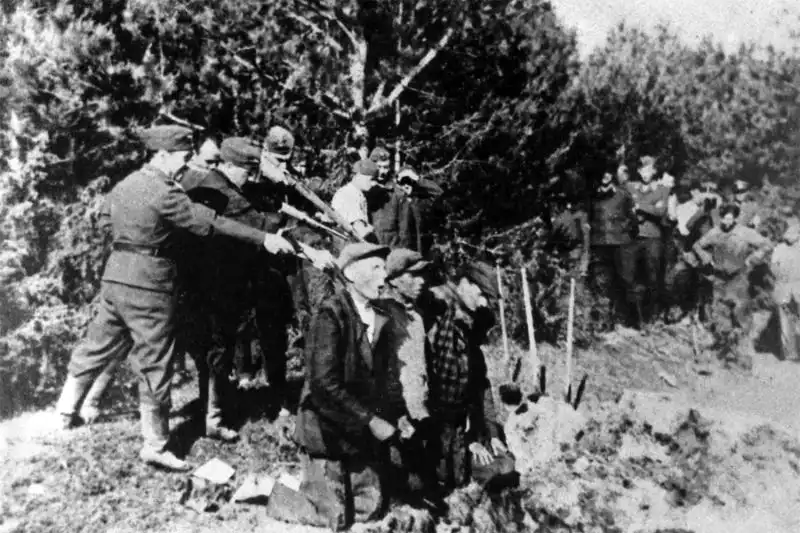
Einsatzgruppe A Mass Executions in Kaunas (Nuremberg Evidence)
This iconic and sobering World War II archival photograph documents mass executions of male civilians carried out in the occupied city of Kaunas, Lithuanian SSR. Executed by perpetrators belonging to Einsatzgruppe A and local auxiliary police units, this image became one of the most definitive visual records of war crimes and crimes against humanity committed on the Eastern Front.
Following the conclusion of World War II, this photograph was submitted by Allied prosecutors as official documentary evidence during the Nuremberg Military Tribunals, specifically within the Subsequent Nuremberg Proceedings targeting SS paramilitary forces.
Historical Context and Einsatzgruppen Operations
Following the invasion of the Soviet Union in June 1941 under Operation Barbarossa, specialized mobile killing units (Einsatzgruppen) operated directly behind advancing German army groups:
- Einsatzgruppe A Jurisdiction: Command area covered the Baltic States (Estonia, Latvia, Lithuania) and the northern approaches toward Leningrad under SS-Brigadeführer Walter Stahlecker.
- Mass Execution Sites in Kaunas: Mass killings were primarily carried out at the Ninth Fort (Devintas Fortas) and surrounding wooded areas around Kaunas, where tens of thousands of civilians and prisoners of war were systematically executed.
- Subsequent Investigations: Photographic evidence collected from captured German military personnel and propaganda archives provided undeniable proof of organized field executions, directly contradicting postwar defense claims regarding the scope of anti-partisan operations.
Legal Impact at the Nuremberg Trials
The visual documentation of mass executions in Kaunas played a decisive role during international war crimes proceedings:
- Einsatzgruppen Trial (Case No. 9): Held in Nuremberg from 1947 to 1948 before United States military tribunals, the trial indicted 24 senior commanders of the death squads based on primary photographic evidence, unit activity reports (Ereignismeldungen UdSSR), and captured military documentation.
- Archival Preservation: Copies of the print are preserved in major international holocaust and war records repositories, including the United States Holocaust Memorial Museum (USHMM), Yad Vashem Archives, and the Federal Archives of Germany (Bundesarchiv).
📍 Location: Kaunas, Lithuanian SSR, Soviet Union
📅 Date: c. 1941–1942
📷 Photographer: Unknown (Captured German / Auxiliary Unit Photograph)
📰 Primary Source: International Military Tribunal (IMT) Nuremberg Evidence Collection
Recommended reading:
- Operational history and structure of SS-Einsatzgruppe A in the Baltic States
- The Einsatzgruppen Trial (Case No. 9) at the Nuremberg Military Tribunals
- Historical documentation of wartime massacres at the Ninth Fort of Kaunas
- Evidentiary standards and photographic proof in international war crimes prosecutions