Historical photograph from summer 1941 documenting a knocked-out Soviet T-34 Model 1940/1941 tank and field recovery efforts during the early months of Operation Barbarossa.
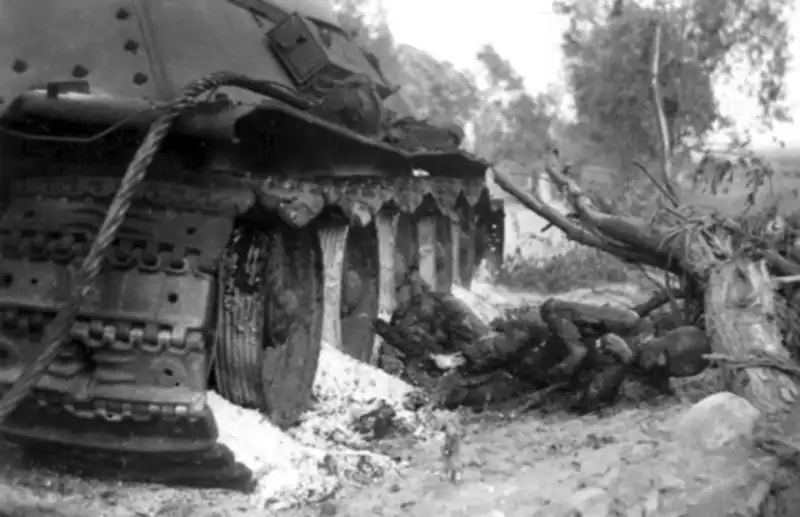
Knocked-Out Soviet T-34 Tank and Crew Recovery (Summer 1941)
This sombre historical photograph from the summer of 1941 documents the grim reality of armored combat during the initial stages of Operation Barbarossa. The image depicts a destroyed Soviet T-34 medium tank resting in a roadside ditch, with field recovery operations underway following a close-quarters engagement on the Eastern Front.
According to original German frontline photographic records, the fallen Soviet crew member was retrieved from the burned armored hull by recovery units for burial in accordance with wartime sanitary field regulations.
Technical Analysis of Early T-34 Production Features
The photograph offers valuable structural details regarding the early-war production variants of the legendary T-34 tank produced by the Kharkiv Locomotive Factory (KhPZ No. 183) and Stalingrad Tractor Factory (STZ):
- Suspension and Track Assembly: The lower hull reveals early-pattern rubber-rimmed road wheels connected to the Christie suspension system. The wide 550 mm steel track shoes (gusenitsa) provided superior low ground pressure in soft soil compared to contemporary German Pz.Kpfw. III and IV tanks.
- Towing Cables and Recovery Gear: Heavy steel towing cables (buksirovochny tros) are visible draped across the front hull and track assembly, indicating attempts by recovery vehicles or tractor units to pull the disabled AFV off the roadway.
- Cast/Welded Turret Features: The side profile showcases the early low-profile 1940/1941 cast or welded turret design housing the 76.2 mm main gun assembly, along with characteristic side vision slits and armor sloped at 60 degrees.
Field Sanitation and Burial Procedures in WWII
During combat operations in the summer of 1941, logistics and medical units on both sides enforced strict field sanitation protocols:
- Sanitary Regulations: Combatant forces operated designated sanitary details tasked with recovering human remains from knocked-out armored vehicles to prevent disease outbreaks in high-temperature summer conditions.
- Identification and Commemoration: Fallen soldiers recovered from armored vehicles were buried in field graves (Kameradengrab or mass graves), often marked by temporary wooden markers or tracked location sketches maintained by division administrative staff.
📍 Location: USSR, Eastern Front
📅 Date: Summer 1941
📷 Photographer: German War Correspondent / Wehrmacht Unit Photographer
📰 Primary Source: WWII German Military Photographic Archives / Private Historical Collection
Recommended reading:
- Technical evolution of the T-34 Model 1940 and Model 1941 medium tanks
- Armored vehicle recovery procedures (Bergepanzer) on the Eastern Front
- Sanitary services and field burial protocols during Operation Barbarossa
- Analysis of early-war Soviet armored losses in June–August 1941