Striking historical photograph capturing the massive assembly line of Consolidated B-24 Liberator heavy bombers in the United States, April 1943.
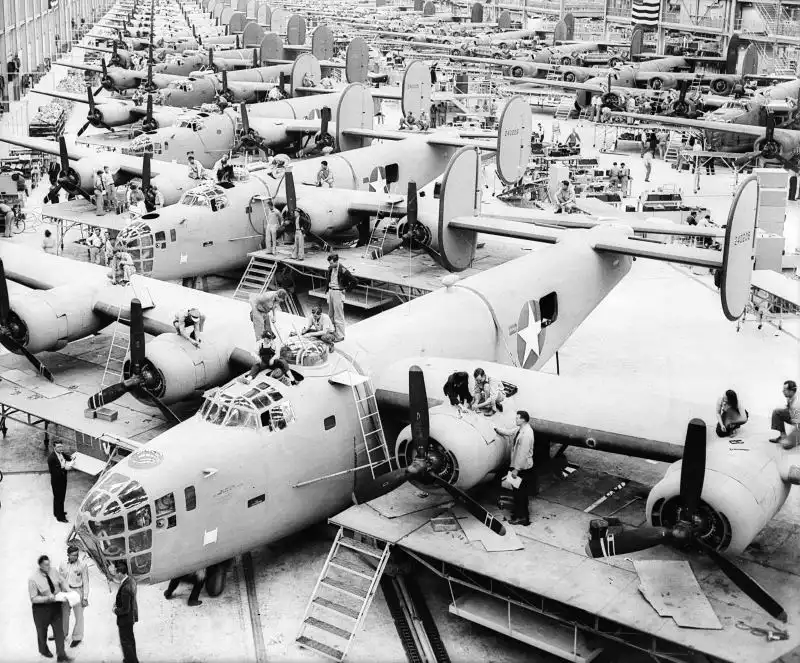
Consolidated B-24 Liberator Assembly Line (April 1943)
This striking archival photograph, dated April 1943, captures the staggering scale of American industrial mobilization during World War II. Inside a massive aviation plant in the United States, dozens of Consolidated B-24 Liberator heavy bombers stretch into the background in parallel assembly lines as factory technicians perform final fitting and wiring installation.
Preserved in the collection of the US Library of Congress, the photograph serves as an iconic visual symbol of the "Arsenal of Democracy," demonstrating the mass-production techniques that overwhelmed Axis industrial capacity.
Design Highlights and Production Records of the B-24
The Consolidated B-24 Liberator holds the historic distinction of being the most-produced American military aircraft in history:
- Record Mass Production: Between 1940 and 1945, a total of 18,482 B-24 airframes were constructed across five major manufacturing facilities, including Consolidated (San Diego and Fort Worth), Douglas, North American Aviation, and the massive Ford Motor Company plant at Willow Run, Michigan.
- Advanced Davis Wing Engineering: Unlike its predecessor, the B-17 Flying Fortress, the B-24 utilized a high-aspect-ratio Davis wing mounted high on the fuselage. This shoulder-mounted efficiency wing provided superior long-range cruising speed, higher payload capacity, and extended operational range across the Atlantic and Pacific wartime theaters.
- Twin-Tail Fuselage Design: The distinctive twin-oval vertical stabilizers provided enhanced directional control and stability when flying heavy bombing missions at high altitudes or operating with asymmetric power following engine failure.
- Pratt & Whitney Powerplants: Each heavy bomber was powered by four 14-cylinder Pratt & Whitney R-1830 Twin Wasp radial engines fitted with General Electric turbosuperchargers.
Industrial Impact on the Allied War Effort
The rapid assembly methods pioneered during B-24 production transformed wartime manufacturing:
- Automotive Assembly Techniques: Automotive giant Ford introduced continuous-flow assembly line principles to heavy bomber manufacturing at Willow Run, reaching peak production rates of nearly one B-24 rolling off the line every hour.
- Global Theater Service: B-24 Liberators served extensively in every combat theater, playing decisive roles in anti-submarine maritime patrols in the Battle of the Atlantic, long-range strategic bombing over Europe, and massive logistics transport missions across the Pacific.
📍 Location: United States (Consolidated / Ford Aircraft Plant)
📅 Date: April 1943
📷 Photographer: Office of War Information (OWI) / Unknown
📰 Primary Source: US Library of Congress Prints and Photographs Division
Recommended reading:
- Mass production technology at the Ford Willow Run B-24 Bomber Plant
- Aerodynamic design and efficiency of the high-aspect-ratio Davis Wing
- Combat history of the Consolidated B-24 Liberator in European and Pacific theaters
- The logistics of the US Office of War Information (OWI) photography program