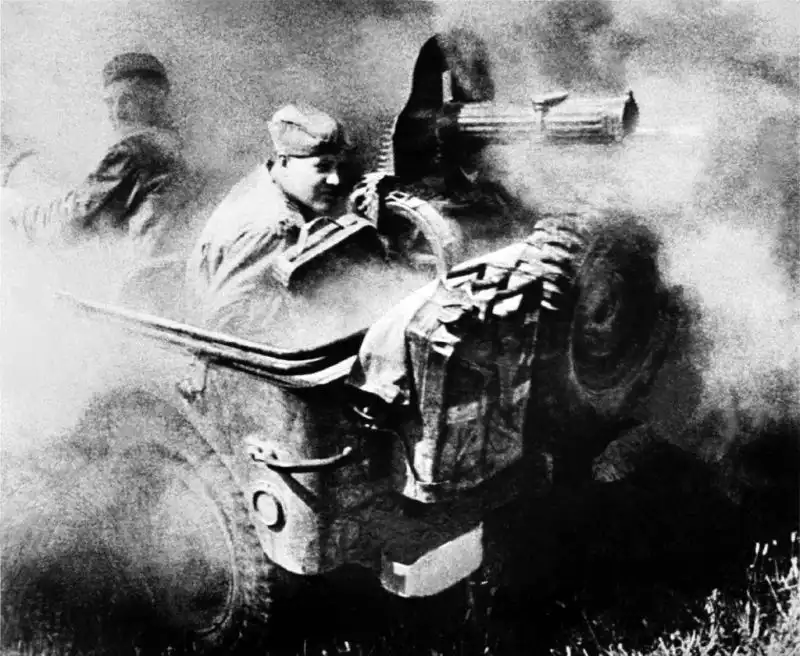
Soviet soldiers operating a Maxim machine gun mounted on a Willys Jeep in 1944. A WWII image showing Lend-Lease mobility and frontline adaptation.
A Mobile Firepower Snapshot
This photograph shows Senior Sergeant Andrey Pankov and Corporal Stepan Ovcharenko operating a Maxim machine gun mounted on a Willys jeep in Northern Transylvania in 1944.
The image captures a striking example of battlefield improvisation: a classic Russian heavy machine gun mounted on a fast American vehicle. It perfectly illustrates the adaptability that often determined success on the Eastern Front.
The Unit and Command
The crew belonged to a machine-gun company commanded by Guards Senior Lieutenant I. G. Kulikov.
- 4th Separate Motorcycle Regiment
- Later redesignated as the 4th Guards Motorcycle Regiment
The regiment served within highly mobile Red Army formations tasked with reconnaissance, pursuit, and rapid exploitation of breakthroughs.
Operational Context
The photograph was taken during Soviet operations in Northern Transylvania in 1944. The motorcycle regiment was attached to the 6th Guards Tank Army, one of the Red Army's elite armored formations participating in the liberation of Eastern Europe.
Tank armies depended heavily on fast reconnaissance and flexible fire support, making improvised weapon platforms especially valuable.
The Maxim Machine Gun
The famous Maxim M1910 remained one of the Red Army's most dependable heavy machine guns throughout the war.
- Water-cooled barrel
- Exceptional reliability
- High sustained rate of fire
- Excellent defensive fire capability
Although normally employed from prepared positions, mounting it on a jeep transformed the weapon into a surprisingly mobile support platform.
The Willys MB Jeep
The machine gun is installed on an American Willys MB supplied under the Lend-Lease program.
The jeep offered several important advantages:
- High mobility
- Excellent cross-country performance
- Simple maintenance
- Mechanical reliability
Beginning in 1942, tens of thousands of Willys jeeps were delivered to the Soviet Union, where they became indispensable transport and reconnaissance vehicles.
Lend-Lease and Soviet Mobility
This photograph demonstrates how Lend-Lease equipment became fully integrated into Soviet combat operations.
American-built vehicles increased the mobility of Soviet formations and allowed crews to combine foreign transport with domestic weapons in practical battlefield configurations.
Such cooperation significantly enhanced operational flexibility during the final offensives of the war.
Tactical Advantages
Installing a Maxim on a jeep provided several important benefits:
- Rapid redeployment
- Flexible fire support
- Quick engagement of enemy targets
- Fast withdrawal after firing
This combination proved especially effective during mobile offensive operations against retreating German and Hungarian forces.
Fighting in Northern Transylvania
During the autumn of 1944, Northern Transylvania became an active battlefield as Soviet and Romanian forces advanced against German and Hungarian defenders.
The varied terrain demanded mobility and rapid adaptation, qualities perfectly illustrated by this improvised fighting vehicle.
Battlefield Improvisation
The weapon mount seen in the photograph was not a factory-designed system. It was created by soldiers responding to immediate battlefield needs.
Such improvisations were common during World War II, when practical experience often produced effective solutions faster than military industry could develop standardized equipment.
Historical Photograph Information
Location: Northern Transylvania, Hungary (present-day Romania)
Date: 1944
Photographer: Anatoly Egorov
Sources
- Frontline Illustration, No. 21 (93), October 1944
- pamyat-naroda.ru
- tankfront.ru
Recommended Literature
- David Glantz & Jonathan House — When Titans Clashed
- Catherine Merridale — Ivan's War
- Richard N. Armstrong — Red Army Tank Commanders
- John Erickson — The Road to Berlin