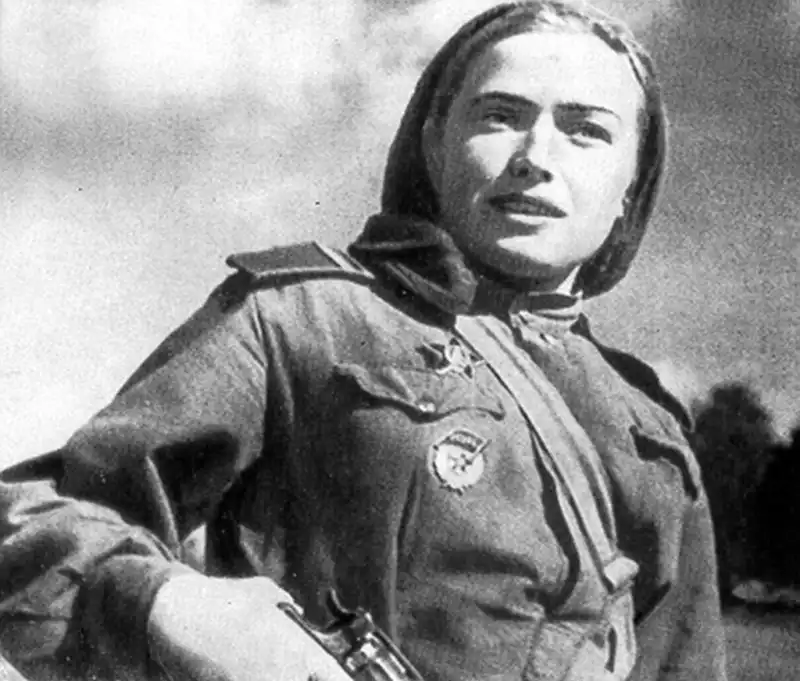
Soviet female medic sergeant with a Nagant revolver and Red Star medal. A powerful WWII image showing frontline bravery and sacrifice.
A Rare and Powerful Image
This photograph shows a young female junior sergeant of the Soviet Guards, serving as a frontline combat medic during World War II.
She carries:
- A medical satchel over her shoulder
- A Nagant revolver for self-defense
And on her chest:
- The Guards badge
- The Order of the Red Star
This is not just a portrait — it is a symbol of survival, courage, and duty.
Women in the Red Army
The Soviet Union mobilized hundreds of thousands of women during the war.
They served as:
- Medics
- Snipers
- Pilots
- Signal operators
Unlike many other armies of the time, women in the Red Army served directly in frontline combat zones.
The Role of a Combat Medic
A frontline medic had one of the most dangerous jobs in the war.
Their duties included:
- Rescuing wounded soldiers under fire
- Providing emergency treatment
- Evacuating casualties from the battlefield
Although many medics were unarmed, others carried sidearms for self-defense, as seen in this photograph.
The Weapon – Nagant Revolver
The Nagant revolver was a standard sidearm in the Red Army.
- Reliable
- Simple
- Effective at close range
For a combat medic, it represented a last means of protection when working under enemy fire.
The Award – Order of the Red Star
The presence of the Order of the Red Star is particularly significant.
It was awarded for:
- Personal bravery
- Combat merit
- Exceptional service in battle
A medic receiving this decoration indicates repeated acts of courage under combat conditions.
The Guards Status
The Guards badge denotes service in an elite Soviet military formation.
Guards units were recognized for:
- Outstanding combat performance
- Battle experience
- Heroism
This woman served in one of these distinguished formations.
Order No. 281
Her award corresponds with the criteria established by Order No. 281, issued on August 23, 1941.
According to the order:
- 15 wounded evacuated — Medal
- 25 wounded evacuated — Order of the Red Star
- 40 wounded evacuated — Order of the Red Banner
- 80 wounded evacuated — Order of Lenin
This suggests she may have evacuated at least 25 wounded soldiers from the battlefield under fire.
Not Just a Medic
This photograph challenges common stereotypes.
She was:
- A rescuer
- A soldier
- A decorated veteran
She was an active participant in frontline combat, not merely a support figure.
The Reality of Frontline Medicine
Saving lives in combat required extraordinary courage.
- Crawling under machine-gun fire
- Carrying wounded soldiers to safety
- Working despite artillery, snipers, and air attacks
Many combat medics were killed while attempting to rescue others. Those who survived earned their decorations through exceptional bravery.
A Human Story Behind the Uniform
Her name remains unknown, but the photograph tells an important story.
- She fought
- She saved lives
- She survived long enough to receive military honors
This image preserves the memory of countless anonymous Soviet medical personnel who served on the front lines.
Historical Photograph Information
Location: USSR
Date: Unknown
Photographer: Unknown
Recommended Books on Women in WWII
1. The Unwomanly Face of War — Svetlana Alexievich
2. Women in War 1939–1945 — Mark J. Harris
3. Soviet Women in Combat — Anna Krylova
4. A Dance with Death — Anna Timofeeva-Egorova