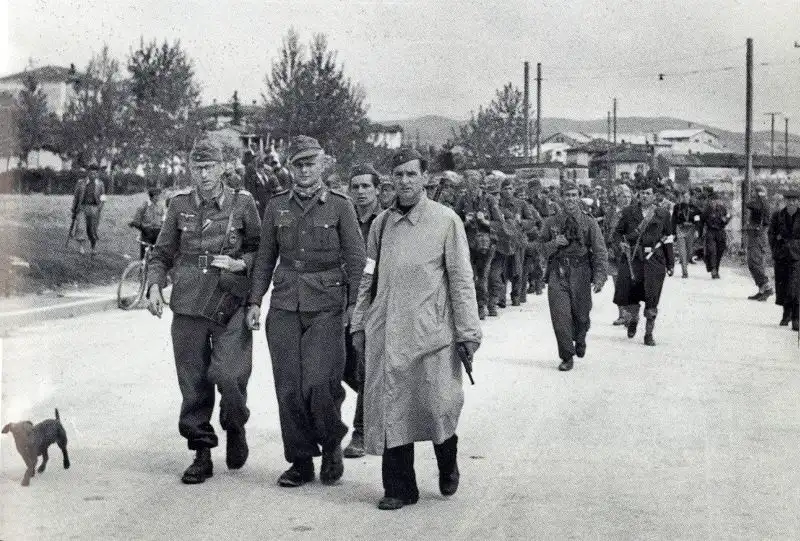
German POWs escorted by Yugoslav partisans in May 1945. A WWII image capturing the collapse of Nazi forces in Eastern Europe.
The End of the War in Europe:
This photograph shows a column of German prisoners of war being escorted by Yugoslav partisans in May 1945.
It captures one of the final moments of World War II in Europe:
👉 The defeated army
👉 The victorious resistance
The Forces – Yugoslav Partisans:
The guards belong to the Yugoslav Partisans, a powerful resistance movement that fought against Axis occupation.
Key characteristics of the partisans:
- Guerrilla warfare tactics
- Deep knowledge of local terrain
- Strong ideological motivation
By 1945, they had transformed into a structured military force.
From Resistance to Army:
Initially formed as small resistance groups, the partisans evolved into:
- A large, organized army
- Capable of conventional operations
- Supported by the Allies
They played a major role in liberating Yugoslavia.
The Prisoners:
The German soldiers in the image are:
- Disarmed
- Organized into a column
- Under armed escort
This reflects the total collapse of German military power in the region.
Improvised Army:
One striking detail:
👉 Some partisans wear civilian clothing
But with:
- Military insignia
- Captured weapons
This highlights the nature of partisan warfare:
- Limited resources
- Adaptation
- Use of enemy equipment
Weapons in the Hands of Partisans:
Many partisans were armed with captured German weapons, such as:
- Karabiner 98k
- MP 40
This allowed them to:
👉 Sustain combat without industrial supply chains
The Bigger Picture – End of World War II in Europe:
The image belongs to the final stage of the End of World War II in Europe.
By this time:
- Germany had lost on all fronts
- Allied forces were advancing from east and west
- Resistance movements gained control of territories
Liberation of Yugoslavia:
Yugoslavia experienced:
- Harsh occupation
- Intense partisan warfare
- Large-scale destruction
By May 1945:
👉 The occupiers were being captured, not advancing
A Reversal of Power:
Earlier in the war:
- German forces controlled large parts of Europe
- Resistance fighters were hunted
Now the roles were reversed:
👉 The occupiers became prisoners
War Without Uniforms:
The mix of civilian and military clothing in the image shows:
- The blurred line between soldier and civilian
- The total nature of the conflict
- How entire populations were drawn into war
Historical Photograph Information:
Location: Yugoslavia
Date: May 1945
Photographer: Unknown
Recommended Books on Yugoslav Partisans and WWII Balkans:
1. War and Revolution in Yugoslavia — Jozo Tomasevich
2. The Partisans — H. James Burgwyn
3. Bosnia and Herzegovina in World War II — Marko Attila Hoare
4. Tito and His Comrades — Jože Pirjevec