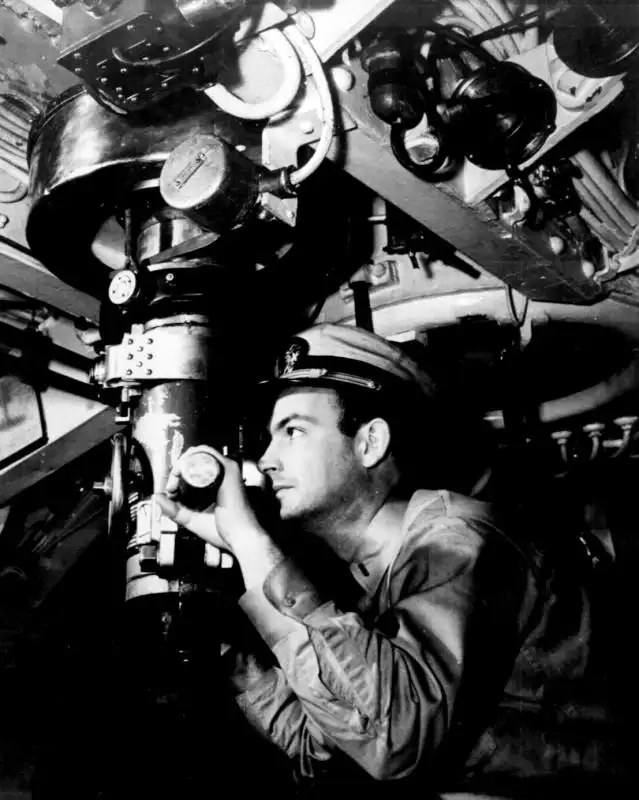
U.S. submarine officer Raymond Alexander at a periscope in 1942. A WWII image showing the silent tension of underwater warfare in the Pacific.
Silent Hunters Beneath the Waves:
This photograph shows U.S. submarine officer Captain Raymond W. Alexander observing the ocean surface through a periscope during World War II.
Inside the cramped control room of a combat submarine, every second matters.
No noise.
No room for error.
👉 Only detection… or death.
The Man at the Periscope – Raymond W. Alexander:
The officer in the image is Raymond W. Alexander, a U.S. Navy submariner operating in the Pacific Theater.
Submarine commanders and officers were responsible for:
- Target detection
- Attack decisions
- Navigation under extreme conditions
One mistake could mean:
👉 The loss of the entire crew
The Weapon of Choice – Periscope:
The Periscope was the submarine's primary "eye" above water.
It allowed the crew to:
- Scan for enemy ships
- Estimate distance and speed
- Prepare torpedo attacks
But it had a major limitation:
👉 It exposed the submarine's position
Submarine Warfare in the Pacific – Pacific War:
The image reflects the reality of submarine warfare during the Pacific War.
U.S. submarines played a crucial role in:
- Disrupting Japanese supply lines
- Sinking merchant vessels
- Targeting naval units
By the end of the war, they had:
👉 Severely weakened Japan's logistics
Life Inside a Submarine:
Conditions aboard WWII submarines were harsh:
- Extremely confined spaces
- Constant humidity and heat
- Limited fresh air
- Long patrols without sunlight
Every crew member lived with:
👉 Continuous psychological pressure
The Moment Before the Attack:
This photograph likely captures a critical phase:
- Searching for targets
- Tracking movement
- Preparing firing solutions
In submarine warfare:
👉 The attack begins with observation
Invisible Danger:
Submarines operated unseen, but they were never safe.
Threats included:
- Depth charges
- Enemy patrol ships
- Aircraft
Once detected, survival chances dropped dramatically.
Precision and Patience:
Submarine combat was not about speed —
It was about:
- Timing
- Stealth
- Accuracy
A successful strike required:
👉 Perfect calculation
A War Few Could See:
Unlike land battles or air combat, submarine warfare remained largely invisible.
But its impact was massive:
- Trade routes disrupted
- Supplies cut off
- Enemy war effort weakened
Historical Photograph Information:
Location: Pacific Ocean
Date: 1942
Photographer: Unknown
Recommended Books on Submarine Warfare:
1. Silent Victory — Clay Blair
2. Clear the Bridge! — Richard O'Kane
3. Thunder Below! — Eugene B. Fluckey
4. The War Below — James Scott