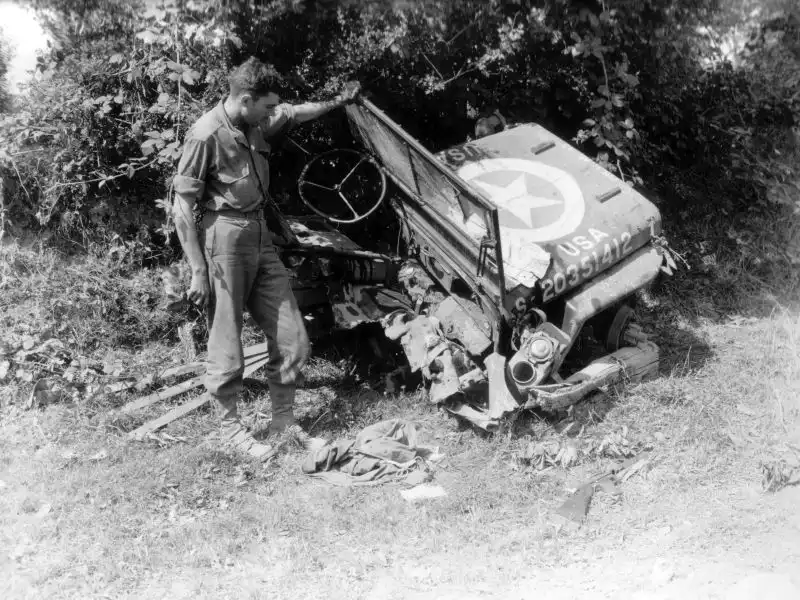
Wreckage of a Willys Jeep destroyed by a German anti-tank mine near Saint-Sever-Calvados, 1944. A stark WWII image of hidden battlefield dangers.
The Aftermath of an Invisible Threat:
This photograph shows the shattered remains of a U.S. Willys Jeep after hitting a German anti-tank mine on August 4, 1944, near Saint-Sever-Calvados, France.
There are no flames.
No smoke.
Only twisted metal scattered across the road — the silent result of a sudden explosion.
The Vehicle – Willys MB:
The destroyed vehicle is a Willys MB, one of the most iconic light utility vehicles of World War II.
It was widely used for:
- Transporting troops
- Delivering messages
- Reconnaissance missions
- Supply runs
Lightweight and fast, the Jeep was essential — but also extremely vulnerable.
The Weapon – Anti-Tank Mines:
The destruction seen in the image was caused by a German anti-tank mine.
These mines were designed to:
- Detonate under vehicle weight
- Destroy or disable armored and unarmored vehicles
- Disrupt movement along roads
Even a lightly armored vehicle like a Jeep stood no chance.
Normandy Campaign Context:
The incident occurred during the Battle of Normandy, following the Allied landings in June 1944.
By August:
- Allied forces were advancing inland
- German troops were retreating but leaving defenses behind
- Roads were heavily mined
Every movement forward carried risk.
Roads as Death Traps:
Mines turned ordinary roads into deadly zones.
Soldiers traveling through Normandy faced:
- Hidden explosives
- Booby traps
- Destroyed infrastructure
Even areas that seemed safe could become lethal in an instant.
Total Destruction:
The condition of the vehicle suggests a powerful explosion:
- The chassis is torn apart
- Components are scattered
- The structure is completely destroyed
This level of damage indicates that the blast occurred directly beneath the vehicle.
The Human Cost:
The photograph does not show the crew.
But the reality is clear:
👉 Survival in such explosions was unlikely
This absence makes the image even more unsettling.
What is missing tells the story.
A War of Hidden Dangers:
Unlike visible threats such as artillery or gunfire, mines were:
- Silent
- Invisible
- Indiscriminate
They did not require a soldier to be present.
They waited.
The Legacy of Mines:
Mine warfare left a long-lasting impact:
- Slowed military advances
- Caused casualties even after battles ended
- Required extensive postwar clearance
Even decades later, unexploded ordnance remained a danger in parts of Europe.
Historical Photograph Information:
Location: Saint-Sever-Calvados, France
Date: August 4, 1944
Photographer: Unknown
Source of the Photograph:
Recommended Books on Normandy and Mine Warfare:
1. The Battle for Normandy — Antony Beevor
2. Overlord: D-Day and the Battle for Normandy — Max Hastings
3. Fields of Death — Terry Copp
4. Mine Warfare on Land — Gordon L. Rottman