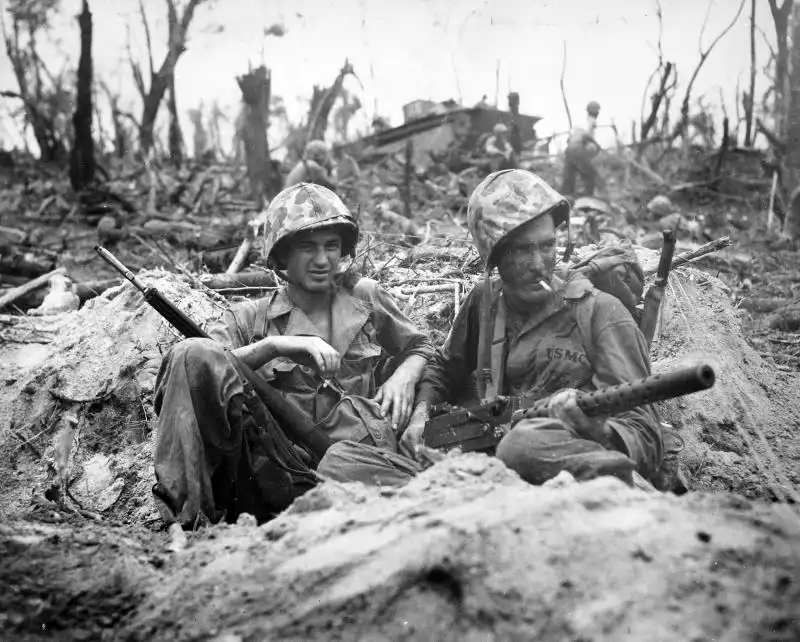
U.S. Marines resting after the Battle of Peleliu, 1944. A powerful WWII image showing exhaustion after one of the Pacific War’s bloodiest battles.
A Moment of Silence After Chaos
This photograph shows two U.S. Marines sitting and smoking after combat during the Battle of Peleliu on September 14, 1944.
Private Douglas Lightheart (right) and his companion Gerald Churchby pause for a brief rest.
No action.
No movement.
👉 Just exhaustion after survival.
The Battle – Battle of Peleliu
The image is tied to the Battle of Peleliu, one of the most brutal engagements in the Pacific Theater.
Peleliu was a small island:
- About 6 miles long
- Roughly 2 miles wide
Despite its size, it became the site of intense fighting.
Why Peleliu Mattered
The island was strategically important because:
- It contained a Japanese-built airfield
- It controlled access to the Palau island group
Capturing Peleliu meant:
👉 Securing Allied dominance in the region.
Two Weeks of Hell
The assault lasted approximately two weeks, but the fighting was:
- Extremely intense
- Close-range
- Relentless
Japanese defenders used:
- Fortified cave systems
- Hidden firing positions
- Defensive tactics designed to inflict maximum casualties
The Human Cost
The battle became one of the bloodiest in the Pacific relative to its size.
For the Marines:
- Heavy casualties
- Physical exhaustion
- Psychological strain
This photograph captures what comes after:
👉 Survival.
The Vehicle in the Background – LVT(A)-1
In the background, an amphibious vehicle is visible, likely an LVT(A)-1 or a related variant.
These vehicles were used for:
- Amphibious assaults
- Supporting infantry during landings
- Providing firepower
Depending on the version, they were armed with:
- 37 mm gun or 75 mm howitzer
- Multiple machine guns
After the Fighting
The photograph was taken during the mopping-up phase, when remaining Japanese resistance was being eliminated.
Even after the main assault:
- Fighting continued
- Hidden defenders remained dangerous
- The island was not fully secure
War and Exhaustion
The image shows something often overlooked:
- Not the battle itself
- But what comes after
Two men sitting, smoking—
👉 Processing what they just lived through.
No Victory Poses
Unlike staged propaganda images:
- No celebration
- No raised flags
- No dramatic gestures
Only fatigue.
And maybe relief.
Historical Photograph Information
Location: Peleliu, Palau Islands
Date: September 14, 1944
Photographer: Unknown
Source
Recommended Books on the Pacific War
1. With the Old Breed — Eugene B. Sledge
2. Helmet for My Pillow — Robert Leckie
3. The Conquering Tide — Ian W. Toll
4. Peleliu 1944 — Gordon L. Rottman