An 85 mm Soviet anti-aircraft gun stands ready to engage German armor in Tula during one of the most dangerous moments of the Battle of Moscow.
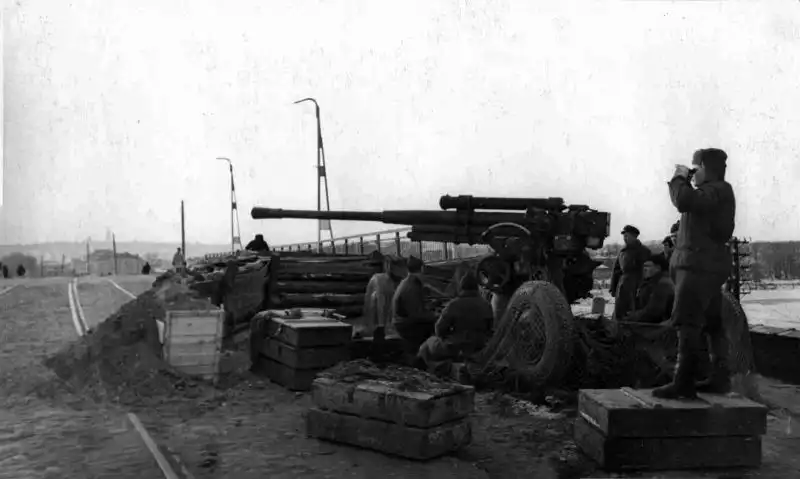
This striking photograph captures a Soviet 85 mm Model 1939 (52-K) anti-aircraft gun deployed on Proletarsky Bridge in the city of Tula during October 1941.
Although designed to destroy enemy aircraft, the gun has been placed in a prepared firing position aimed at ground targets. The crew is waiting for the possible appearance of advancing German armored vehicles as the Wehrmacht pushes toward Moscow.
The image reflects the desperate atmosphere of the autumn battles of 1941, when every available weapon was pressed into service to stop the German advance.
Tula: The Southern Shield of Moscow:
In October 1941, German forces launched Operation Typhoon, the massive offensive intended to capture Moscow before winter.
The city of Tula occupied a vital position south of the Soviet capital. If German troops succeeded in capturing it, they could threaten Moscow from the south and disrupt important Soviet communications and supply routes.
As the front approached the city, Tula rapidly transformed into a fortress. Defensive lines were constructed, factories were mobilized for wartime production, and anti-aircraft units prepared to fight not only aircraft but also tanks and infantry.
The defense of Tula became one of the key episodes of the Battle of Moscow.
The Powerful 85 mm 52-K:
The weapon shown in the photograph is the Soviet 85 mm 52-K anti-aircraft gun, introduced in 1939.
It was among the most capable Soviet heavy anti-aircraft guns of the war and was designed to engage high-altitude bombers. Its powerful shell and high muzzle velocity also made it effective against armored targets.
When German tanks threatened Soviet cities during 1941, commanders frequently deployed heavy anti-aircraft guns in direct-fire roles. Similar tactics had already proven successful in several battles where anti-aircraft artillery was used to stop armored breakthroughs.
The 52-K possessed enough firepower to penetrate the armor of most German tanks encountered during the first years of the war.
Waiting for the Panzers:
The photograph shows the gun positioned on Proletarsky Bridge, a likely avenue of approach for German forces.
The firing position appears carefully prepared. Sandbags and field fortifications surround the weapon, providing at least limited protection for the crew against small-arms fire and shell fragments.
Unlike anti-aircraft combat, where targets move through the sky, engaging tanks required the crew to fight in direct line of sight. Such battles were extremely dangerous. Once a gun opened fire, it immediately became a priority target for enemy artillery and tank crews.
Every member of the gun crew understood that if German armor appeared, they would be among the first defenders to engage it.
The Budenovka Helmets:
One of the most interesting details visible in the photograph is the headgear worn by several crew members.
The soldiers appear to be wearing winter helmets known as the Budenovka, a distinctive piece of military clothing associated with the Red Army of the Civil War era.
Officially introduced in the early years of Soviet military history, the Budenovka remained in use for a surprisingly long time despite gradually being replaced by more practical winter headgear.
Its presence in October 1941 illustrates the severe logistical pressures faced by the Soviet Union during the first months of the German invasion. Frontline units often used whatever equipment was available, regardless of whether it represented the latest standard issue.
The Defense That Held:
German forces never succeeded in capturing Tula.
The city's defenders, supported by Red Army formations and local volunteers, resisted repeated attacks and prevented German troops from achieving a breakthrough.
The successful defense of Tula played an important role in frustrating German plans during Operation Typhoon. When the Soviet winter counteroffensive began in December 1941, the Wehrmacht was already exhausted and unable to achieve its objective of taking Moscow.
Photographs such as this one preserve the memory of those tense days when anti-aircraft gunners stood ready to fight tanks on the streets and bridges of Soviet cities.
Photo Details:
📍 Location: Tula, USSR
📅 Date: October 1941
📷 Photographer: Anatoly Garanin
Recommended Reading:
- David M. Glantz — Barbarossa Derailed: The Battle for Smolensk and the Road to Moscow
- David Stahel — Operation Typhoon: Hitler's March on Moscow
- John Erickson — The Road to Stalingrad
- Rodric Braithwaite — Moscow 1941: A City and Its People at War
- Steven J. Zaloga — Moscow 1941: Hitler's First Defeat
- Aleksei Isaev — The Battle for Moscow