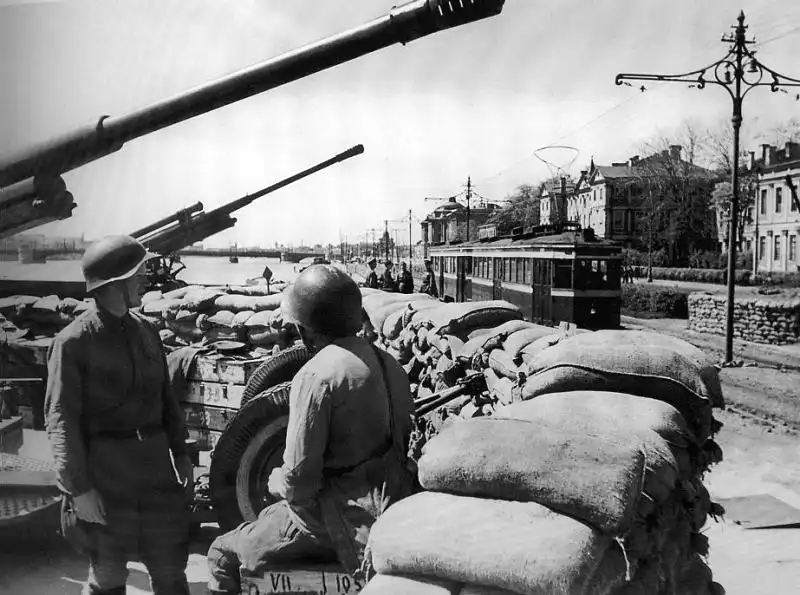
A Soviet battery of 85mm 52-K anti-aircraft guns positioned on the Neva embankment in Leningrad, June 1942. The image shows the city’s air defense during the siege.
Defending the Sky Over Leningrad:
This photograph shows a Soviet anti-aircraft battery equipped with 85mm 52-K guns, deployed along the University Embankment of the Neva River in besieged Leningrad.
Commanded by Senior Lieutenant Ibatulin, the battery was part of the city's layered air defense system, tasked with protecting Leningrad from constant Luftwaffe air raids.
Positioned within the city itself, these guns were a visible and vital line of defense against aerial bombardment.
The 85mm 52-K Anti-Aircraft Gun:
The 52-K (Model 1939) was one of the most effective Soviet anti-aircraft weapons of World War II.
Key features:
- Caliber: 85 mm
- High-altitude engagement capability
- Effective against both aircraft and ground targets
- Rapid rate of fire for its class
The gun was comparable to the famous German 88 mm Flak, and in some cases, it was even used in a similar dual-role capacity—engaging both aircraft and armored targets.
Air Defense During the Siege:
Leningrad was subjected to continuous air raids throughout the siege. The Luftwaffe targeted:
- Industrial facilities
- Transportation infrastructure
- Civilian districts
To counter this threat, the city developed an extensive air defense network that included:
- Anti-aircraft artillery batteries
- Searchlights and observation posts
- Fighter aircraft support when available
Batteries like the one in this photograph played a crucial role in limiting the effectiveness of German bombing campaigns.
Fighting From Within the City:
Unlike many battlefields, Leningrad's defenses were integrated directly into the urban environment.
Anti-aircraft guns were often placed:
- Along river embankments
- On rooftops and open squares
- Near key infrastructure and government buildings
This positioning allowed for better coverage but also meant that gunners operated under constant danger, often becoming targets themselves during air raids and artillery shelling.
More Than Just Air Defense:
The 52-K guns were not limited to anti-aircraft roles.
In extreme situations, they could be used against:
- Enemy ground forces
- Light and medium armored vehicles
- Fortified positions
This versatility made them a valuable asset in the defense of Leningrad, where every available weapon had to serve multiple purposes.
A City That Refused to Fall:
This image represents more than just military hardware—it symbolizes the determination of Leningrad's defenders.
Despite relentless bombing, starvation, and isolation, the city maintained an active defense system that protected both its people and its remaining infrastructure.
The presence of these guns along the Neva stands as a testament to the resilience and organization of a city under siege.
Historical Photograph Information:
Location: Leningrad, USSR
Date: June 1942
Photographer: Vsevolod Tarasevich
Source: photo.rgakfd.ru
Recommended Books on Air Defense and the Siege of Leningrad:
1. The 900 Days: The Siege of Leningrad — Harrison E. Salisbury
Classic account covering both civilian life and military defense.
2. Leningrad: State of Siege — Michael Jones
Detailed narrative of survival and defense efforts.
3. Leningrad: The Epic Siege of World War II — Anna Reid
Modern historical analysis with rich context.
4. Soviet Anti-Aircraft Artillery of WWII — Steven J. Zaloga
Technical and operational study of Soviet AA systems.