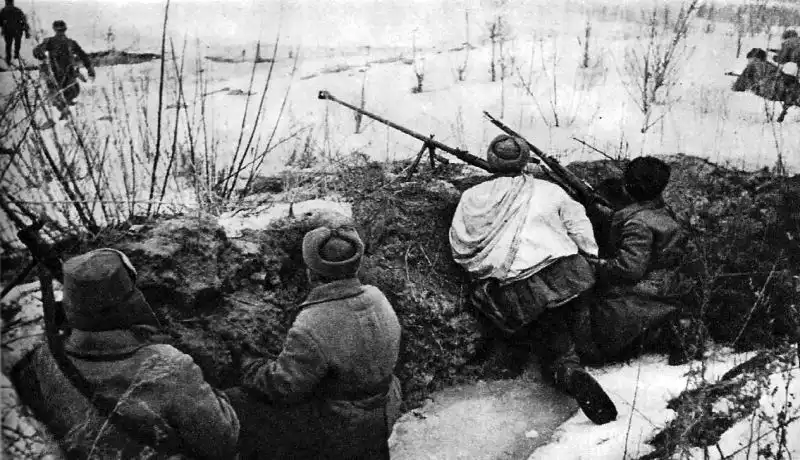
Soviet soldiers armed with anti-tank rifles, Mosin-Nagant rifles, and DP-27 machine guns wait in defensive trenches near Kharkov on March 16, 1943. The photograph captures the tense atmosphere during the Third Battle of Kharkov, as Red Army troops prepared to repel an expected German attack.
Waiting for the Enemy
This photograph shows Soviet infantry occupying defensive trenches near Kharkov during one of the most critical phases of the Third Battle of Kharkov in March 1943. The soldiers quietly wait for the next German assault, their weapons already positioned and their attention fixed on the front.
Armed with 14.5 mm anti-tank rifles, Mosin-Nagant rifles, and DP-27 light machine guns, these troops represent the standard composition of Red Army infantry units during the middle years of the war. The image captures not combat itself, but the tense moments beforehand, when preparation and discipline often determined survival.
Weapons of the Red Army Infantry
The soldiers carry several of the Soviet Union's most widely used infantry weapons, each designed to fulfill a specific battlefield role.
- Mosin-Nagant rifle – the standard bolt-action service rifle, valued for its durability, simplicity, and long-range accuracy.
- DP-27 light machine gun – providing sustained suppressive fire to protect advancing or defending infantry.
- 14.5 mm anti-tank rifles – powerful weapons capable of defeating lightly armored vehicles, armored cars, and the weaker armor of early-war German tanks.
Together, these weapons allowed Soviet infantry units to engage enemy infantry while retaining a limited capability against armored vehicles without relying entirely on artillery support.
The Third Battle of Kharkov
The photograph was taken during the Third Battle of Kharkov, fought between February and March 1943. Following the Soviet victory at Stalingrad, Red Army forces launched a major offensive that liberated Kharkov and several surrounding cities. However, German forces under Field Marshal Erich von Manstein soon organized a powerful counteroffensive.
During these operations:
- Soviet formations advanced rapidly after the collapse of German positions following Stalingrad.
- Kharkov was temporarily recaptured by the Red Army.
- German armored forces launched a successful counterattack that forced Soviet troops to withdraw.
- New defensive lines were established east of the city near the Seversky Donets River.
The fierce fighting around Kharkov became one of the last major German operational victories on the Eastern Front before Soviet strategic superiority gradually became overwhelming.
Life Inside the Trenches
Although the Second World War is often associated with tanks, aircraft, and fast-moving offensives, trench warfare remained a constant reality across much of the Eastern Front. Infantry soldiers frequently spent days or weeks occupying defensive positions while waiting for enemy attacks.
Daily responsibilities included:
- Maintaining constant observation of enemy positions.
- Repairing trench systems damaged by artillery fire.
- Preparing anti-tank defenses.
- Enduring cold weather, mud, and shortages of supplies.
- Remaining ready to respond immediately to infantry or armored assaults.
For many soldiers, long periods of anxious waiting were interrupted only by brief but extremely violent engagements.
Holding the Line
The men shown in this photograph symbolize the determination of the Red Army during one of the most difficult periods of 1943. After advancing rapidly across eastern Ukraine, Soviet forces suddenly found themselves defending against an experienced and aggressive German counteroffensive.
Despite suffering heavy casualties and temporarily losing Kharkov, these defensive actions slowed the German advance and prevented a broader collapse of the front. The experience gained during these battles helped prepare Soviet commanders and troops for the decisive campaigns that followed later in 1943, including the Battle of Kursk.
This image reminds us that victory on the Eastern Front depended not only on dramatic offensives but also on countless ordinary soldiers who quietly waited in trenches, prepared to defend every position entrusted to them.
Historical Photograph Information
Location: Near Kharkov, Ukrainian SSR, Soviet Union
Date: March 16, 1943
Photographer: Unknown
Recommended Books on the Third Battle of Kharkov and the Eastern Front
1. Kharkov 1943: The Wehrmacht Strikes Back — Lloyd Clark
A detailed examination of the Third Battle of Kharkov and the German counteroffensive that temporarily regained the city.
2. When Titans Clashed — David M. Glantz & Jonathan House
One of the best single-volume histories of the Soviet-German war, providing balanced analysis of operations on the Eastern Front.
3. The Battle of Kursk — David M. Glantz & Jonathan House
Explains how the fighting around Kharkov directly influenced the strategic situation leading to the Battle of Kursk.
4. Armageddon in Stalingrad — David M. Glantz
Examines the Soviet winter offensives of 1942–1943 and the military developments that culminated in the battles around Kharkov.