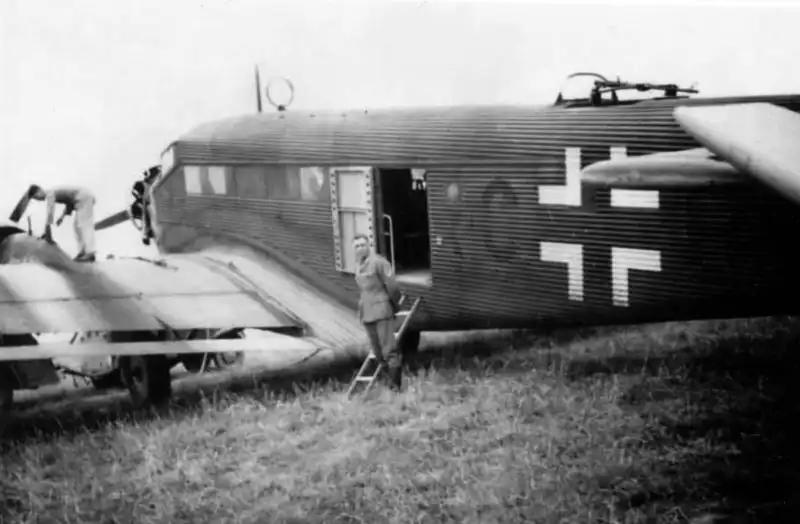
A Junkers Ju 52 stands at a Luftwaffe airfield in Germany while ground crew perform maintenance. The 1937 photograph highlights the aircraft’s role in pre-war aviation, emphasizing the technical expertise required to keep Germany’s most famous transport aircraft in service.
Ground Crew and the Legendary "Tante Ju"
This photograph shows a Junkers Ju 52 transport aircraft parked at a German Luftwaffe airfield in 1937, where mechanics are performing routine maintenance on its engines. Although attention often focuses on pilots, aircraft like the Ju 52 owed much of their reliability to the skilled ground crews responsible for inspection, repairs, and preparation before every flight.
By the late 1930s the Ju 52 had already earned the affectionate nickname "Tante Ju" ("Aunt Ju"), reflecting its dependable handling characteristics and remarkable ability to continue operating under difficult conditions.
Engineering Designed for Reliability
The Ju 52 became one of the world's best-known transport aircraft thanks to its simple but extremely durable design. Every aspect of the aircraft emphasized reliability, ease of maintenance, and the ability to operate from primitive airfields where sophisticated infrastructure was unavailable.
Distinctive features visible or associated with the aircraft include:
- Corrugated metal skin that strengthened the airframe while reducing structural weight.
- Three-engine configuration that increased operational safety if one engine failed.
- Large engine access panels that simplified maintenance and repairs.
- Fixed landing gear capable of operating from rough, unprepared landing fields.
These practical engineering solutions allowed the Ju 52 to remain in active service for decades, long after many contemporary aircraft had disappeared.
The Importance of Ground Maintenance
The image offers a rare glimpse into the work performed by aviation mechanics before World War II. Ground personnel inspected aircraft after every flight, searching for mechanical wear, oil leaks, damaged control surfaces, or engine problems before the next mission.
Their routine responsibilities included:
- Inspecting engines and propellers.
- Repairing worn or damaged components.
- Refueling and servicing aircraft systems.
- Preparing aircraft for scheduled flights.
- Ensuring operational safety before takeoff.
Although these tasks attracted little public attention, they formed the foundation of every successful flight. Without experienced maintenance crews, even the most advanced aircraft could not remain operational.
Early Radio Navigation Equipment
One interesting feature visible on this aircraft is the loop antenna of the radio direction finder (radio compass). During the 1930s, radio navigation represented one of the most significant technological advances in aviation.
This equipment enabled pilots to:
- Determine direction using radio beacons.
- Navigate during poor weather and low visibility.
- Improve long-distance flight accuracy.
- Reduce the risk of becoming lost on cross-country routes.
Although primitive compared to modern navigation systems, these radio compasses dramatically improved flight safety and helped establish reliable commercial air transport throughout Europe.
From Civil Aviation to Military Service
In 1937 the Ju 52 still maintained an important civilian role. It flew regular airline routes throughout Europe and served airlines in South America, Africa, and Asia. At the same time, Germany's expanding Luftwaffe increasingly incorporated the aircraft into military planning.
Many airfields during this period served both civilian and military purposes. Aircraft identical in appearance could transport airline passengers one day and participate in military exercises the next. This dual-use system reflected Germany's rapid rearmament during the second half of the 1930s.
Within only a few years, the Ju 52 would become indispensable for transporting troops, delivering supplies, evacuating wounded soldiers, and dropping airborne forces during campaigns across Europe, North Africa, and the Eastern Front.
A Calm Scene Before Global War
This peaceful maintenance scene contrasts sharply with the aircraft's future wartime service. In 1937 the mechanics seen here were simply carrying out routine inspections, unaware that the same aircraft type would soon become one of the Luftwaffe's primary transport workhorses.
Thousands of Ju 52s would eventually participate in major military operations including the invasions of Norway, the Low Countries, Crete, North Africa, and the Soviet Union. Throughout the conflict the aircraft earned a reputation for ruggedness, versatility, and reliability despite increasingly difficult conditions.
Today, photographs like this preserve not only the appearance of one of aviation's most recognizable aircraft, but also the largely unseen work of the technicians whose expertise kept it flying.
Historical Photograph Information
Location: Germany
Date: 1937
Photographer: Unknown
Recommended Books on the Junkers Ju 52 and German Aviation
1. Warplanes of the Third Reich — William Green
Comprehensive technical reference covering the development, production, and operational history of German military aircraft, including the Ju 52.
2. German Aircraft of the Second World War — J.R. Smith & Antony Kay
A detailed encyclopedia describing Luftwaffe aircraft specifications, variants, and operational use.
3. The Luftwaffe 1933–45 — Chris Bishop
An accessible overview of German air power from its formation through the Second World War.
4. Transport Aircraft of the Luftwaffe — Henry L. deZeng IV
A specialized study of German transport aviation, logistics, and the extensive wartime service of the Ju 52.