A column of T-34 tanks from the legendary 1st Guards Tank Brigade moves across the snowy front in a rare "tire-track" winter camouflage scheme.
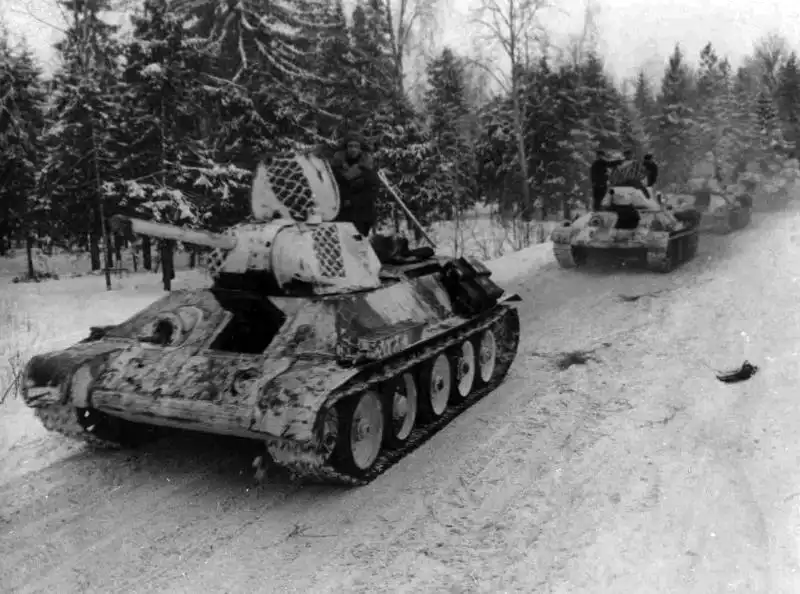
This remarkable wartime photograph shows a column of Soviet T-34-76 medium tanks from the famous 1st Guards Tank Brigade advancing across a snow-covered landscape during the winter of 1942.
At first glance, the image appears to depict a typical Soviet armored formation on the Eastern Front. A closer look, however, reveals one of its most fascinating details: the tanks are covered with an unusual winter camouflage pattern designed to blend into snowy terrain.
The photograph offers a rare glimpse into the practical field innovations employed by Soviet tank crews during one of the most difficult periods of the war.
The Legendary 1st Guards Tank Brigade:
The tanks belonged to the 1st Guards Tank Brigade, one of the most celebrated armored formations of the Red Army.
The brigade was commanded by Mikhail Katukov, one of the Soviet Union's most respected armored commanders. Under his leadership, the brigade distinguished itself during the desperate defensive battles of 1941 and later took part in the Soviet winter counteroffensive.
Katukov became famous for developing flexible defensive tactics that helped Soviet tank units survive and defeat German armored formations during the critical months of the war.
By February 1942, the Red Army had already halted the German advance on Moscow and was attempting to push the exhausted Wehrmacht back from the Soviet capital.
The Rare "Tire-Track" Camouflage:
The most striking feature of this photograph is the camouflage applied to the tanks.
Instead of simply covering the vehicles with a solid coat of white paint, Soviet crews created a distinctive striped pattern often referred to as "tire-track camouflage" or "scale camouflage."
The purpose was to break up the recognizable outline of the tank against snowy terrain. From a distance, the irregular dark stripes could resemble wheel ruts, shadows, or disturbed snow, making it more difficult for enemy observers to identify armored vehicles.
Because winter camouflage was usually applied quickly in field conditions using whatever materials were available, no universal pattern existed. As a result, photographs showing such elaborate paint schemes are relatively uncommon.
The T-34 in the Winter War of 1941–1942:
The T-34 was already proving itself to be one of the most effective tanks of the Second World War.
Its combination of sloped armor, wide tracks, mobility, and a powerful 76.2 mm gun gave Soviet tank crews significant advantages in difficult terrain, especially during winter operations.
Snow, ice, and freezing temperatures created enormous challenges for both sides. Vehicles often became immobilized, engines failed, and crews endured extreme weather conditions. Camouflage therefore became an important part of survival, helping tanks approach enemy positions while reducing the risk of detection.
The winter battles around Moscow demonstrated that the Red Army had recovered from the catastrophic losses of 1941 and was capable of conducting large-scale offensive operations.
A Symbol of Soviet Recovery:
This image captures an important moment in the war.
Only a few months earlier, German forces had been approaching Moscow itself. By February 1942, Soviet armored units were advancing through snow-covered battlefields as part of a growing counteroffensive.
The column of T-34s photographed here symbolizes more than military hardware. It reflects the Red Army's ability to regroup, adapt, and return to the offensive after surviving the most dangerous phase of the German invasion.
The unusual camouflage visible on these tanks serves as a reminder that victory on the Eastern Front depended not only on industrial production and battlefield courage, but also on countless practical innovations developed by soldiers and crews in the field.
Photo Details:
📍 Location: USSR
📅 Date: February 1942
📷 Photographer: Unknown
Recommended Reading:
- David M. Glantz — When Titans Clashed: How the Red Army Stopped Hitler
- Robert Forczyk — Tank Warfare on the Eastern Front 1941–1942
- Steven J. Zaloga — T-34 Medium Tank 1941–45
- Mikhail Baryatinskiy — T-34 in Action
- John Erickson — The Road to Stalingrad
- Boris Kavalerchik — The Tanks of Operation Barbarossa