A damaged Soviet T-26 tank and the bodies of its crew and tank riders during the desperate fighting near Daugavpils in the opening days of Operation Barbarossa.
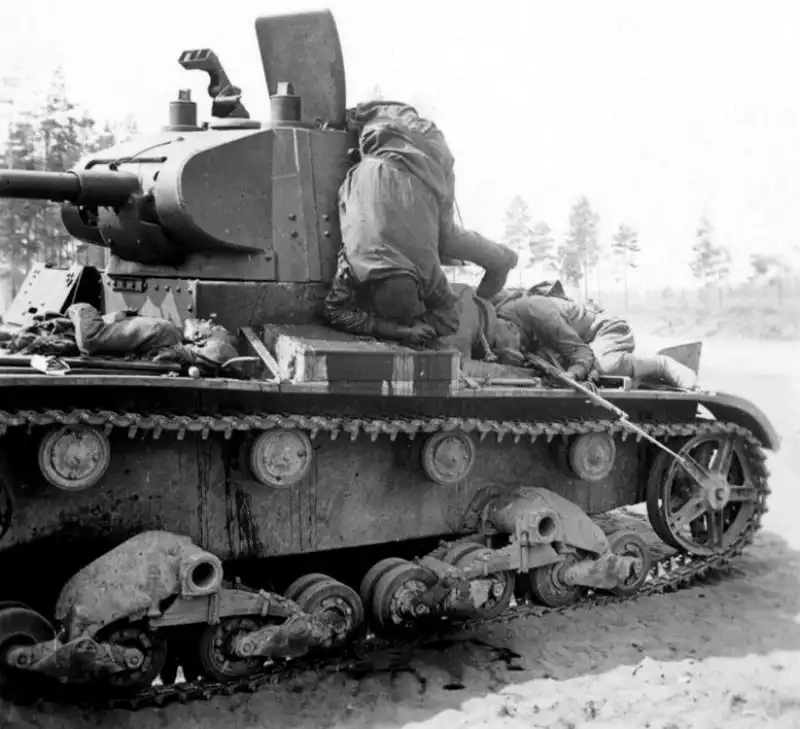
This haunting photograph captures one of the countless tragedies of the opening weeks of the German invasion of the Soviet Union.
The bodies of Soviet tank crewmen and infantrymen riding as tank desant troops lie atop a damaged T-26 light tank during the border battles of summer 1941. According to one version, the vehicle belonged to the 42nd Tank Division of the 21st Mechanized Corps and was knocked out near Daugavpils during a failed Soviet counterattack on 28 June 1941.
The image is a stark reminder of the enormous human cost paid by the Red Army during the first days of Operation Barbarossa.
The Battle for Daugavpils:
Following the launch of the German invasion on 22 June 1941, Army Group North advanced rapidly through the Baltic region toward Leningrad.
One of the key objectives was the capture of the strategically important bridges over the Daugava River near Daugavpils, then known as Dvinsk. German armored spearheads reached the area with remarkable speed, threatening to collapse Soviet defenses before reserves could be organized.
In response, Soviet mechanized formations launched a series of hurried counterattacks. Many of these attacks were conducted with incomplete information, limited coordination, and insufficient air support.
The fighting around Daugavpils became one of many desperate attempts to slow the German advance during the chaotic opening phase of the campaign.
The T-26 Light Tank:
The vehicle in the photograph is a T-26 light tank, one of the most numerous armored vehicles in Soviet service at the beginning of the war.
Originally developed from the British Vickers 6-Ton design, the T-26 had formed the backbone of Soviet armored forces throughout the 1930s. By 1941, however, it was already becoming obsolete.
Its armor was vulnerable to modern anti-tank weapons, and many vehicles suffered from mechanical wear after years of intensive service. Nevertheless, thousands of T-26 tanks remained in frontline units when Germany launched its invasion.
Despite its shortcomings, the T-26 continued to fight throughout the summer and autumn of 1941, often against overwhelming odds.
Tank Desant Troops:
The infantrymen visible on the tank were likely members of a tank desant detachment.
Tank desant tactics involved infantry soldiers riding on armored vehicles during attacks. This allowed infantry to keep pace with advancing tanks and rapidly dismount when combat began.
The method offered mobility but exposed soldiers to enormous danger. Any direct hit on the vehicle, machine-gun fire, artillery fragments, or anti-tank weapons could inflict severe casualties among the riders.
The photograph tragically illustrates the risks associated with this form of combat.
The Summer of Catastrophe:
The border battles of June and July 1941 resulted in some of the heaviest losses suffered by the Red Army during the entire war.
Many Soviet units fought with determination, but poor communications, surprise, air attacks, and rapid German maneuver warfare often left formations isolated and unsupported.
Thousands of tanks were destroyed, abandoned, or captured. Entire divisions ceased to exist within weeks.
Yet these sacrifices were not entirely in vain. The fierce resistance encountered by German forces during the opening phase of the invasion contributed to delays that would ultimately affect the course of the campaign.
A Silent Memorial:
Unlike photographs showing victory or celebration, this image preserves a moment of silence after combat has ended.
There are no visible signs of movement, no advancing troops, and no dramatic action. The battle is already over for the men lying upon the tank.
Today the photograph serves as a powerful memorial to the Soviet soldiers who fought and died during the desperate defensive battles of 1941. Their names are largely unknown, but their sacrifice formed part of the immense struggle that would eventually lead to the defeat of Nazi Germany.
Photo Details:
📍 Location: Daugavpils, USSR
📅 Date: Summer 1941
📷 Photographer: Unknown
Recommended Reading:
- David M. Glantz — Barbarossa: Hitler's Invasion of Russia 1941
- David Stahel — Operation Barbarossa and Germany's Defeat in the East
- Robert Forczyk — Tank Warfare on the Eastern Front 1941–1942
- John Erickson — The Road to Stalingrad
- Steven J. Zaloga — T-26 Light Tank: Backbone of the Red Army
- Evan Mawdsley — Thunder in the East: The Nazi-Soviet War 1941–1945