Detailed archival photograph from the summer 1942 Siege of Sevastopol showing a disabled German Pz.Kpfw. III Ausf. J medium tank equipped with a 50mm KwK 38 L/42 gun and thrown tracks.
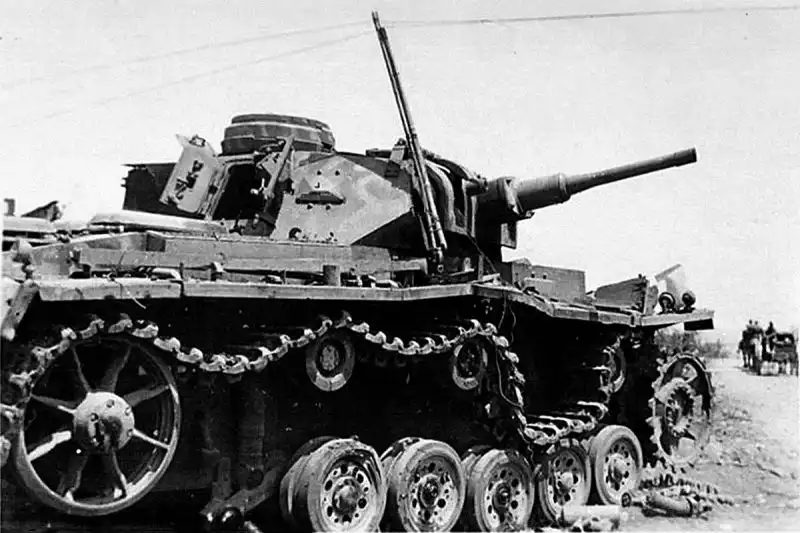
Disabled Panzer III Ausf. J Medium Tank During the Siege of Sevastopol (Summer 1942)
This striking archival photograph from the summer of 1942 captures a knocked-out German Panzerkampfwagen III Ausf. J (Sd.Kfz. 141) medium tank sitting immobilized during the final stages of the Battle of Sevastopol in Crimea. The vehicle belonged to armored units supporting Generalfeldmarschall Erich von Manstein's 11th Army during Operation Störfang (the assault on the Sevastopol Fortress).
The photograph provides an exceptionally clear close-up view of battle damage sustained to the tank's lower hull, suspension, and track assemblies under heavy Soviet artillery and anti-tank fire.
Technical Features and Identification Details
A detailed inspection of the armored vehicle confirms its specific production batch and field modification features:
- Variant Identification (Ausf. J Early Production): The presence of double-hatch side turret doors, redesigned vision ports, and an updated external gun mantlet identifies this model as an early-production Panzer III Ausf. J manufactured between March and December 1941.
- Armament (50mm KwK 38 L/42): The tank is equipped with the short-barreled 50mm KwK 38 L/42 main gun. The muzzle exhibits a protective muzzle cap or blank-firing attachment (Platzpatronengerät) fitted over the barrel tip.
- Suspension Damage: The drive sprocket, torsion bar suspension arms, and rubber-rimmed road wheels are severely distorted, causing the heavy steel track chain to shed completely onto the ground.
- Stowed Small Arms: Mounted vertically along the side of the turret stowage area is a captured Soviet Mosin-Nagant bolt-action rifle equipped with a socket bayonet.
The Crimean Campaign and Sevastopol Armor Operations
During the assault on the heavily fortified Sevastopol Defense Region in June and July 1942, German medium tank units faced dense minefields, coastal artillery, and rugged mountain terrain. Thin side armor (30mm) left the Panzer III vulnerable to Soviet 45mm anti-tank guns and PTRD/PTRS anti-tank rifles, leading to significant mechanical and combat attrition among Axis panzer formations in the Crimea.
📍 Location: Sevastopol, Crimean ASSR, Ukrainian SSR, USSR
📅 Date: Summer 1942
📷 Photographer: Unknown (German Army / Propaganda Company Archive)
📰 Primary Source: Central Archive of the Russian Ministry of Defense (CAMD) / Federal Archives of Germany (Bundesarchiv)
Recommended reading:
- Technical development of the Panzerkampfwagen III Ausf. J series
- Siege warfare tactics: The Axis assault on the Sevastopol Fortress (1942)
- Ballistic performance of the 50mm KwK 38 L/42 tank gun vs. Soviet armor
- German armored losses in the Crimean Campaign (Operation Störfang)