Archival November 1943 photograph depicting German fighter ace Heinrich Bartels leaning against the tail rudder of his Messerschmitt Bf 109 G-6 on Kalamaki Airfield, Greece, showing 70 victory tallies.
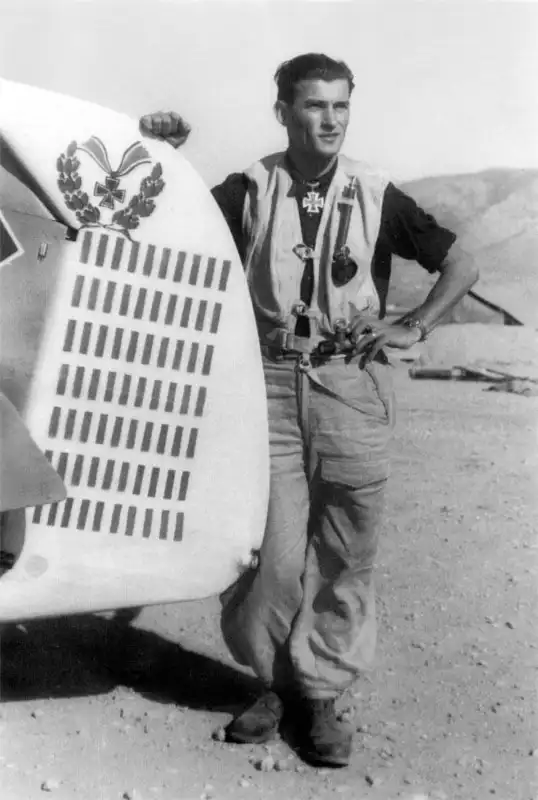
German Fighter Ace Heinrich Bartels at Kalamaki Airfield (November 1943)
This historic photograph from November 17, 1943, captures German fighter pilot Oberfeldwebel Heinrich Bartels (1912–1944) posing beside the vertical stabilizer and rudder of his Messerschmitt Bf 109 G-6 fighter aircraft at Kalamaki Airfield near Athens, Greece.
Assigned to 11. Staffel / Jagdgeschwader 27 (JG 27), Bartels was one of the Luftwaffe's leading fighter pilots operating in the Mediterranean Theater of Operations during late 1943 following earlier combat tours on the Eastern Front and in North Africa.
Tail Rudder Markings and Combat Career
The photograph offers a clear view of standard Luftwaffe fighter victory documentation and personal awards:
- Victory Markings (Abschussbalken): The white rudder of his Bf 109 G-6 features 70 individual vertical victory bars indicating confirmed aerial victories scored against Allied aircraft over the Eastern Front and the Mediterranean.
- Ritterkreuz Illustration: Painted above the tallies is a graphical representation of the Knight's Cross of the Iron Cross (Ritterkreuz des Eisernen Kreuzes) encircled by a laurel wreath, commemorating his official award on November 13, 1942.
- Personal Uniform and Survival Gear: Bartels wears a tropical flight combination along with a Model 10-30 B-2 inflatable life jacket (Schwimmweste) essential for over-water missions across the Aegean and Mediterranean Seas.
- Overall Victory Record: Over the course of approximately 500 combat sorties, Bartels was officially credited with 99 aerial victories (49 over the Eastern Front and 50 over Western Allied air forces).
Final Mission and Post-War Discovery
On December 23, 1944, during intense aerial engagements surrounding the Ardennes Offensive (Battle of the Bulge), Heinrich Bartels took off in his Messerschmitt Bf 109 G-10 (W.Nr. 130359) for a mission near Bonn. He failed to return after engaging US Army Air Forces P-47 Thunderbolt fighters from the 56th Fighter Group.
For twenty-three years he remained listed as missing in action (MIA). On January 26, 1968, the wreckage of his Bf 109 G-10 was accidentally uncovered during excavation work near Meckenheim, Germany, containing his undisturbed remains and unopened parachute, settling his wartime fate.
📍 Location: Kalamaki Airfield, Athens, Greece
📅 Date: November 17, 1943
📷 Photographer: Unknown (German Propaganda Company / Bundesarchiv Archive)
📰 Primary Source: Federal Archives of Germany (Bundesarchiv) / Imperial War Museum (IWM)
Recommended reading:
- Technical evolution and variants of the Messerschmitt Bf 109 G-6 fighter
- Operations of Jagdgeschwader 27 (JG 27) in the Mediterranean and Aegean Theaters (1943)
- Traditions and iconography of Luftwaffe victory markings (Abschussbalken)
- Air defense of the Reich: Western Allied strategic bombing raids vs. Luftwaffe fighters (1944)