Dramatic archival photograph from May 19, 1945, depicting the burning wreckage of the U.S. Army Air Forces B-29 Superfortress "Queen Cathy" following a landing accident on Guam after a raid over Tachikawa, Japan.
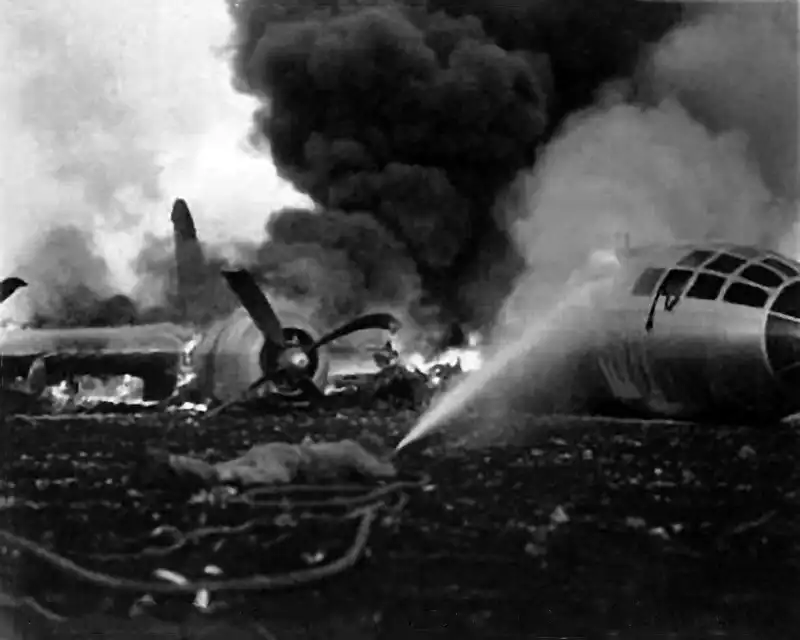
Crash Landing of B-29 Superfortress "Queen Cathy" on Guam (May 19, 1945)
This intense archival photograph, captured on May 19, 1945, records the catastrophic post-landing fire of a Boeing B-29 Superfortress heavy bomber (serial number 42-94053, named "Queen Cathy") assigned to the 39th Bombardment Group, 20th Air Force, stationed on the island of Guam.
During a daytime strategic daylight bombing mission against industrial targets in Tachikawa, Japan, the aircraft suffered severe engine malfunctions. Upon returning to its airfield on Guam, the damaged heavy bomber veered off the runway during landing, structural failure ensued, and fuel lines ignited a massive post-crash fire.
Incident Details and Aircraft History
The photograph captures the immediate emergency response and damage sustained by the heavy bomber:
- Fuselage Separation: The iconic pressurized glazed nose compartment of the B-29 has detached from the main fuselage, allowing firefighters to direct high-pressure water streams toward the burning midsection.
- Engine and Airframe Damage: Visible in the center frame is one of the four Wright R-3350 Duplex-Cyclone radial engines and the blazing wing structure submerged in thick black smoke.
- Casualties and Rescue: Airbase crash rescue personnel quickly responded to extinguish the blaze and extract the crew. Several crew members suffered severe burn injuries, and one aviator tragically succumbed to injuries sustained in the crash.
- Operational Record: Entering combat service on April 19, 1945, "Queen Cathy" completed 8 successful bombing missions over the Japanese mainland; the May 19 raid against Tachikawa marked its 9th and final combat sortie.
Strategic Role of Guam in the Pacific Air Campaign
Following the liberation of Guam, Tinian, and Saipan in mid-1944, the Marianas Islands were transformed into massive forward operating bases for XXI Bomber Command. Hundreds of B-29 Superfortress bombers flew round-trip missions exceeding 3,000 miles to strike industrial and military targets across Japan until the cessation of hostilities in August 1945.
📍 Location: Guam, Marianas Islands, Pacific Ocean
📅 Date: May 19, 1945
📷 Photographer: Unknown (U.S. Army Air Forces Official Photo / National Archives Archive)
📰 Primary Source: National Archives and Records Administration (NARA) / U.S. Air Force Historical Research Agency (AFHRA)
Recommended reading:
- Technical design and specifications of the Boeing B-29 Superfortress heavy bomber
- Air operations in the Marianas: 20th Air Force B-29 bases on Guam, Saipan, and Tinian
- Target analysis: Strategic bombing missions against Tachikawa industrial sites (1945)
- Emergency response and crash rescue procedures in USAAF Pacific Theater operations