Iconic June 1941 photograph depicting a disabled Red Army KV-1 heavy tank from the 2nd Tank Division covered in non-penetrating shell impacts following fierce combat against the German 6th Panzer Division near Raseiniai.
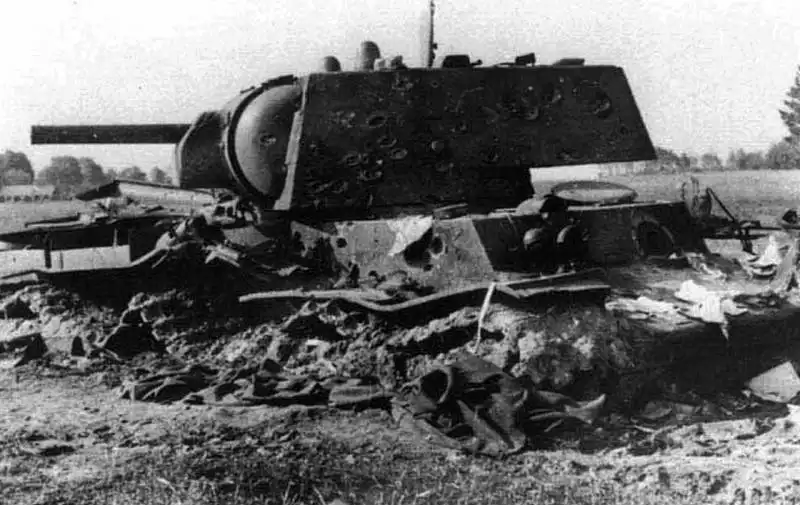
Soviet KV-1 Heavy Tank in the Battle of Raseiniai (June 1941)
This famous archival photograph from the summer of 1941 captures a disabled Soviet KV-1 Model 1940 heavy tank displaying dozens of non-penetrating anti-tank shell strikes across its turret and side hull plates. Believed to have belonged to the Red Army's 2nd Tank Division (3rd Mechanized Corps), this armored giant participated in the legendary Battle of Raseiniai in Lithuania during the opening days of Operation Barbarossa, engaging elements of the German 6th Panzer Division.
The image dramatically highlights the extreme technological shock experienced by Wehrmacht anti-tank crews when first encountering heavy Soviet armor on the Eastern Front.
Armor Inspection and Combat Engagement Details
A detailed technical review of the disabled vehicle demonstrates the formidable ballistic protection of early-war Soviet heavy tanks:
- Resilience Against Standard Anti-Tank Guns: The welded turret displays approximately 30 non-penetrating impact craters left by 3.7 cm PaK 36 and 5 cm KwK 38 anti-tank rounds, which were entirely incapable of piercing the 75mm primary armor reinforced with additional appliqué armor plates (KV-1E).
- Fatal Penetration by 88mm Flak: The fatal shell penetrations located along the middle section of the hull were inflicted by a high-velocity German 8.8 cm FlaK 18/36 anti-aircraft gun, which was brought into direct-fire position as the only weapon capable of neutralizing the heavy tank.
- Battlefield Context: Single or small groups of KV-1 and KV-2 tanks frequently blocked entire German advance routes, ambushing panzer columns and delaying divisional movements along critical road junctions.
- 76.2mm F-32 Tank Gun: The main armament, a 76.2mm F-32 tank gun, provided overwhelming firepower against contemporary German Pz.Kpfw. 35(t), Panzer III, and Panzer IV tanks.
Historical Impact of Soviet Heavy Armor in 1941
The engagements near Raseiniai forced the German High Command to fundamentally revise its tactical doctrines on the Eastern Front, accelerating the development of heavier anti-tank guns (7.5 cm PaK 40) and specialized armor piercing ammunition to counter Red Army heavy tanks.
📍 Location: Near Raseiniai, Lithuanian SSR, USSR
📅 Date: June 1941
📷 Photographer: Unknown (German Army / Propaganda Company Archive)
📰 Primary Source: Central Archive of the Russian Ministry of Defense (CAMD) / Federal Archives of Germany (Bundesarchiv)
Recommended reading:
- Armored engagements of Operation Barbarossa: The Battle of Raseiniai (June 1941)
- Technical design and armor protection of the KV-1 heavy tank series
- Combat history of the Red Army 2nd Tank Division (3rd Mechanized Corps)
- Anti-tank role of the German 8.8 cm FlaK 18/36 dual-purpose gun