German Opel Blitz 3.6S truck drives past a destroyed Soviet KV-2 from the 2nd Tank Division in 1941, showing fierce early-war armored combat.
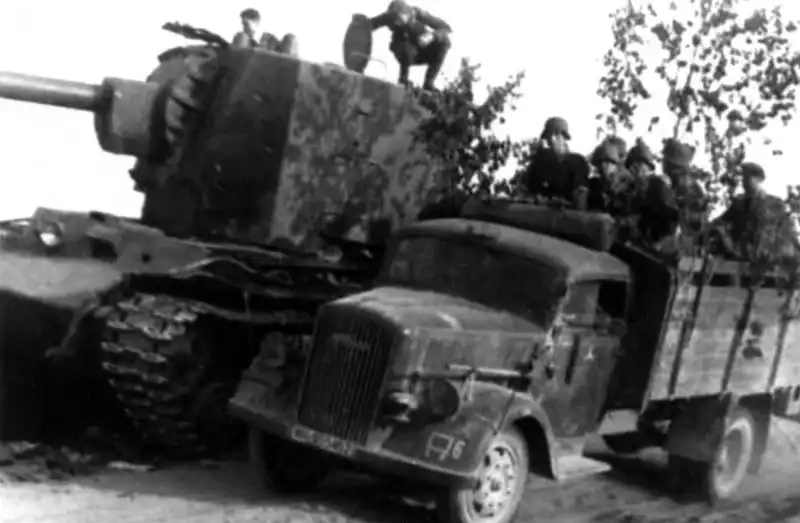
Opel Blitz Passing a Knocked-Out KV-2 (1941):
This wartime photograph shows a German Opel Blitz 3.6S truck, carrying infantry, driving past a knocked-out Soviet KV-2 heavy tank in the USSR in 1941. The contrast between the moving German vehicle and the immobilized Soviet giant captures a sharp moment from the chaotic armored battles of the first year of the war.
The KV-2 belonged to the 2nd Tank Division of the 3rd Mechanized Corps, 11th Army. According to available information, it managed to break through into the German rear and reach artillery positions, but was ultimately destroyed after a fierce engagement.
Photo Information:
- Location: USSR
- Date: 1941
- Photographer: Unknown
What the Photo Shows:
The image depicts:
- A German Opel Blitz 3.6S truck transporting infantry
- A KV-2 heavy tank, disabled and scarred by numerous shell impacts
- Visible battle damage concentrated on the turret
- Evidence of intense close-range combat
The KV-2 stands as a massive silhouette on the roadside, its heavy armor marked by repeated hits. At least one crew member was killed during the engagement.
The KV-2: A Heavy Assault Tank:
The KV-2 was one of the most formidable Soviet tanks in 1941:
Key Features:
- Extremely thick armor for its time
- Massive turret with a 152 mm howitzer
- Designed to destroy fortified positions
- Slow, mechanically unreliable, and difficult to maneuver
When functioning properly, it was almost immune to standard German anti-tank guns in early 1941. However, once immobilized, even a heavily armored tank could be systematically destroyed.
A Breakthrough into the Rear:
According to records, this KV-2:
- Belonged to the 2nd Tank Division, 3rd Mechanized Corps
- Broke through German lines
- Reached enemy artillery positions
- Engaged in a prolonged and intense fight
The numerous impact marks on the turret suggest that German forces concentrated fire on the tank, likely using heavier guns or close-range tactics to disable it.
Such actions were not uncommon in 1941, when individual Soviet heavy tanks sometimes caused serious disruption behind enemy lines, but often at enormous cost.
The Opel Blitz 3.6S:
The Opel Blitz 3.6S was one of the main logistical trucks of the German army:
- Used to transport infantry, ammunition, and supplies
- Highly mobile and reliable compared to many armored vehicles
- Essential for maintaining operational momentum
In this image, the truck passing the destroyed KV-2 symbolizes the continuation of German advance despite isolated acts of resistance.
The Reality of 1941 Armored Warfare:
The first year of the war on the Eastern Front was marked by:
- Rapid advances and counterattacks
- Mechanical failures and fuel shortages
- Tanks fighting in isolation
- Improvised solutions on both sides
Even powerful machines like the KV-2 could be lost due to:
- Mobility issues
- Lack of support
- Overwhelming concentrated fire
- Tactical isolation
Armor thickness alone could not guarantee survival.
Why This Photograph Matters:
This image is significant because it shows:
- A documented KV-2 from a specific division
- Evidence of a fierce engagement behind enemy lines
- The contrast between heavy armor and mobile logistics
- The brutal cost of breakthrough attempts in 1941
It captures both technical history and human sacrifice within a single frame.
Conclusion:
The photograph of a German Opel Blitz passing a knocked-out KV-2 in 1941 tells a layered story: a bold breakthrough attempt, a fierce firefight, and the destruction of one of the most powerful tanks of its time. Scarred by multiple impacts and left immobile, the KV-2 stands as a testament to both its strength and its vulnerability — and to the brutal, fast-moving nature of armored warfare in the opening year of the conflict.