Iconic August 1942 Bundesarchiv photograph showing a Soviet KV-1 heavy tank covered in dozens of shell impacts during the brutal early defensive battles of Stalingrad.
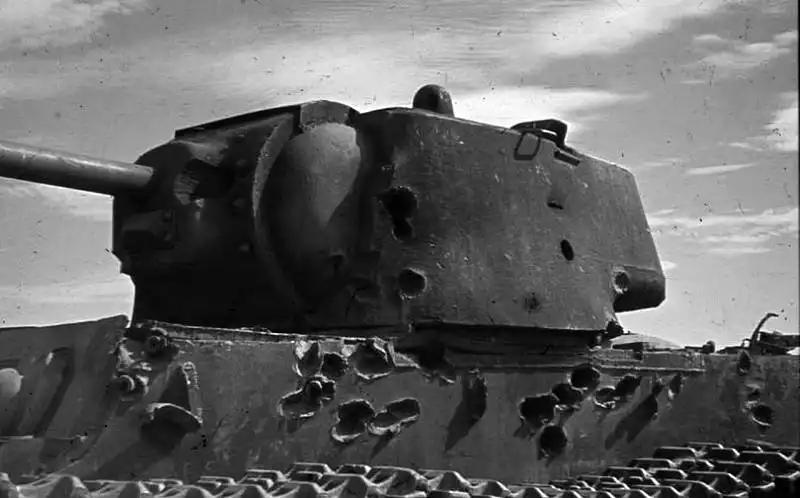
Battle-Damaged Soviet KV-1 Heavy Tank at Stalingrad (August 1942)
This famous wartime photograph from the German Federal Archives (Bundesarchiv Bild 169-0441), taken in August 1942 near Stalingrad, presents a dramatic close-up of a knocked-out Soviet KV-1 heavy tank covered in dozens of direct shell impacts.
During the opening phase of German Case Blue (Unternehmen Blau) and the approach to Stalingrad, heavy tanks like the KV-1 served as formidable steel fortresses, often holding up advancing Axis mechanized columns for hours under intense concentrated fire.
Armor Resilience and Anti-Tank Battle Analysis
The close-up detail of the vehicle's cast turret and upper hull side reveals the extreme tactical challenges faced by Wehrmacht anti-tank gunners in 1941–1942:
- Cast Turret Model (1941/1942): The tank features the late-style cast turret with 90mm-thick armor plates, designed to streamline production at Chelyabinsk Tractor Plant (ChTZ) and Uralmash.
- Multiple Non-Penetrating Hits: Dozens of deep gouges, scoops, and non-penetrating craters line the side hull armor plate. These were left by standard German 3.7 cm PaK 36 and 5 cm PaK 38 anti-tank rounds, which were largely incapable of penetrating thick KV-1 frontal and side armor at standard engagement distances.
- Fatal Penetrations: Among the shallower ricochets, several clean penetrations are visible along the lower turret ring and hull, likely inflicted by high-velocity 8.8 cm FlaK anti-aircraft guns or concentrated point-blank artillery fire.
- Tactical Burden on German Forces: Stopping a single KV-1 often required German troops to bypass the vehicle, isolate it from supporting infantry, and call in heavy artillery, 88mm dual-purpose guns, or Luftwaffe Stuka dive-bombers.
The Legacy of the KV-1 in the Defense of Stalingrad
Though heavy and prone to mechanical transmission failures, the extreme armor protection of the KV-1 played a vital role in slowing down the German 6th Army's advance toward the Volga River, buying crucial time for Red Army command to organize urban defenses inside Stalingrad.
📍 Location: Stalingrad, RSFSR, USSR
📅 Date: August 1942
📷 Photographer: Unknown (German Propaganda Company / PK Archive)
📰 Primary Source: German Federal Archives (Bundesarchiv Bild 169-0441)
Recommended reading:
- Heavy tank doctrine: Design evolution and combat history of the KV-1 heavy tank
- Anti-tank warfare: German tactical responses to heavily armored Soviet tanks in 1942
- Stalingrad Campaign: The summer defensive operations of the Red Army on the approaches to the Volga
- Metallurgy and armor: Cast vs. welded armor protection on Soviet mid-war tanks