Historic photograph of a Red Army soldier with a PPSh-41 submachine gun escorting a frostbitten German soldier during the end of the Battle of Stalingrad.
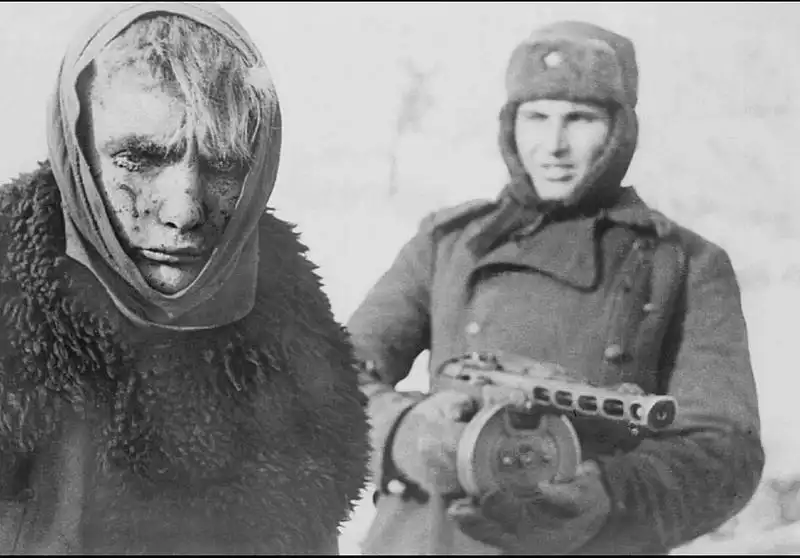
Soviet Soldier Escorts a Frostbitten German Prisoner in Stalingrad (Winter 1943)
This iconic photograph captures the tragic finale of the Battle of Stalingrad in January–February 1943. A Red Army escort, armed with a 7.62mm PPSh-41 submachine gun, marches behind a captured German soldier covered in ice during the winter of 1941–1942 whose face bears severe injuries and acute frostbite from the harsh winter conditions.
Following the encirclement of General Friedrich Paulus's 6th Army, over 90,000 Axis troops surrendered to Soviet forces. The photograph illustrates the extreme physical degradation and total defeat experienced by the Wehrmacht during the final collapse of the Stalingrad pocket.
Equipment, Uniforms, and Visual Features
The image highlights the stark contrast between Soviet and German winter readiness during early 1943:
- Small Arms (PPSh-41): The Soviet guard holds a 7.62mm PPSh-41 (Pistolet-Pulemyot Shpagina) equipped with a 71-round drum magazine, serving as the main automatic firepower of Red Army infantry squads.
- German POW Condition: The captured German soldier has wrapped a cloth shawl over a fur collar to protect his face. Visible facial trauma, soot, and frostbite emphasize the extreme supply shortages and winter exhaustion faced by encircled Wehrmacht units.
- Soviet Winter Gear: The Soviet soldier is dressed in a standard winter uniform, including a warm fur hat (ushanka) and padded coat, well-equipped for sub-zero patrol conditions.
- Psychological Contrast: The determination of the Red Army guard directly contrasts with the dazed, hollow expression of the defeated German prisoner.
The Surrender at Stalingrad
Between late January and February 2, 1943, remaining Axis pockets in Stalingrad surrendered following Operation Ring. Cut off from food, fuel, and medical supplies for months, thousands of captured Wehrmacht personnel required urgent medical attention upon surrender.
📍 Location: Stalingrad (now Volgograd), Russian SFSR, USSR
📅 Date: January–February 1943
📷 Photographer: Unknown
📰 Primary Source: German Federal Archive (Deutsches Bundesarchiv, Bild 183-E0406-0022-011)
Recommended reading:
- The final stage of Stalingrad: Operation Ring and the capitulation of the 6th Army (1943)
- Tactical role and production of the PPSh-41 submachine gun
- Extreme winter conditions: Frostbite, medical supply collapse, and survival in the Stalingrad Cauldron
- Fate of prisoners: German POWs on the Eastern Front after Stalingrad