A German soldier laughs despite the freezing conditions of the Eastern Front. Ice covers his face in one of the most memorable images of the harsh winter of 1941–1942.
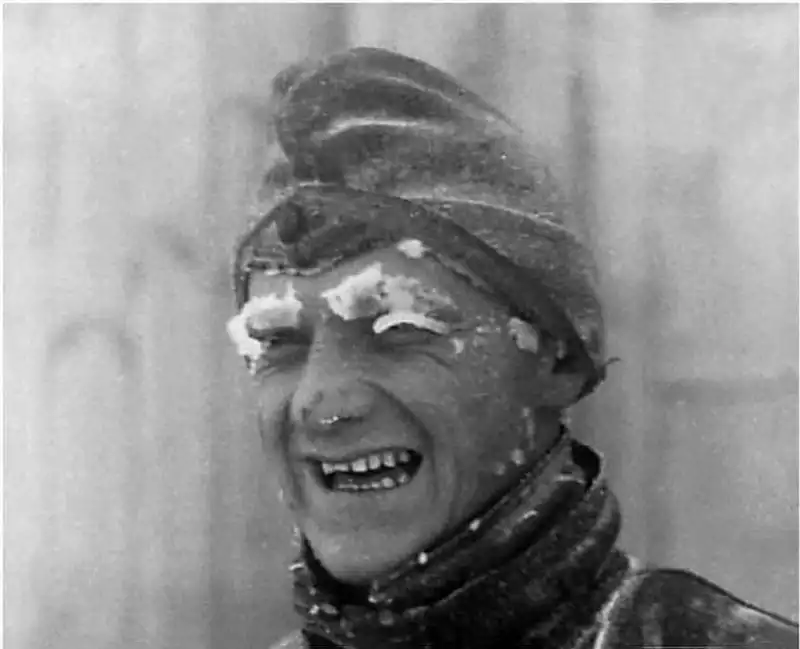
The winter of 1941–1942 became one of the greatest challenges faced by the German army during the Second World War. This remarkable photograph captures a German soldier somewhere on the Eastern Front, his face covered with a thick layer of ice while he smiles directly at the camera.
At first glance the image almost seems humorous. Yet behind the soldier's smile lies the reality of one of the harshest winters experienced during the war. The photograph perfectly illustrates both the severity of the weather and the lack of preparation that accompanied the German invasion of the Soviet Union.
The Wehrmacht Meets the Russian Winter:
When Germany launched Operation Barbarossa in June 1941, military planners expected a rapid campaign that would end before winter arrived. As a result, many German units entered the Soviet Union with limited cold-weather equipment.
By late autumn the offensive had slowed dramatically. Heavy rains turned roads into seas of mud, and when winter arrived temperatures dropped far below freezing. Vehicles broke down, lubricants thickened, weapons malfunctioned, and thousands of soldiers suffered from frostbite.
The soldier in this photograph is still wearing a lightweight field cap rather than proper winter headgear. Such scenes were common during the first winter campaign, when many frontline troops had to improvise protection against the cold.
A Human Face of the Eastern Front:
Unlike dramatic combat photographs, this image focuses on a single individual. His frozen eyebrows, ice-covered cheeks, and frost-covered clothing reveal the brutal environment more effectively than any battlefield scene.
Yet what makes the photograph memorable is the expression on his face. Despite the freezing conditions, exhaustion, and constant danger, the soldier appears cheerful. Whether he was genuinely amused or simply posing for the camera is impossible to know, but the image captures a moment of humanity amid one of the deadliest conflicts in history.
Such photographs remind us that soldiers on all sides faced not only enemy fire but also hunger, disease, fatigue, and the unforgiving forces of nature.
Winter as a Strategic Factor:
The winter of 1941–1942 did not defeat Germany by itself, but it severely weakened German offensive capabilities at a critical moment. Soviet forces launched major counteroffensives around Moscow while German units struggled with equipment failures and mounting casualties caused by cold weather.
For many veterans of the Eastern Front, the first Russian winter remained one of the most vivid memories of the entire war. Temperatures, snow, and ice became enemies almost as dangerous as opposing armies.
This photograph serves as a powerful symbol of that winter—a season that exposed the limits of German planning and demonstrated the immense hardships endured by millions of soldiers fighting across the vast territories of the Soviet Union.
Photo data:
📍 Location: USSR
📅 Date: Winter 1941–1942
📷 Photographer: Unknown
Recommended Literature:
- John Erickson — The Road to Stalingrad
- David Stahel — Moscow 1941: Hitler's First Defeat
- Robert Forczyk — Moscow 1941: The German Advance and Soviet Recovery
- David Glantz — Barbarossa Derailed
- Antony Beevor — The Second World War
- Earl F. Ziemke — Moscow to Stalingrad: Decision in the East