Soviet motorcycle troops riding TIZ AM-600 motorcycles head toward the front near Leningrad in autumn 1941. Sidecars armed with DP machine guns reveal their combat role.
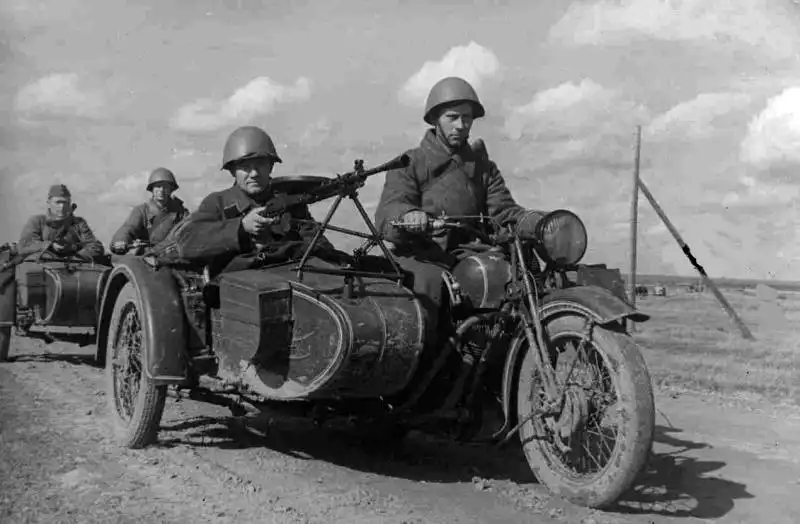
A column of Soviet motorcycle troops riding TIZ AM-600 motorcycles advances toward the front line on the Leningrad Front during the autumn of 1941. Mounted in the sidecars are 7.62 mm DP light machine guns, transforming these civilian-derived motorcycles into mobile combat vehicles suitable for reconnaissance, communications, and rapid infantry support.
The photograph captures a moment from one of the most difficult periods of the war, when Soviet forces were fighting desperately to halt the German advance toward Leningrad.
The TIZ AM-600: A Soviet Heavy Motorcycle:
The TIZ AM-600 was produced between 1936 and 1941 at the Taganrog Tool Factory (TIZ). It was one of the first mass-produced heavy motorcycles built in the Soviet Union.
Its design was based largely on the British BSA motorcycle, which Soviet engineers adapted for domestic production. The machine was powered by a 595 cc single-cylinder four-stroke side-valve engine producing approximately 16.5 horsepower.
Although modest by later standards, the motorcycle was rugged and relatively easy to maintain under field conditions, qualities highly valued by the Red Army.
Motorcycles in the Red Army:
Before and during the early years of the Second World War, motorcycles played an important role in military operations. They were considerably faster than horse transport and consumed far fewer resources than armored vehicles.
Motorcycle units were commonly used for:
- Reconnaissance missions;
- Dispatch and communications duties;
- Escort and security operations;
- Rapid movement of machine-gun teams;
- Traffic control and battlefield liaison.
The DP machine gun mounted in the sidecar significantly increased the firepower of these formations. While the crew remained vulnerable to enemy fire, the combination of mobility and automatic weapons could be highly effective during fast-moving operations.
The Leningrad Front in 1941:
The autumn of 1941 was a critical period for the defense of Leningrad. German and Finnish forces had largely isolated the city, and Soviet troops fought continuous defensive actions to maintain communications and prevent a complete collapse of the front.
Motorcycle units often operated on poor roads, through forests, and across difficult terrain while carrying messages, escorting officers, or supporting frontline troops. Photographs such as this one provide a rare glimpse into the everyday reality of these formations.
The riders shown here are moving toward the fighting at a time when the outcome of the campaign around Leningrad remained uncertain. Many similar units would suffer heavy losses during the brutal battles that followed.
A Rare View of Early-War Soviet Mobility:
Today the TIZ AM-600 is remembered as one of the iconic motorcycles of the pre-war Soviet military. Far less famous than tanks such as the T-34 or aircraft like the Il-2, these machines nevertheless played an important supporting role during the opening years of the conflict.
This photograph preserves a valuable image of Soviet motorcycle troops heading toward the front during one of the most dramatic chapters of the Eastern Front.
Photo data:
📍 Location: Leningrad Region, USSR
📅 Date: Autumn 1941
📷 Photographer: Unknown
Recommended Literature:
- Steven J. Zaloga — Red Army Handbook 1939–1945
- David Glantz — Barbarossa Derailed
- Boris Kavalerchik — Once Again About the T-34
- Mikhail Baryatinskiy — Motorcycles of the Red Army
- Chris McNab — The Eastern Front 1941–1945
- Robert Forczyk — The Battle for Leningrad 1941–1944