Historical winter 1941 photograph showing Red Army personnel inspecting captured German 5 cm PaK 38 anti-tank guns alongside a Soviet STZ-5 tractor during the Moscow counteroffensive.
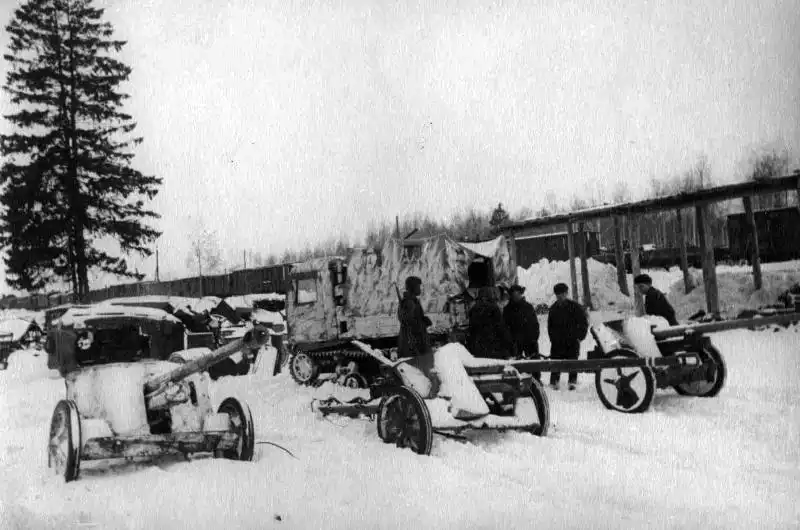
Captured German PaK 38 Guns During the Battle of Moscow (Winter 1941)
This remarkable frontline photograph taken during the Soviet winter counteroffensive near Moscow in December 1941 captures Red Army soldiers inspecting valuable captured enemy artillery equipment, including German 5 cm PaK 38 anti-tank guns.
As Soviet forces broke through the overextended German wings during Operation Typhoon, retreating Wehrmacht units abandoned massive quantities of heavy weapons, vehicles, and artillery across the frozen roads of the Moscow region.
Technical Significance of the Captured Trophies
The image highlights both German anti-tank technology and Soviet tactical logistics during the winter of 1941:
- The German 5 cm PaK 38: Unlike the lightweight 3.7 cm PaK 35/36, the 5 cm PaK 38 was one of the few German anti-tank guns in late 1941 capable of penetrating the sloped armor of Soviet T-34 medium tanks at combat ranges, especially when utilizing tungsten-core APCR ammunition.
- Tubular Steel Trails and Curved Shield: The distinct curved armor shield and tubular steel trail legs of the PaK 38 are clearly visible on the artillery pieces lined up in the snow.
- Soviet STZ-5 "Stalinets" Tractor: Parked directly behind the captured guns is a Soviet STZ-5 tracked artillery tractor featuring a whitewashed winter camouflage scheme. Produced at the Stalingrad Tractor Plant, the STZ-5 was extensively used to haul medium artillery pieces and salvage abandoned battlefield hardware.
- Trophy Collection Operations: Special Red Army salvage teams systematically gathered captured Axis equipment for immediate re-issue to frontline units or for technical analysis by Soviet defense engineers.
Impact of the Moscow Counteroffensive
The liberation of the Moscow region in winter 1941–1942 yielded thousands of captured German artillery pieces, vehicles, and small arms, providing a crucial morale boost and practical materiel support for advancing Red Army formations.
📍 Location: Moscow Region, RSFSR, USSR
📅 Date: Winter 1941
📷 Photographer: Unknown (Red Army Frontline Press Archive)
📰 Primary Source: Russian State Film and Photo Archive (RGAKFD) / Central Archive of the Russian Ministry of Defence (CAMD)
Recommended reading:
- Anti-tank weapons: The operational role and performance of the 5 cm PaK 38 on the Eastern Front
- Soviet artillery movers: Design and service history of the STZ-5 Stalinets tracked tractor
- Strategic counteroffensive: The defeat of Army Group Centre at the gates of Moscow (1941–1942)
- Battlefield recovery: Red Army trophy collecting units and weapon re-utilization