German 7.5 cm infantry guns and 105 mm howitzers deploy in a pine forest in the Baltic region during the fighting on the Eastern Front in 1944.
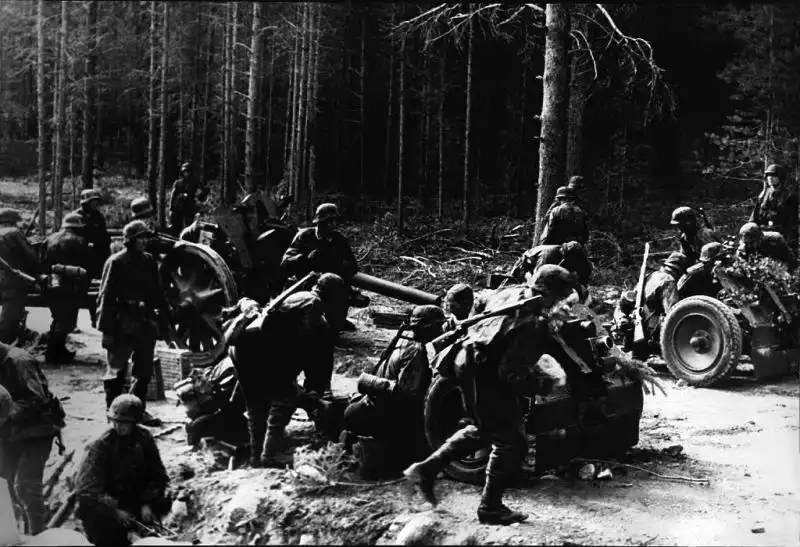
This photograph captures a German artillery unit rapidly occupying firing positions in a pine forest somewhere in the Baltic region during 1944.
The image is particularly interesting because it shows two different types of artillery operating together. In the foreground stands the 7.5 cm leichte Infanteriegeschütz 18 (leIG 18), while in the background several 10.5 cm leFH 18 light field howitzers can be seen preparing for action.
By 1944, the Wehrmacht was fighting a defensive campaign across the Eastern Front, making rapid deployment and camouflage increasingly important for artillery units constantly threatened by Soviet counter-battery fire and air attacks.
Source: audiovis.nac.gov.pl
The 7.5 cm leIG 18 Infantry Gun:
The weapon visible in the foreground is the 7.5 cm leichte Infanteriegeschütz 18, one of the standard infantry support guns of the German Army.
Designed to accompany infantry formations, it was remarkably light for a weapon of its caliber, weighing only about 375 kilograms in firing position. This allowed the gun to be moved relatively easily by its crew or horse teams, even over difficult terrain.
Its principal role was to destroy machine-gun nests, bunkers, field fortifications, and concentrations of enemy infantry that could not be effectively engaged by small arms.
One drawback of the weapon was its separate-loading ammunition, which reduced the practical rate of fire compared with fixed-ammunition guns. Nevertheless, its high-angle fire and powerful high-explosive shells made it an invaluable source of close artillery support.
The leFH 18 Light Field Howitzer:
In the background are several 10.5 cm leichte Feldhaubitze 18 (leFH 18) light field howitzers.
This was the standard divisional artillery piece of the Wehrmacht throughout most of the Second World War and one of Germany's most widely produced artillery systems.
The leFH 18 fired a considerably heavier shell than the infantry gun and possessed a much longer range, allowing it to strike troop concentrations, artillery positions, supply routes, and defensive strongpoints well behind the front line.
Together, the leIG 18 and the leFH 18 complemented one another, providing German commanders with both immediate close support and deeper indirect fire.
Camouflage and Survival:
The dense pine forest offered natural concealment from enemy reconnaissance aircraft and artillery observers.
By 1944, Soviet forces had achieved increasing superiority in artillery and tactical aviation. German batteries that remained exposed for too long risked being destroyed by concentrated counter-battery fire.
For this reason, artillery crews were trained to occupy firing positions as quickly as possible, camouflage their guns, complete fire missions, and relocate before enemy observers could accurately determine their location.
The scene preserved in this photograph likely represents one of countless temporary firing positions established during the increasingly mobile and difficult fighting in the Baltic theatre.
Artillery on the Defensive:
Unlike the early years of the war, when German artillery often supported advancing infantry, the situation in 1944 had fundamentally changed.
As Soviet offensives pushed westward across the Baltic region, German artillery increasingly served as a defensive force, attempting to slow enemy advances, cover withdrawals, and support local counterattacks.
Photographs such as this illustrate not only the equipment used by the Wehrmacht but also the tactical realities of the final phase of the war on the Eastern Front.
📍 Location: Baltic Region, USSR
📅 Date: 1944
📷 Photographer: Unknown
Recommended Reading:
- Terry Gander — German Artillery of World War Two
- Ian V. Hogg — German Artillery of World War Two
- Chris McNab — Hitler's Armies: A History of the German War Machine
- Steven J. Zaloga — Defense of the Baltic States 1944–1945
- Robert M. Citino — The Wehrmacht Retreats: Fighting a Lost War, 1943
- Samuel W. Mitcham Jr. — German Order of Battle