A rare photograph showing a wrecked Polish PZL P.23 Karaś bomber alongside a German Fi 156 Storch after the September Campaign of 1939.
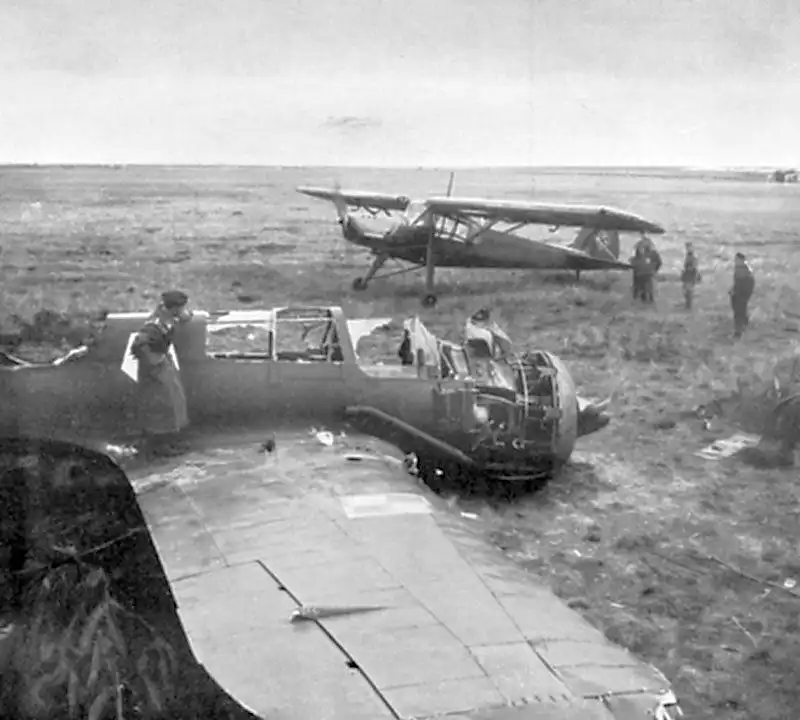
This rare photograph, taken shortly after the defeat of Poland in September 1939, shows two aircraft that represent very different aspects of the opening campaign of the Second World War.
In the foreground lies a destroyed PZL P.23 Karaś light bomber of the Polish Air Force. Nearby stands a German Fieseler Fi 156 Storch liaison and reconnaissance aircraft on a captured field airfield.
The image symbolizes the rapid conclusion of the Polish campaign while contrasting two aircraft designed for entirely different missions.
Source: audiovis.nac.gov.pl
The PZL P.23 Karaś:
The PZL P.23 Karaś ("Crucian Carp") was the principal light bomber and reconnaissance aircraft of the Polish Air Force before World War II.
Introduced during the mid-1930s, it was considered a modern aircraft for its time, combining reconnaissance capability with the ability to deliver light bomb loads against enemy troop concentrations, bridges, and supply columns.
During the German invasion, Karaś crews flew hundreds of combat sorties despite overwhelming Luftwaffe superiority. They attacked advancing armored formations, artillery positions, and transport columns, often suffering heavy losses from German fighters and anti-aircraft fire.
Many aircraft were destroyed both in combat and on airfields as Poland's defensive situation rapidly deteriorated.
The Remarkable Fi 156 Storch:
Standing beside the Polish bomber is one of Germany's most famous utility aircraft—the Fieseler Fi 156 Storch ("Stork").
Unlike the Karaś, the Storch was not intended for combat. Instead, it served as a liaison, observation, reconnaissance, and medical evacuation aircraft.
Its extraordinary short takeoff and landing performance allowed it to operate from tiny improvised airstrips close to the front line. Thanks to automatic leading-edge slats and large high-lift devices, the aircraft could take off and land in distances that were astonishing for its era.
Throughout the war, the Fi 156 became indispensable to German commanders, artillery observers, and reconnaissance units.
Two Aircraft, Two Different Missions:
Although appearing together in this photograph, these aircraft fulfilled entirely different roles.
The Polish Karaś represented offensive tactical aviation, carrying bombs while also performing reconnaissance missions under increasingly dangerous conditions.
The German Storch, by contrast, functioned as the eyes and courier of the Wehrmacht, transporting commanders, directing artillery fire, evacuating wounded personnel, and maintaining communication between rapidly advancing formations.
Their presence side by side provides an unusual visual comparison of two distinct aviation philosophies at the beginning of the war.
A Silent Reminder of September 1939:
By the time this photograph was taken, organized Polish resistance had largely collapsed in most regions of the country.
Captured airfields contained numerous damaged or abandoned aircraft, many of which had been destroyed by bombing, strafing attacks, or demolition by their own crews to prevent capture.
Today, the photograph preserves a small fragment of that dramatic campaign, illustrating both the courage of Polish airmen and the overwhelming military imbalance that characterized the opening weeks of World War II.
📍 Location: Poland
📅 Date: September 1939
📷 Photographer: Unknown
Recommended Reading:
- Jerzy Cynk — Polish Aircraft 1893–1939
- Steven J. Zaloga — Poland 1939: The Birth of Blitzkrieg
- Roger Moorhouse — First to Fight: The Polish War 1939
- Robert Jackson — The Encyclopedia of Military Aircraft
- Heinz J. Nowarra — Fieseler Fi 156 Storch
- E.R. Hooton — Luftwaffe at War: Blitzkrieg in the West