Polish soldiers prepare a 37 mm Bofors wz.36 anti-tank gun during military maneuvers shortly before the outbreak of World War II.
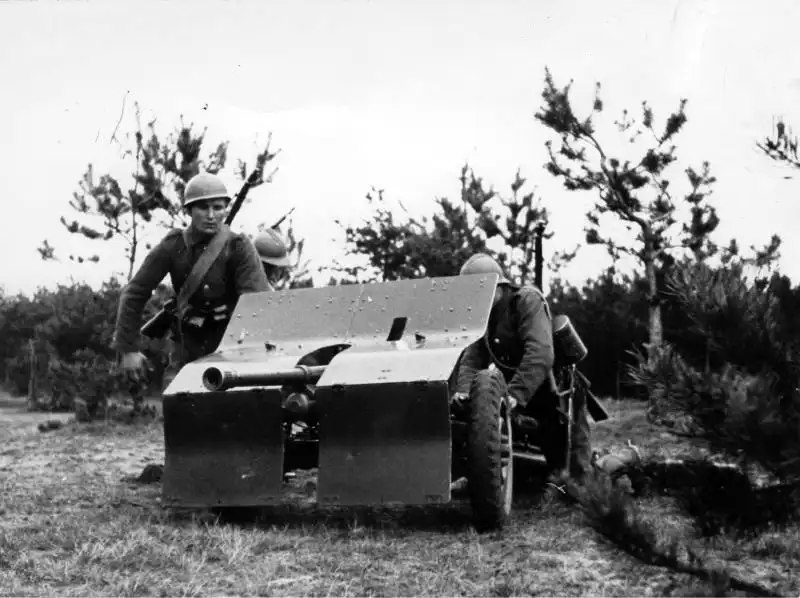
This photograph shows a Polish 37 mm Bofors wz.36 anti-tank gun deployed in a firing position during military exercises in Poland in 1939, only months before the outbreak of the Second World War.
Although based on a Swedish design, the gun seen here was part of the standard armament of the Polish Army and had become one of its most important anti-tank weapons by the eve of the German invasion.
Source: audiovis.nac.gov.pl
The Polish Bofors wz.36:
The weapon originated from the highly successful Swedish 37 mm Bofors anti-tank gun, which attracted considerable international interest during the 1930s.
Poland initially purchased approximately 300 guns directly from Sweden. Later, production began under license at Stowarzyszenie Mechaników Polskich z Ameryki S.A. (SMPzA) in Pruszków. Several hundred additional guns were manufactured domestically, while some were also exported abroad.
In Polish service the weapon received the official designation 37 mm armata przeciwpancerna wz.36.
By September 1939, the Polish Army possessed around 1,200 of these guns, making them the backbone of Poland's anti-tank defense.
One of the Best Anti-Tank Guns of Its Time:
When introduced, the Bofors wz.36 ranked among the finest anti-tank guns in Europe.
Its high muzzle velocity, good accuracy, and relatively light weight allowed crews to move and conceal the weapon efficiently while retaining sufficient firepower to defeat the armor of most contemporary tanks.
During the German invasion of Poland, the gun proved highly effective against early German armored vehicles, including the Panzer I, Panzer II, and many variants of the Panzer III and Panzer IV encountered during the campaign.
The weapon demonstrated that well-trained anti-tank crews could inflict serious losses even against numerically superior armored formations.
Captured by the Wehrmacht:
Following the defeat of Poland, German forces captured large numbers of these guns.
A total of 621 Polish wz.36 anti-tank guns entered Wehrmacht service, where they received the designation 3.7 cm Pak 36(p).
The Germans appreciated both the quality and reliability of the weapon, employing captured examples for training, occupation duties, and combat service during the early years of the war.
This was not unusual: throughout the conflict, the Wehrmacht made extensive use of captured military equipment whenever it proved effective.
A Photograph from the Last Months of Peace:
The image captures a quiet moment during military training rather than combat.
The gun crew prepares its weapon with professional precision, unaware that within a short time these same guns—or others exactly like them—would be fighting desperately against one of the most powerful armies in Europe.
Today, the photograph serves as an important reminder of the efforts made by the Polish Army to modernize its defenses before 1939 and of the professionalism of the soldiers who would soon face the opening battles of World War II.
📍 Location: Poland
📅 Date: 1939
📷 Photographer: Unknown
Recommended Reading:
- Steven J. Zaloga — Poland 1939: The Birth of Blitzkrieg
- Roger Moorhouse — First to Fight: The Polish War 1939
- Terry Gander — Anti-Tank Weapons
- Ian V. Hogg — Allied Artillery of World War Two
- Janusz Magnuski — Wojsko Polskie 1939
- Steven J. Zaloga — The Polish Army 1939–45