A column of Polish Vickers Mark E tanks during military exercises in 1939, only months before the outbreak of World War II.
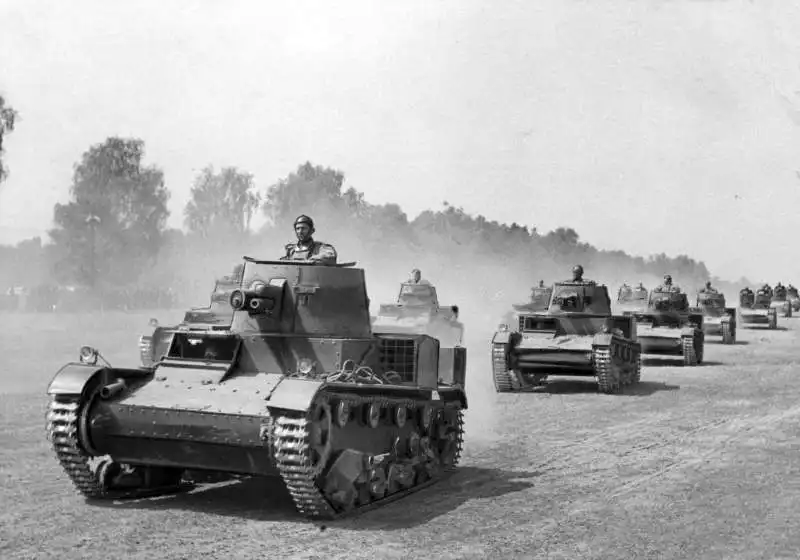
This remarkable pre-war photograph shows a column of Polish Vickers Mark E light tanks participating in military exercises in Poland during 1939, only a short time before the outbreak of the Second World War.
The leading vehicles are Type B tanks with a single turret, while the Type A twin-turret version can be seen farther back in the column. Although the image bears visible signs of retouching—a common practice in press photography of the era—it remains an excellent record of the armored forces of the Polish Army on the eve of war.
Source: audiovis.nac.gov.pl
Britain's Most Influential Export Tank:
The Vickers Mark E was designed in Great Britain during the late 1920s and became one of the most successful export tanks of the interwar period.
Although the British Army itself never adopted the design in large numbers, the vehicle attracted considerable international interest. It was purchased or manufactured under license by several countries, including Poland, Finland, the Soviet Union, China, Thailand, and others.
The tank's simple construction, reliability, and ease of maintenance made it an attractive choice for armies seeking to modernize their armored forces.
Poland's Vickers Tanks:
Poland acquired dozens of Vickers Mark E tanks in the early 1930s.
Two principal versions entered Polish service:
- Type A, armed with two machine-gun turrets.
- Type B, equipped with a single turret mounting a 47 mm cannon and a coaxial machine gun.
Both variants are visible in this photograph, illustrating the transitional state of Polish armored forces shortly before the war. The cannon-armed Type B offered significantly greater combat capability against armored targets, while the earlier twin-turret version reflected tactical concepts inherited from the late 1920s.
Experience gained with the Vickers tanks also influenced the development of Poland's own 7TP, widely regarded as one of the most advanced light tanks in Europe at the outbreak of World War II.
The Last Months of Peace:
The photograph captures a confident and well-organized armored formation during peacetime maneuvers.
By 1939, however, Europe stood on the brink of conflict. Germany had already absorbed Austria and occupied Czechoslovakia, while tensions along Poland's western frontier continued to rise.
For the soldiers participating in these exercises, the maneuvers represented routine military training. Few could have imagined that within months many of these same vehicles and their crews would enter one of the most unequal campaigns of the war.
September 1939:
When Germany invaded Poland on 1 September 1939, Vickers tanks fought alongside the newer 7TPs and other armored vehicles of the Polish Army.
Although generally reliable and handled by well-trained crews, the Vickers had become outdated by the late 1930s. Thin armor and relatively modest firepower limited their effectiveness against modern German anti-tank weapons and coordinated combined-arms tactics.
Nevertheless, Polish armored units frequently fought with determination and, in numerous engagements, demonstrated that experienced crews could still inflict significant losses on the advancing Wehrmacht despite overwhelming numerical and technological disadvantages.
Today, photographs such as this preserve the image of an army preparing for a war that would soon reshape the history of Europe.
📍 Location: Poland
📅 Date: 1939
📷 Photographer: Unknown
Recommended Reading:
- Steven J. Zaloga — Poland 1939: The Birth of Blitzkrieg
- Roger Moorhouse — First to Fight: The Polish War 1939
- David Porter — Tanks of World War II
- Richard Ogorkiewicz — Tanks: 100 Years of Evolution
- Janusz Magnuski — Czołgi Wojska Polskiego 1918–1939
- Steven J. Zaloga — Polish Armor of the Blitzkrieg