German 20 mm Anti-Aircraft Gun Transported by Horse-Drawn Sleigh
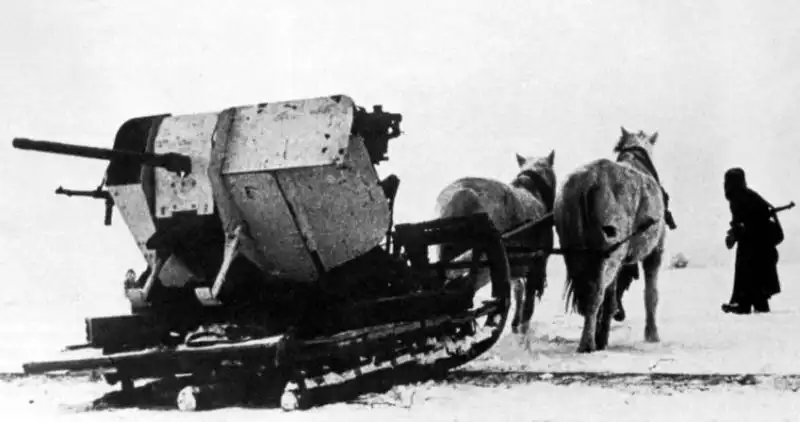
Horse-Drawn German Anti-Aircraft Gun on the Eastern Front:
This remarkable World War II photograph challenges the popular image of the Wehrmacht as a completely motorized army. It shows a German 20 mm automatic anti-aircraft gun mounted on a simple wooden sleigh pulled by two horses somewhere on the Eastern Front during the winter of 1941–1942.
The gun crew is armed with MP 38/40 submachine guns, while their winter clothing consists mainly of lightweight greatcoats and improvised felt boots. Their equipment illustrates the severe logistical difficulties faced by German forces during the first winter campaign in the Soviet Union.
The Myth of a Fully Mechanized Wehrmacht:
The Wehrmacht is often remembered as an army of tanks, trucks and armored vehicles. While Germany possessed one of the world's most advanced armored forces, the majority of its army depended on horses throughout the war.
During the invasion of the Soviet Union in 1941, hundreds of thousands of horses accompanied German formations. They hauled artillery pieces, ammunition, food supplies, fuel, engineer equipment and even anti-aircraft weapons whenever roads became impassable or motor vehicles were unavailable.
Photographs like this provide a valuable reminder that animal transport remained an essential component of German logistics, particularly during the harsh Russian winter.
The 20 mm Flak:
The weapon mounted on the sleigh is a 20 mm automatic anti-aircraft cannon, most likely a member of the famous Flak 30 or Flak 38 family.
These light anti-aircraft guns were designed to defend troops against low-flying aircraft but proved equally effective against lightly armored vehicles, machine-gun positions and infantry. Their high rate of fire made them among the most versatile support weapons in German service.
Normally transported on a two-wheeled trailer behind trucks or half-tracks, the gun seen here has been placed directly onto a civilian sleigh, an expedient solution well suited to deep snow.
Winter Logistics in the Soviet Union:
The winter of 1941–1942 became one of the greatest challenges faced by German forces. Snow-covered roads, extreme cold and frozen engines severely limited the mobility of motor vehicles.
Under such conditions, horse-drawn transport often proved more reliable than trucks. Sleighs could move across snow-covered terrain where wheeled vehicles frequently became stuck, allowing ammunition, weapons and supplies to reach frontline units despite the weather.
At the same time, the photograph reveals another serious problem. The gun crew's light overcoats and improvised winter footwear offered only limited protection against temperatures that could fall far below freezing. Germany's failure to adequately equip many frontline troops for prolonged winter operations became one of the defining logistical shortcomings of the 1941 campaign.
A Photograph That Tells a Larger Story:
Rather than depicting an unusual improvisation, this image illustrates an important reality of the Eastern Front. Advanced military technology coexisted with surprisingly traditional methods of transportation.
Powerful automatic weapons, modern submachine guns and horse-drawn sleighs appear together in a single frame, reflecting the unique logistical conditions under which the Wehrmacht fought its first winter campaign in the Soviet Union.
📍 Location: USSR
📅 Date: Winter 1941–1942
📷 Photographer: Unknown
Recommended reading:
- German logistics during Operation Barbarossa
- The 20 mm Flak 30 and Flak 38
- Horse transport in the Wehrmacht
- The winter campaign of 1941–1942 on the Eastern Front