Smiling B-25 Mitchell Gunner Beside the Top Turret Before a Mission
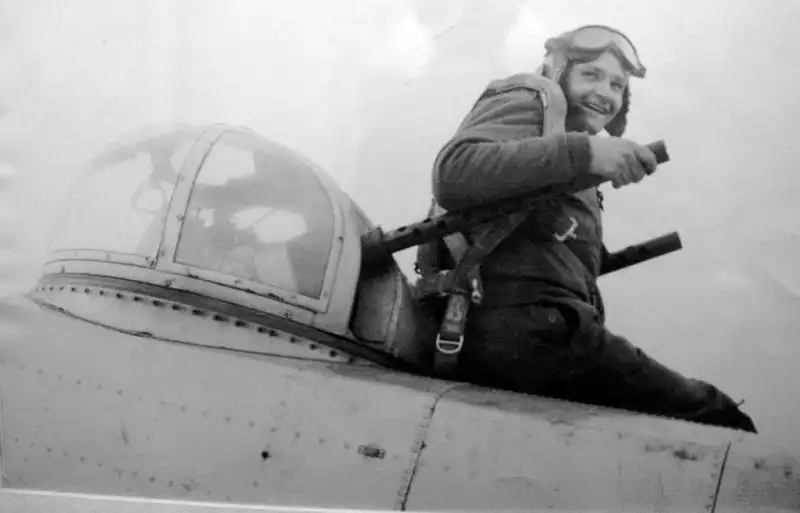
American B-25 Mitchell Gunner Before Takeoff:
This striking World War II photograph captures a smiling crewman of an American North American B-25 Mitchell medium bomber sitting on the aircraft's fuselage beside its powered dorsal gun turret. Wearing his parachute and flight gear, the gunner appears completely prepared for another combat mission.
Despite the danger that awaited bomber crews, photographs like this reveal a very human side of wartime aviation. Calm expressions, confident smiles and relaxed poses often concealed the knowledge that every mission carried significant risks.
The B-25 Mitchell — One of America's Most Successful Medium Bombers:
The North American B-25 Mitchell became one of the most successful twin-engine bombers of the Second World War. It combined reliability, respectable speed and heavy defensive armament with the ability to operate from relatively short airfields.
The aircraft served in almost every theater of the war, including Europe, North Africa, the Mediterranean, China-Burma-India and the Pacific. It became famous after the Doolittle Raid against Japan in April 1942, demonstrating that medium bombers could undertake daring long-range operations.
Thousands of Mitchells remained in frontline service until the end of the war, carrying out bombing, strafing, reconnaissance and maritime strike missions.
The Twin Browning Top Turret:
Immediately behind the cockpit was one of the bomber's primary defensive positions—the electrically powered dorsal turret visible in this photograph.
Armed with two 12.7 mm (.50 caliber) Browning M2 machine guns, the turret provided excellent protection against attacks from above and behind, directions commonly used by enemy fighters attempting to exploit blind spots.
The turret rotated through almost a full circle while its guns could be elevated independently, allowing the gunner to engage fast-moving aircraft approaching from many angles. Although the system greatly improved the bomber's defensive capabilities, effective operation demanded excellent coordination, quick reactions and accurate shooting under combat conditions.
The Men Behind the Machine Guns:
The aircraft's defensive armament was only as effective as the crew operating it. Gunners spent long hours scanning empty skies, fully aware that an enemy fighter might appear without warning.
The smiling airman in this photograph carries his parachute on his shoulders, indicating that the crew was either preparing for takeoff or had just completed pre-flight checks. Like thousands of other Allied bomber crewmen, he depended not only on his weapons but also on teamwork, discipline and mutual trust.
Many surviving photographs from the period show bomber crews smiling before missions. Those expressions reflected confidence, camaraderie and determination rather than any illusion that combat would be easy.
A Moment of Calm Before War:
This image preserves one quiet moment before the engines roared to life and another mission began. The polished machine guns, the ready parachute and the relaxed smile together illustrate the daily routine of American bomber crews during World War II.
Today, the photograph stands as a reminder that behind every famous aircraft were ordinary young men whose courage, professionalism and optimism helped sustain the Allied air campaign.
📍 Location: Unknown
📅 Date: Unknown
📷 Photographer: Unknown
Recommended reading:
- The North American B-25 Mitchell during World War II
- Defensive armament of American medium bombers
- The Browning M2 .50 caliber machine gun
- Bomber crews and aerial combat over Europe and the Pacific