Rare photo of the first KV-2 heavy tank prototype, Leningrad, January 1940.
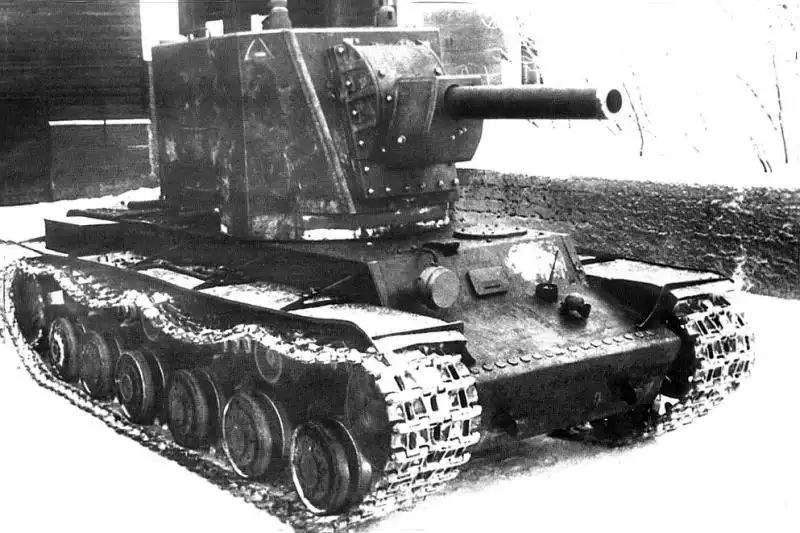
This rare photograph captures the very first prototype of the Soviet KV-2 heavy tank, photographed in Leningrad in January 1940 during the final stages of its development. Unlike later production vehicles, this experimental machine featured a noticeably different turret with unique proportions, a distinctive gun mantlet, and several design elements that would be revised before mass production. The image offers an exceptional glimpse into the evolution of one of the Red Army's most recognizable heavy tanks.
The KV-2 was conceived after combat experience gained during the Winter War with Finland revealed the need for a heavily armored assault vehicle capable of destroying reinforced bunkers and concrete fortifications. To meet this requirement, Soviet engineers mounted a powerful 152 mm howitzer on the KV chassis, creating a vehicle whose immense firepower far exceeded that of contemporary tanks. The prototype shown here represents one of the earliest attempts to balance protection, firepower, and battlefield practicality.
Development work at the Kirov Plant in Leningrad continued throughout 1940 as engineers refined the turret design, improved internal layout, and addressed mechanical shortcomings. Production KV-2 tanks eventually received a redesigned turret that simplified manufacturing and offered modest improvements in crew ergonomics, although the vehicle remained exceptionally tall and mechanically demanding. Its imposing silhouette made it an easy target, while its considerable weight placed enormous strain on the transmission and suspension.
Despite these limitations, the KV-2 earned a formidable reputation during the opening months of Operation Barbarossa in 1941. Its thick armor proved resistant to many early German anti-tank guns, and its massive howitzer could devastate enemy strongpoints, artillery positions, and concentrations of troops. Several famous engagements demonstrated that even isolated KV heavy tanks could temporarily halt advancing Wehrmacht columns until heavier weapons or coordinated attacks were brought forward.
This photograph therefore records far more than a prototype vehicle. It documents an important stage in the rapid development of Soviet armored warfare on the eve of the Second World War. Studying early machines like this KV-2 helps historians trace how combat experience, engineering compromises, and industrial realities shaped one of the most unusual heavy tanks ever to enter military service.
Technical photo data:
📝 Source: Soviet military archives / historical armored vehicle collections
📍 Location: Leningrad, USSR
📅 Date: January 1940
📷 Photographer: Unknown
- First KV-2 prototype photo
- KV-2 development in Leningrad 1940
- Pre-production KV-2 heavy tank
- Experimental Soviet heavy tanks
- Soviet tank prototypes before WWII
- KV-2 unique turret design
- Soviet bunker-busting tank WWII
- Early KV series tank designs
- Prototype KV-2 vs production models
- Red Army heavy tank innovation