Dramatic historical photograph capturing a Chance Vought F4U Corsair carrier fighter balancing vertically on its propeller hub following a carrier landing accident on the flight deck during WWII.
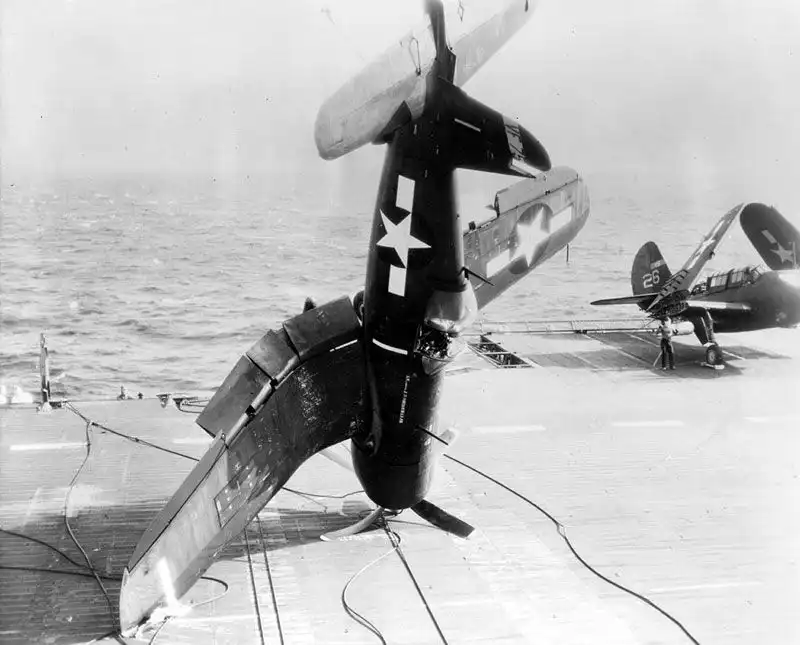
F4U Corsair Carrier Deck Accident: Vertical Nose-Over Landing:
This striking historical photograph captures a dramatic flight deck incident involving a US Navy or US Marine Corps Chance Vought F4U Corsair fighter. Following a botched landing attempt aboard an aircraft carrier in the Pacific Theater, the fighter nose-dived and came to a complete rest perfectly balanced in a vertical position on its propeller hub and engine cowl.
The image vividly illustrates the extreme hazards inherent to carrier-based naval aviation operations during World War II, where split-second landing errors often resulted in catastrophic structural damage or unusual crash attitudes.
Physics and Mechanics of the Vertical Nose-Over Position:
The unusual stability of the aircraft in this standing vertical position is explained by specific aeronautical weight distribution and flight deck conditions:
- Center of Gravity and Engine Weight: The F4U Corsair was powered by the massive 18-cylinder Pratt & Whitney R-2800 Double Wasp radial engine. With depleted fuel tanks and expended ammunition following a combat sortie, the heavy steel-and-aluminum engine assembly represented the vast majority of the airframe's remaining dry weight, shifting the center of gravity directly onto the propeller shaft hub.
- Arrester Wire Engagement: Dislodged and stretched arresting cables (arresting gear) visible across the wooden flight deck indicate that the landing hook engaged a wire at high speed, causing rapid deceleration that pitched the tail forward over the nose.
- Flight Deck Dynamics and Wind Support: To launch and recover aircraft, carriers steamed directly into the wind at high speed (creating 25–30 knots of headwind across the deck). This strong relative airflow against the flat underside of the wings and tailplane helped momentarily sustain the aircraft in its upright vertical stance without instantly collapsing sideways.
The F4U Corsair in Naval Service:
Known for its distinctive inverted gull-wing design, the F4U Corsair faced initial operational challenges in carrier service:
- Landing Visibility Challenges: Due to the long forward fuselage housing the massive R-2800 engine and the pilot's rearward cockpit position, visibility on final approach was severely restricted, earning the early Corsairs the nickname "Ensign Eliminator."
- Deck Activity: Visible in the background is a Grumman TBF/TBM Avenger torpedo bomber with folded wings (marked tail number 26), demonstrating routine flight deck parking procedures while deck crews stabilized the crashed fighter.
📍 Location: Pacific Ocean (US Navy Aircraft Carrier)
📅 Date: c. 1943–1945
📷 Photographer: Unknown (US Navy Official / Photographic Reconnaissance Unit)
📰 Primary Source: US National Archives Naval Aviation Photographic Collection
Recommended reading:
- Carrier landing procedures and arresting gear mechanics in World War II
- Technical design of the Pratt & Whitney R-2800 Double Wasp engine
- Operational history of the Chance Vought F4U Corsair on carrier decks
- Flight deck safety and crash recovery operations (Crash Division) in the US Navy