U.S. Marine Corps mechanics take a brief break on the wings of a Vought F4U Corsair at Bougainville during the Pacific War.
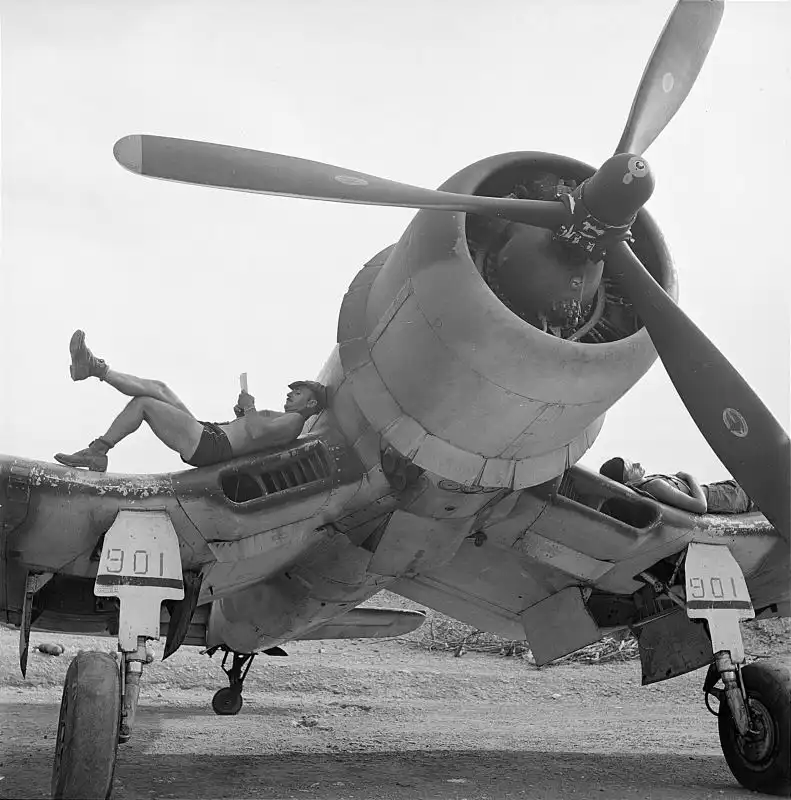
This remarkable photograph captures a quiet moment far removed from aerial combat. Aviation mechanics of Marine Fighting Squadron 222 (VMF-222) relax on the wings of a Vought F4U Corsair at an airfield on Bougainville Island in the South Pacific during April 1944.
While fighter pilots often became the public face of military aviation, it was the tireless work of ground crews that kept combat aircraft flying day after day under difficult tropical conditions.
Source of photograph: research.archives.gov
Keeping the Corsair in the Air:
The Vought F4U Corsair was one of the most successful carrier- and land-based fighters of the Second World War.
Powered by the massive Pratt & Whitney R-2800 Double Wasp engine producing more than 2,000 horsepower, the Corsair combined high speed, heavy armament, and impressive range. Armed with six .50-caliber Browning machine guns, it excelled in air superiority missions, ground attack, and close support operations throughout the Pacific.
Its distinctive inverted gull wing became one of the most recognizable aircraft designs of the war.
The Men Behind Every Sortie:
Every combat mission depended on the work of aviation mechanics.
Between flights they inspected engines, repaired combat damage, replaced worn components, serviced machine guns, refueled aircraft, and prepared fighters for the next mission—often working long hours in heat, humidity, and tropical rain.
The photograph captures one of the few opportunities for these men to rest before returning to another demanding maintenance cycle.
Bougainville and the Pacific Campaign:
The campaign for Bougainville formed part of the Allied strategy of isolating the major Japanese base at Rabaul rather than attacking it directly.
Once airfields had been established on the island, Marine and Army Air Forces fighters operated almost daily against Japanese aircraft, shipping, and ground positions throughout the northern Solomon Islands.
Aircraft availability became a critical factor in maintaining Allied air superiority, making experienced maintenance crews just as essential as the pilots themselves.
A Different Face of War:
Unlike dramatic combat photographs, this image reflects the ordinary rhythm of military life.
The relaxed mechanics sitting on the Corsair's wings appear almost carefree, yet within hours they would likely be preparing the same aircraft for another operational sortie.
It is a reminder that victory in the Pacific depended not only on courageous pilots but also on thousands of skilled technicians whose work largely took place behind the scenes.
📍 Location: Bougainville Island, Pacific Ocean
📅 Date: April 1944
📷 Photographer: Charles Jacobs
Recommended Reading:
- Barrett Tillman — Corsair: The F4U in World War II
- William N. Hess — F4U Corsair in Action
- John B. Lundstrom — The First Team and the Guadalcanal Campaign
- Eric Hammel — Bougainville: The Forgotten Campaign
- Richard B. Frank — Tower of Skulls
- Ian W. Toll — Twilight of the Gods: War in the Western Pacific, 1944–1945